
Industrial inspection requires more than human eyesight. It needs tools that enable researchers or operators to see beyond the basics, and the UV camera lens meets those needs exactly. It allows one to see beyond what can already be seen with natural eyesight and with standard lenses present for monitoring the processes. Without the use of ultraviolet camera lenses, many small defects go unnoticed and cause errors in the later process. Sometimes this undetected error or defect causes significant losses in the industry and even halts work temporarily. That’s why proper installation and use of ultraviolet cameras are necessary in the industrial sector, specifically.
This blog dive deepr intothe use of UV camera lens and their uses,benfits and imporatnceinthe industrial settings. It will be a comprehensive guide with detailed information, without skipping any points, ensuring a clear, in-depth understanding. So you, as an industrial leader, can adapt these changes in your system to detect the undetectable error before it causes a big problem. Let’s start by understanding the science behind UV lenses that enable them to be adaptable to advanced processing systems.
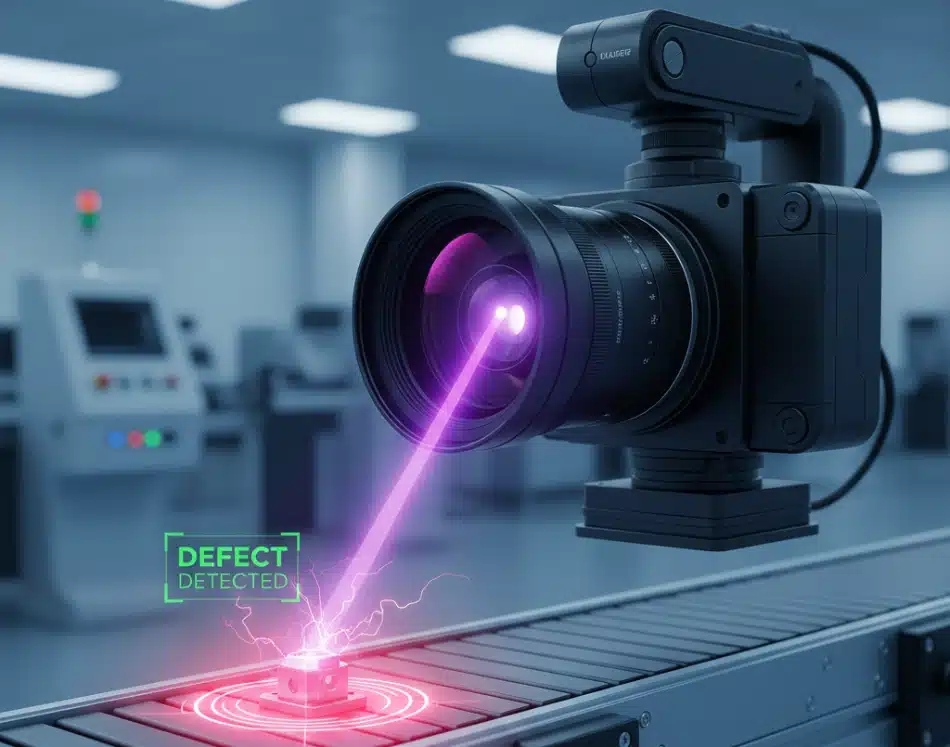
The Major Difference In Standard And UV Lenses
A UV Camera Lens is a specialized optical lens designed to transmit and focus ultraviolet light. Unlike standard glass optics, which are optimized for visible light, and as a result these conventional glasses strongly absorb UV wavelengths. Meanwhile, UV lenses enable cameras to capture images beyond the visible spectrum because of their material properties. Including materials such as fused silica or quartz, which also allows UV light to pass through and be focused into sensors.
On the other hand, because standard lenses absorb UV wavelengths, they are unsuitable for applications that require ultraviolet imaging. Surging the need for Industrial cameras lens, so they avoid missing critical defects in materials or products in the industrial sector.
What Science Logic Backed Ultravoilet Lenses for Imaging?
Let’s look at the three main reasons the UV camera is the best option for industrial applications.
1. Specialized Materials
Standard optical glasses typically act as a barrier to UV light, absorbing frequencies below 350 nm and rendering images unclear. To tackle this issue, UV lenses utilize many distinct materials:
- Fused Silica and Quartz: Unlike standard glass, these materials allow deep UV light down to 190nm, so they can pass UV rays effectively without absorbing. These properties enable the UV camera lens to operate effectively in the industrial sector, where constant monitoring is required.
- Chromatic Corrections: Elements like quartz are essential for correcting focus shift, which ensures that UV light focuses sharply and does not refract unpredictably. Properties like this make UV lenses essential, not a luxury, to avoid missing hidden defects that standard lenses might overlook.
2. Wavelengths and Coatings
UV cameras capture images based on wavelength by targeting specific invisible frequencies and require a specific chemical coating to work effectively. Here’s why
- Target Ranges: The industrial sector requires high resolution lenses with UV capability to focus on UVA (315-400 nm) for fluorescence (glowing blue/ink) detection. UVB (280-315 nm) is used to detect microscopic surface scratches on their products and materials and to work effectively in their setting.
- Special Transmission: Another property is the specialized anti-reflective coating, which is engineered to maximize transmission in the 200-400 nm range specifically.
- Noise Blocking: The chemical coating used in these lenses also acts as a filter, blocking stray visible and infrared light to ensure high-contrast imaging.
3. Ruggedizations
Rigidity is crucial for cameras to maintain optical precision in harsh factory environments.
- Vibration Resistance: Unlike consumer lenses, UV camera lens used in industries have the feature of locking screws on focus and iris rings. These prevent machine vibrations from altering settings and capture sharp, high-quality imaging.
- Athermal Design: The mechanical barrel is designed to accommodate thermal expansion and maintain sharpness, ensuring the focus remains stable even during temperature fluctuations in the factory.
- Environmental Sealing: Robust mechanical housings protect the sensitive quartz elements from oil mist, dust, and physical shock common on production lines.
Final Thoughts!
The major benefit of using a UV camera lens in industrial applications is the ability to identify invisible defects and ensure process integrity. Additionally, achieving superior image quality makes it the most vital lens used to process and identify defects. For an industrial sector, UV lenses are no longer a luxury but a necessity to have for seamless, defect-free processing of material. Having a UV lens installed in the system allows the industry to make a specialized investment. As ROI comes from the reduced waste and higher product quality.
For such an amazing UV camera lens, choose the best manufacturer of optical lenses, like Superior CCTV. We are a reputable brand in the optics market. The lenses can also be engineered based on specific customization requirements or requests.
FAQs
Why are ultraviolet lenses vital for PCB (Printed Circuit Board) inspection?
These Industrial cameras lens helps inspectors check printed boards with more clarity. When UV light shines on the boards, the special coating and solder masks make it appear or glow differently. On comparison with the under normal light, making it easier to spot tiny problems like cracks, weak solder joints, or leftover flux. If that is not identified, it can lead to a major defeat, causing the board to fail later.
What does high resolution lenses mean when applied with UV lens camera?
In the context of UV cameras, high resolution refers to the ability to resolve extremely fine details despite the challenges posed by short-wavelength light. A high-resolution UV lens is specifically designed to minimize optical aberrations while maintaining sharpness across the entire sensor. Often, with the matching sensors with 5MP, 12 MP, or higher, to ensure the smallest defects are captured clearly.
Do UV lenses require extra lighting setups tocapture imaging?
Yes, a UV camera lens requires a specific lighting setup to function properly and capture a sharp, bright image. As the lenses were designed to focus on ultraviolet light, the scene must be illuminated by a UV light source. For example, a UV LED array to capture the desired image. Conversely, these lenses often have special coatings to block visible light (IR cut filters) to ensure that only UV data is captured. Preeventing image from being washed out by ambient factory lighting.