
Security solutions are a basic need in every sector and in most of the spaces around us. However, they are no longer judged on just how well they protect or monitor the surrounding area. They are also highly evaluated for how well they fit their surroundings, and the M12 CCTV lens is the one that does so best. In places like retail stores, banks, and smart homes, the setup of bulky cameras doesn’t fit multiple purposes. In retail shops, bulky cameras make customers hesitate to come, as they don’t like being monitored. While in banks, even though security is crucial, maintaining professionalism also matters, and a bulky camera ruins it.
In all these places, including smart homes, modern, compact cameras are in high demand for their versatility. The spaces now need an M12 CCTV lens, as the industry demand looks for board cameras that require high performance in a small form factor. Unlike traditional lenses that compromise on image quality, these are modernised with advanced features that capture images to the point. In this blog, we will discuss the mechanics, common misconceptions about small cameras, and some key applications of them. Let’s start by understanding the mechanism behind why they are an ideal choice now.
The M12 Pinhole Optics Built Mechanism for Deeper Understanding
Among the many compact security cameras, the M12 CCTV lens stands out, which is often referred to as an S-Mount lens. While the term “M 12” simply signifies the metric thread size of the lens holder, which is 12mm in diameter. The thread sizes of these lenses are standardized, making them ideal for a modular approach to security. With these 12 mm-diameter threads, integrators can easily screw different lenses into a board camera to achieve the desired viewing angles. However, in the cases where discretion is the priority, traditional optics don’t fit the vibe, as they are too bulky and visible. Making people feel constantly monitored.
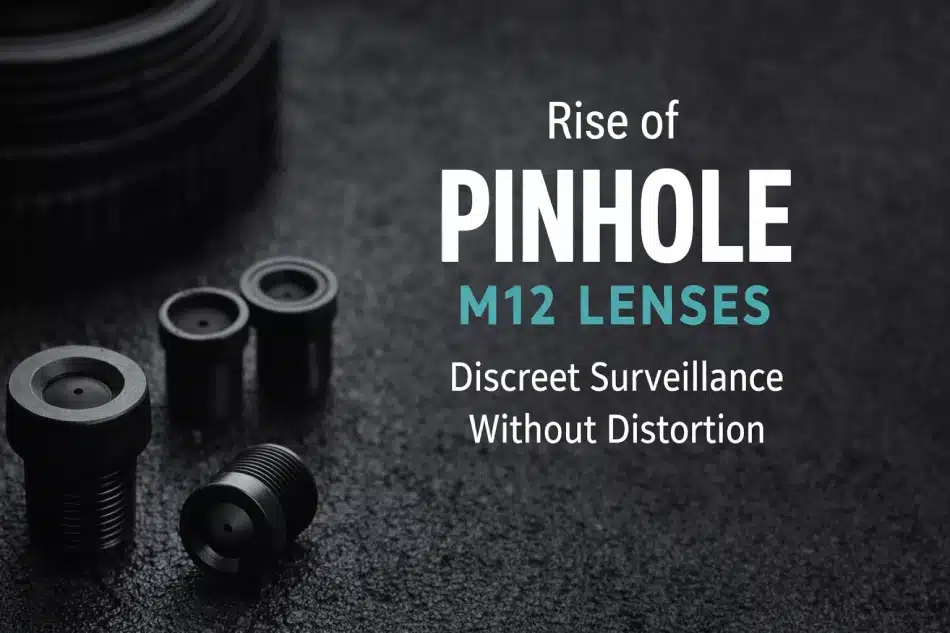
The M12 pinhole lenses are now revolutionizing surveillance hardware and transforming the entire landscape of monitoring. Unlike standard lenses that require a large glass element to gather light, pinhole lenses are engineered with a tapered, conical shape. Along with a tiny pupil, this unique setup of mechanical design allows the lens to capture a full field of view. By using an opening as small as 2mm (roughly the size of the tip of a pen). However, the physical aperture is so small that choosing high-quality M12 lenses is essential to ensure sufficient light reaches the image sensor. The reach of proper lighting provides a bright, usable picture.
Here’s a mechanical difference between standard and M12 lens to help distinguish between these optics types:
- Physical Profile: Standard lenses usually have a flat or protruding glass face, while pinhole variants feature a tapered, cone-like nose. These designs allow pinhole lenses to press against a concealing surface.
- Aperture Type: Standard M12 optics often have a faster aperture (allowing more light to enter), whereas pinhole lenses have a fixed, smaller aperture. Thus, this requires sensors with higher sensitivity.
- Mount Compatibility: Even with different lens shapes, both lenses use the same 12mm thread pitch, allowing them to be interchangeable on most S-mount camera boards.
End the Era of Fisheye Distortion Imaging: Use M12 Pinhole Optics
The era of M12 pinhole lenses is improving the monitored imaging, where the fishbowl effect is clearly visible. With the fishbowl effect, the straight walls curving inward, the hallways look like circular tunnels, and people on the edges of the frame appear stretched beyond recognition. The phenomenon of imaging like this is known as the barrel distortion, which is the natural enemy of effective surveillance. The problem with this wide-angle view was that it might capture the moving object or individual, but failed terribly at recognizing them. What is actually moving in the picture? Becomes a matter of guesswork.
As a result, the suspect’s face is distorted, or a license plate appears bent, reducing the footage’s evidentiary value. The good news for the problem is that opting for an M12 lens provides a discreet, compact setup and no longer settling for a fun-house mirror image. Here’s how:
- Through advances in rectilinear correction technology, optical engineers have found a way to “flatten” the light before it reaches the image sensor.
- Uses precise, high‑grade glass elements.
- These elements map the image to minimize curvature.
- Ensures that straight lines in the real world remain straight on your monitor.
Selecting the right hardware is also vital. While low-cost optics get the job done for basic motion detection, premium M12 lenses are essential for many tasks. For example, reading ID text, capturing license plates, and supporting facial recognition. These lenses preserve edge-to-edge clarity and, with balanced focal length and corrective elements, deliver a broad distortion-free view without the fisheye effect.
Summing It Up!
The evolution of the M12 CCTV lens has brought compact surveillance to a new level, advancing from grainy, wrapped images to high-definition clarity. With technological advancements in the optical sector, many industries can now use compact cameras. That can hide behind the object or sit in a corner, almost unnoticeable yet capturing images crystal clear. In these industries, maintain professionalism by not making customers feel they’re being monitored too closely, yet still ensuring the work is done.
These lenses ensure customer comfort and ease in the banking retail sector, thereby enhancing security. M12 lenses are the prime example that security does not always have to be visible to be effective. If you’re looking for a manufacturer to source our security systems, look no further than Superior CCTV. We are a market-established brand that manufactures optics with advanced technology, ensuring high quality and the best materials. Contact us today and get the seamless security that operates silently and doesn’t scare customers away.
FAQs
What exactly are M12 lenses?
An M12 lens, widely known as an S-mount lens, is a compact lens standard used primarily in board-level security cameras and webcams. Featuring a 12mm thread diameter. These lenses are popular because they offer a balance of high optical quality and small physical size. Offering a perfect balance of modern compact surveillance systems.
Do M12 Pinole Lesnes capture distorted or curved images?
While the wide-angle lens can naturally create a “fisheye” effect, high-quality M12 pinhole lenses are specifically engineered to minimize these issues.With features like rectilinear correction in the glass design that keeps the line straight rather than curved.
Is it possible to swap a standard lens or a pinhole M12 lens?
Generally, yes, as long as the camera uses a standard M12 mount. However, you must ensure the lens matches the sensor size (e.g., ⅓ or ¼). Furthermore, check that the camera sensor has high sensitivity for low-light performance, as pinhole lenses let in less light due to their small apertures.
What are the main advantages of using an M12 pinhole lens?
The primary advantage of these lenses is discretion. These lenses capture a full field of view through an opening as small as 2mm, making the camera virtually invisible. They are perfect for hidden surveillance in ATMs, retail stores, or doorway monitoring, where the need is to capture evidence without alerting subjects to the camera’s presence.