
When it comes to advanced lenses, you will find various miniature versions of the M12 lenses everywhere. Whether it’s your car, retail entry/exit stops, security surveillance cameras, robotic eyes, medical applications, or more, M12 CCTV lens rules every sector. Furthermore, M12 lenses are the most commonly used size of a whole class of fixed-focus, screw-mount, small lenses. Additionally, they are known as board-mount lenses because they screw directly into a small mounting bracket connected to the printed circuit board that houses the camera’s image sensor.
The “12” in M12 CCTV camera lens refers to the lens barrel’s 12mm outer-diameter thread. Additionally, the M12 board lens is typically available in a wide range of sizes, with thread diameters from 4mm to 16mm. Likewise, these are identified by their accurate thread size as “M4”, “M6”, and more.
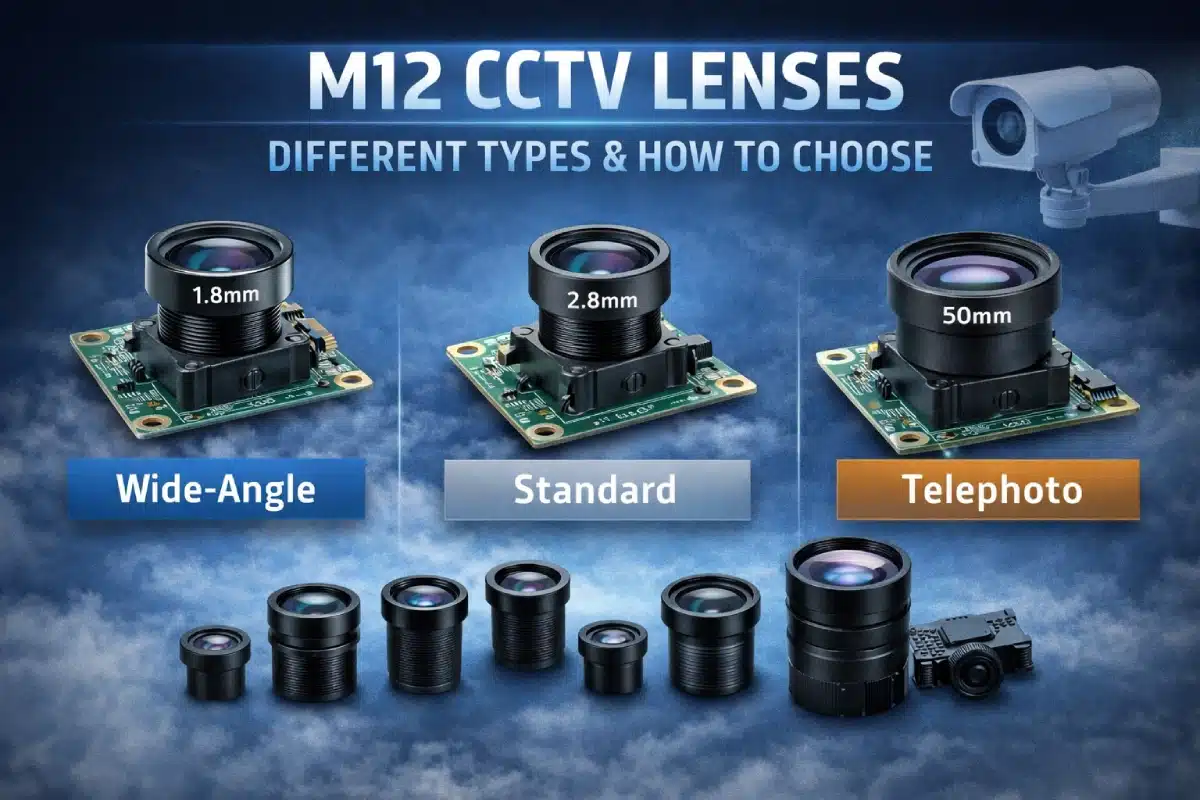
Technical Configuration of M12 CCTV Lenses
| Parameter | Description / Typical Value |
|---|---|
| Lens Mount | M12 (S-mount), 12 mm thread |
| Focal Length | 2.1 mm, 2.8 mm, 3.6 mm, 4 mm, 6 mm, 8 mm, 12 mm (varies by model) |
| Maximum Aperture (F-number) | F/1.8 – F/2.8 |
| Minimum Object Distance (MOD) | ~0.1 m – 0.3 m |
| Image Format / Sensor Coverage | 1/2.5″, 1/2.7″, 1/3″, 1/4″ CMOS |
| Horizontal Field of View (HFOV) | ~30° – 150° (depends on focal length & sensor) |
| Mount Type | Fixed focus or manual focus |
| Focus Adjustment | Manual, turn the ring to adjust |
| Iris Type | Fixed iris (some manual iris) |
| Optical Elements / Groups | 4–8 elements in 3–5 groups |
| Distortion | Typically <5% |
| Resolution Support | Up to 8 MP / 12 MP (model dependent) |
| Modulation Transfer Function (MTF) | ~30–60 lp/mm (varies by design) |
| Material (Housing) | Metal barrel (aluminum or brass) |
| Operating Temperature | ~-20 °C to +60 °C |
| Weight | ~5–15 g |
| Dimensions (Ø × L) | ~12 mm × 8–14 mm |
| Coating | Anti-reflective coating (multi-coated) |
Types of M12 Lenses to Know
There are many fundamental types of M12 lenses available in focal lengths from 1mm to 50mm, with high-resolution abilities often ranging from 4MP to 12MP+. However, let’s discuss different types of M12 CCTV lens in detail:
1. Fisheye/Ultra-Wide Lenses
Fisheye and ultra-wide lenses are short-focal-length, specialized lenses (normally 6mm to 16mm) that offer a wide field of view. Thus, this M12 CCTV lens typically provides 180° or more coverage. Furthermore, they create dramatic, curved-barrel distortion to fit a wide scene onto a balanced sensor. It makes them an ideal choice for artistic, security surveillance, and action photography.
2. Wide-Angle Lenses
A wide-angle CCTV lens is a camera lens with a short focal length, normally 35mm or less on an end-to-end or full-frame camera that delivers an expansive field of view. Thus, it allows it to capture more area than the human eye. Additionally, these lenses are remarkable for architecture, security, landscapes, and tight interior spaces. Likewise, it often overstated the sense of depth and distance between foreground and background objects.
3. Low-Distortion/Machine Vision Lenses
Machine vision or low-distortion lenses consist of precision optical properties designed to minimize geometric aberration (distortion) to less than 1-3%, ensuring correct, undistorted imaging, and high-contrast imaging, often with <0.03% aberration, for measurement, industrial inspection, and robotics applications. This M12 CCTV lens maintains high resolution and stable magnification across the whole field of view.
4. Low-Light/Fast Lenses
A fast or low-light lens is a camera lens with a broad maximum aperture (usually f/2.8 or wider, such as f/1.2, f/1.8, or f/1.4) that allows more light to reach the main sensor. They are created to excel in indoor, evening, and dark environments. It enables faster shutter speeds to decrease motion blur and lower ISO (International Organization for Standardization) settings to minimize image noise.
5. Telephoto/Narrow Angle Lenses
A narrow or telephoto CCTV Lens is a camera lens with a wide focal length (normally 70mm or more) that delivers a narrow field of view. Thus, it makes distant objects appear much closer. They are distinguished by robust compression that brings foreground and background properties closer together and a shallow depth of field. It also creates a smooth, blurred background that helps viewers see the captured items clearly and concisely. These lenses are imperative for security, sports, portrait, and wildlife photography, allowing subjects to be isolated from a distance.
6. Pinhole Lenses
A pinhole M12 board lens is an optical device, ranging from cameras to eyeglasses, that uses a small aperture instead of glass components to form images or sharpen vision by restricting light to a narrow beam. Also, they operate on the “pinhole effect,” enhancing depth of field and decreasing light scatter.
7. Infrared (IR) Corrected/Lens-Free Filters
Infrared (IR) corrected or lens-free filters, also known as IR-Pass Filters or IR-Cut-Off Filters, depending on the application. These lenses specialize in optical components for machine vision and photography that block or pass infrared light to a camera sensor. They are imperative for capturing images beyond the visible spectrum (approx 400-700nm). Thus, it allow f0pr exclusive, creative, or technical results.
How to Choose the Right M12 Lenses to Get the Best Coverage?
Here, we have listed the five imperative points that every buyer should consider when purchasing an M12 CCTV lens to get the best coverage for security surveillance:
- Field of View (FoV) and Focal Length: Ensure to pick the lens based on the preferred coverage area. Furthermore, shorter focal length (1mm to 4mm) provides a broader field of view, while longer focal lengths (10mm to 50mm) offer a zoomed-in, narrower view.
- Sensor Size Compatibility: The lens’s image circle must exceed or match the sensor size (for eg, 1/4″, 1/2″, and 1/3″) to avoid vignetting (dark corners). A 1/3″ lens can typically be used on a 1/4″ sensor, but it is not applicable for vice versa.
- Aperture and Light (F-number): A smaller F-number (for eg, F1.8) allows more brightness, excellent for low-light recording situations, while a large F-number offers an in-depth field of view.
- Working Distance (WD): It is specified as the distance between the lens and the object. An M12 CCTV lens is typically used at a specific distance (e.g., >0.5m for security surveillance). Therefore, ensure you select one that aligns with your application’s focus area.
- Resolution and Distortion: Wide-angle mainly introduces higher distortion, which might need software correction. Furthermore, ensure the lens resolution (e.g., 5MP) matches the sensor’s resolution to improve image sharpness.
It’s Time To Wrap Things Up!
With rising demand for higher-resolution cameras and more sophisticated security surveillance systems, the M12 CCTV lens market is evolving. Moreover, lenses are increasingly specialized, with products that provide ultra-high-definition video, even autonomous-vehicle systems, and 3D sensing. Superior CCTV is at the forefront of such developments, manufacturing lenses ideally suited to unique sensors, with a proven track record of breaking performance records across a wide range of applications. Whether it is sports applications, machine automation, medical imaging, or any other application that suits your needs and preferences. So, do not wait any longer. Connect with us today!
FAQs
Q.1: What is an M12 lens?
A: An M12 lens is a small board-mount lens mainly used in CCTV cameras, machine vision, robotics, and medical applications. It is called an “M12” lens because its thread size is 12mm.
Q.2: Why are M12 lenses called board lenses?
A: Because these lenses directly screw into a camera bracket fixed to a PCB board. In short, they directly mount onto the camera module; therefore, “board lens.”
Q.3: What is the focal length range of M12 lenses?
A: The focal length of M12 lenses usually varies from 1mm to 50mm.
- 1mm-4mm = ultra-wide field of view
- 10mm+ = narrow/narrowed-down view
Q.4: What is the difference between a wide-angle lens and a fisheye lens?
A: A wide-angle lens gives a wide field of view but with less distortion.
A fisheye lens provides a very wide field of view (sometimes 180° or wider), but the image is prone to barrel distortion.
Q.5: What is a low-distortion M12 lens used for?
A: A low-distortion lens is mainly used in machine vision, industrial inspection, and robotics, where precise measurement is required. The images appear straight and correct, with little distortion.