
Industries are increasingly turning to automation, driven by the introduction of powerful software tools and Artificial Intelligence. They are aiming to reduce manual labour by introducing precise machines and robots into production lines. A machine vision system sits at the core of this automation revolution, providing visual data to robots and machines. And to do that, it is equipped with a machine vision lens that acts as the system’s eye, capturing every little detail.
To put it simply, the operational efficiency and precision of robotics all boil down to the accuracy of the machine vision lenses used. Therefore, choosing the right machine vision lens is critical and has a major impact on the overall performance of machine vision systems. You will find essential information regarding the factors that you should consider to make an informed decision and choose the right type of lens.
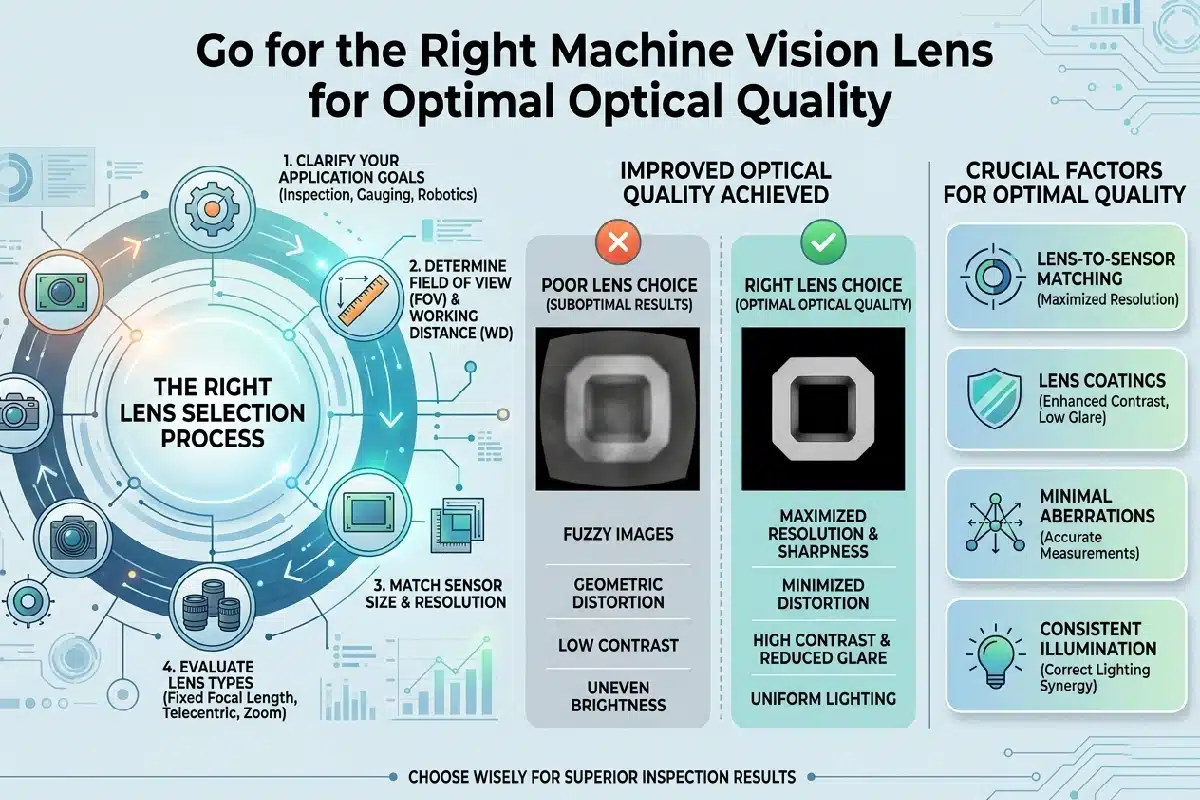
How to Select the Right Machine Vision Lens?
To choose the right industrial cameras lens, you need to balance multiple factors such as optical clarity, sensor-type, budget, and others. Hence, you need to understand the key factors associated with the machine vision lenses to make the right decision. Here are some of the key factors to consider when choosing machine vision lenses.
1. Get a Clear Picture of the Application
The key requirement for selecting the right machine vision lens is to match it to the application type. For example, if your application requires accurate measurement, a telecentric machine vision lens is the right choice. On the other hand, if the application involves capturing tiny objects, it is best to use a macro lens to capture microscopic details. Thus, before purchasing the lens, make sure that you have a clear picture of the application and its requirements.
2. Focal Length of the Lens
Focal length determines image quality, distortion, and field of view. Thus, the focal length of the lens must be balanced according to the working distance and the required field of view. Shorter focal lengths are generally better for inspecting larger areas as they can capture a wider field of view. The focal length of a machine vision lens also governs its magnification capabilities.
3. Choose the Lens According to the Sensor Size and Mount
First and foremost, you need to check the camera’s sensor format, width, pixel size, and mount type. Only after that should you start looking for a lens. Then, you need to match the camera’s sensor and the size of the industrial camera lens. A simple rule is to never choose a lens with a smaller size than the camera’s sensor. Additionally, the lens and camera should have the same mount-type to ensure a perfect fit. There are multiple mount types available, including C-mount (very common in industrial cameras), CS-mount, F-mount, and M12 (small board cameras).
4. Image Resolution
The quality of the lens directly impacts the image’s resolution. Lenses with higher resolution deliver sharper and more detailed images. That is precisely why a machine vision telecentric lens is used when higher-resolution images are required. Choosing an inadequate resolution can result in softer, less-detailed images, even with a higher-resolution camera.
5. Lens Aperture
Aperture is mentioned as the f-number, and it is inversely proportional to the amount of light that enters the lens. Therefore, a smaller aperture means more light enters the lens, which is ideal for the low light conditions. You will also need to pair the smaller aperture with a faster shutter speed to get the best results. On the contrary, if you are using the machine vision lens in a well-lit environment, go for a higher aperture. Aperture is also selected based on the object’s dimensions and the measurement’s precision requirements.
6. Overall Cost of the Lens
Performance and clarity are not the only factors to base your decision, you also need to consider the overall cost of the lens. It is obvious that the more expensive lens you purchase, the higher quality you can achieve. However, not all applications require extremely high resolution, and in such cases, you can rely on more affordable options, such as a fixed-focal-length lens.
Type of Machine Vision Lenses and Their Specialities
If you are looking for lenses for a machine vision system, the table below can provide you with complete assistance. Choosing the right lens type is one of the most basic and critical factors to consider when selecting a machine vision lens.
| Lens Type | Specialties / Key Advantages | Best Used For |
|---|---|---|
| Fixed Focal Length Lens | Stable magnification, sharp image quality, cost-effective, low distortion options available | General industrial inspection, barcode reading, assembly verification |
| Telecentric Lens | Eliminates perspective error, constant magnification at varying object distances, and extremely low distortion | Precision measurement, gauging, dimensional inspection, PCB inspection |
| Zoom Lens | Adjustable focal length, flexible framing without changing working distance | Applications requiring variable object sizes or multi-product inspection |
| Macro Lens | Optimized for close-up imaging, high magnification, and enhanced detail capture | Microelectronics, small component inspection, and medical device inspection |
| Wide-Angle Lens | Large field of view at short working distances | Conveyor belt monitoring, large object inspection in compact spaces |
| SWIR Lens (Short-Wave Infrared Lens) | Designed for SWIR wavelength imaging (900–1700 nm), enhanced material penetration | Semiconductor inspection, food sorting, and moisture detection |
| Line Scan Camera Lens | Optimized for line scan cameras, with uniform magnification across the scan line | Web inspection, textile inspection, print inspection |
| Fisheye Lens | Ultra-wide field of view (up to 180°), covers large areas in one frame | Surveillance-style industrial monitoring, robot guidance |
More Efficient Industrial Operations with SuperiorCCTV
The amount of knowledge and research required to choose machine vision lenses can be overwhelming. Experts at Superior CCTV Lens help you avoid all that hassle and choose the machine vision lens that perfectly fits your specific production and industrial requirements. As a result, you will be able to reduce downtime, perform accurate quality checks, and obtain precise measurements across various industrial applications.
Moreover, our lens assembly includes the most prominent types of industrial camera lenses, including a telecentric lens, a line scan camera lens, and many others. On top of that, you will always have the guidance of our camera and lens experts to help you choose the right type of camera lens for your needs.
FAQs
What are the different applications of a machine vision lens?
Machine vision lenses are used for the following applications:
- Quality inspection – Detects defects, scratches, cracks, or surface flaws in products.
- Dimensional measurement – Measure size, height, thickness, and tolerances with high accuracy.
- Barcode & QR code reading – Fast and reliable code scanning on packaging and labels.
- PCB inspection – Check solder joints, component placement, and micro-level defects.
- Automated assembly verification – Ensure correct part placement and alignment.
- Robotics guidance (Pick & Place) – Help robots identify the position and orientation of objects.
How is the image quality affected by lens and sensor mismatch?
Lens and camera sensor mismatch can significantly affect the image quality in multiple ways. In such cases, you will observe dark circles in the corners, reduced sharpness, and significant distortion. Therefore, choosing the wrong lens for the sensor type can have disastrous consequences, especially for industrial manufacturers.
When should I use a telecentric lens for machine vision systems?
The following applications are ideal for using a machine vision telecentric lens:
- When you need high-precision dimensional measurement (tight tolerances).
- When the object height varies, the magnification must stay constant.
- When you want to eliminate perspective error.
- When accurate edge detection is critical.
- For gauging applications (diameter, gap, and thickness measurement).
- During PCB and micro-component inspection.
What are the benefits of using a line scan camera lens in machine vision systems?
A line scan camera lens is considered ideal to capture high-resolution images of long objects, and is even better than telecentric lenses for such applications. Additionally, you can use this lens for inspecting moving objects for quality control or security checks.
For what applications can I use a lower resolution industrial cameras lens?
Not all industrial applications require you to use expensive high-resolution cameras. A lower resolution industrial cameras lens is sufficient when you need extreme detail and to monitor large-scale objects. Specific applications include object counting, basic sorting, position verification, and security or monitoring in industrial settings.