
The automotive sector has finally found a solution to the pressing problem facing vehicles on the road and drivers. An automotive camera lens is the solution. It is an advanced sensor device that is slowly making its way into vehicles to enhance driver safety. For years, driver safety relied on simple reflective glass and peripheral vision, which were effective to a degree. It becomes ineffective in many situations, including zero visibility in snow and rain, dangerous blinding spots, and blinding glare from trailing headlights. As roads become crowded over time and vehicles become faster, the need for advanced safety is rising.
However, the limited availability of rare mirrors makes them vulnerable to human vision and analog mirrors. That’s why the automotive camera lens has been introduced and is currently gaining traction in the market, poised to achieve a rapid lead in the future. The system allows vehicles to shift from passive viewing to active sensing. Therefore, this blog will explore the key information and features of automotive lenses, as well as the factors driving high market demand. The prediction is that this sector will increase by 4.3% from 2026 to 2033.
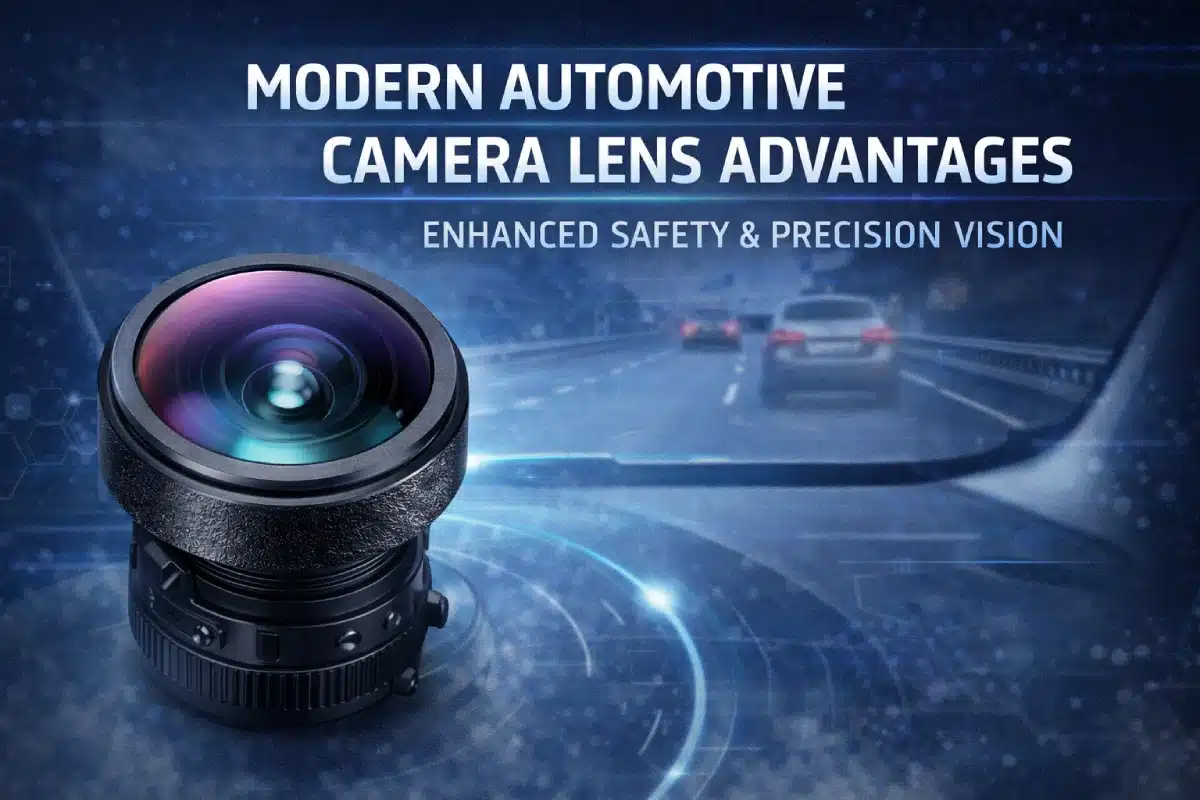
What are Automotive Camera Lenses? And it’s Technology?
The vehicle has turned into a data-gathering computer, while the reflection of simple glass is fading. An automotive camera lens is a specialized optical component used in vehicles, primarily as part of a camera system. That provides safety and driver-assistance features. Unlike standard glasses or plastic lenses, automotive lenses are engineered for durability, clarity, and performance under challenging conditions, including heat, vibration, and weather. Manufacturers play a key role in this, using digital precision instead of traditional mirrors, replacing them with high-definition sensors. Therefore, these capture what the naked human eye misses.
The automotive optical system performs a function similar to that of a standard camera lens. It gathers light and focuses it onto a digital image sensor. However, the similarities between the two camera ends exist because a photography lens is designed to capture an aesthetic moment. An automotive lens is engineered to capture critical safety data with absolute precision, regardless of the environment.
The technology that works is further categorized into three distinct types, each serving a role in vehicle safety:
1. Viewing Lenses
It is typically a wide-angle optic that provides guidance to the driver in tight spaces or parking spaces. So they can skillfully move vehicles. It is used for rear-view and 360-degree surround view systems. Moreover, they assist in maneuvering in tight spaces. The wide angle makes parking easier, which is generally considered one of the toughest tasks. With advanced technology, it is possible and easy.
2. Sensing Lenses
A CCTV lens is the eye for the surroundings. The sensing lenses are the eyes of the Advanced Driver Assistance System (ADAS). With these, it gets easier to see the narrow fields of view to see further down the road. Identifying lane markings, traffic signs, and obstacles for features like automatic emergency braking. These help drivers easily and safely, without compromising safety, making driving in unpredictable weather easier and safer.
3. Interior Lenses
Interior lenses are placed inside spaces. As popularity has increased, these are mounted inside the cabin to monitor driver alerts and ensure drivers keep their eyes on the road.
Manufacturing such a product requires high precision and sophisticated engineering. A vehicle operates in harsh environments, from freezing winters to scorching summers. Therefore, it requires a high-quality Auto Lens, a specialized build designed to maintain focus stability during rapid temperature changes. It’s a hybrid product of glass and specialized optical plastics. This process is known as athermalization. It ensures images remain sharp and data remain accurate, whether the car is starting up in a cold garage or driving on a hot highway.
Why is an Automotive Lens Better Than a Traditional Camera Lens?
While both look the same on the spec sheet, the vehicles require different operational features than the stationary building. The following table highlights why a standard CCTV lens cannot simply be swapped into a moving vehicle. While explaining the need for automotive optics to bridge the gap.
| Feature / Challenge | Standard Security (CCTV Lens) | Specialized Automotive Camera Lens |
|---|---|---|
| Vibration & Shock | Designed for static mounts (walls/ceilings). Internal elements may shift under constant vibration. | Ruggedized Construction: Built to withstand high-speed bumps, potholes, and G-force stops without losing focus. |
| Lighting Extremes | optimized for consistent lighting or infrared night vision. Struggles with rapid light changes. | High Dynamic Range (HDR): Instantly adjusts when driving from a dark tunnel into bright sunlight to prevent “blindness.” |
| Temperature | Operates best in climate-controlled or mild outdoor ranges. | Athermalized Design: Uses hybrid glass/plastic elements to maintain focus from -40°F to 185°F (thermal shock). |
| Environmental Seal | Weather-resistant (rain/dust). | Hydrophobic & Oleophobic: Coatings repel water, mud, road salt, and oil to keep the view clear at highway speeds. |
| Latency (Speed) | Minor lag is acceptable for recording. | Real-Time Transmission: Near-zero latency is required to enable immediate driver response and ADAS safety systems. |
Summing It Up!
In residential safety, CCTV lens is available in various types based on the purpose they serve. When it comes to vehicles, an automotive lens is the product that changes the game and provides the perfect solution. Addressing vehicle and driver safety concerns is equally important. Manufacturers have upgraded the process and used high-quality materials to produce these automotive lenses, resulting in an excellent product. Advanced plastic or glass with a special coating is used to improve light transmission, reduce glare, and balance color. Making it an unbeatable product in any case, whether it be the weather, crowd, or damaged roads.
The automotive camera lens works effectively and delivers the best use case. Common use cases include rear-view and surround-view cameras, lane departure warning systems, parking assistance, autonomous driving sensors, and Advanced driver-assistance systems (ADAS). It is essential to contact the leading manufacturer with a large global supply to secure your lenses. Superior CCTV is the manufacturer of optical solutions that tick the boxes.
FAQs
Q.1: How is an automotive lens different from a standard photography lens?
A: Automotive lenses are built to perform without disturbance even in extreme conditions, whether it’s a thermal shock or road vibration. To ensure safety and perform their intended function, protective lenses must be engineered specifically. Superior CCTV supplies ruggedized optics that ensure your vision is maintained and calibrated in the harshest environments.
Q.2: What is “Athermalization” in lens manufacturing?
A: Athermalization is a design process that prevents a camera lens from going out of focus when the temperature changes. It’s critical for safety. It is essential to use a hybrid optical design in such cases. So the lens works perfectly, ensuring your camera system remains set up, whether it’s a freezing, snowy winter or scorching desert heat.
Q.3: Does SuperiorCCTV work on projects that require custom optical designs?
A: Yes. Unlike many other suppliers that only offer off-the-shelf components, we specialize in custom optical engineering. Whether you need lenses for a residential, commercial, or industrial project, we can cut them to your specifications. We manufacture lenses to your specifications, including focal length, unique mount types, and tailored housing materials, for industrial applications.
Q.4: What are the quality control measures you follow in your manufacturing?
A: Quality is paramount in optics. SuperiorCCTV guarantees and maintains product purity. Therefore, our manufacturing facilities utilize rigorous testing protocols, including modulation transfer function (MTF) analysis and environmental stress testing.
Q.5: Are bulk orders for large projects possible?
A: Absolutely. We are the leading scale company that manufactures and supplies the product worldwide. Therefore, we are well-equipped to handle large or bulk orders. We are the Original Equipment Manufacturers (OEMs).