


How to Select Spectral Coatings and Color-Corrected Vision Lenses
A buyer-focused method for matching lens coatings, optical materials and color correction to visible, NIR, SWIR, laser and multispectral imaging systems.
Key Takeaways
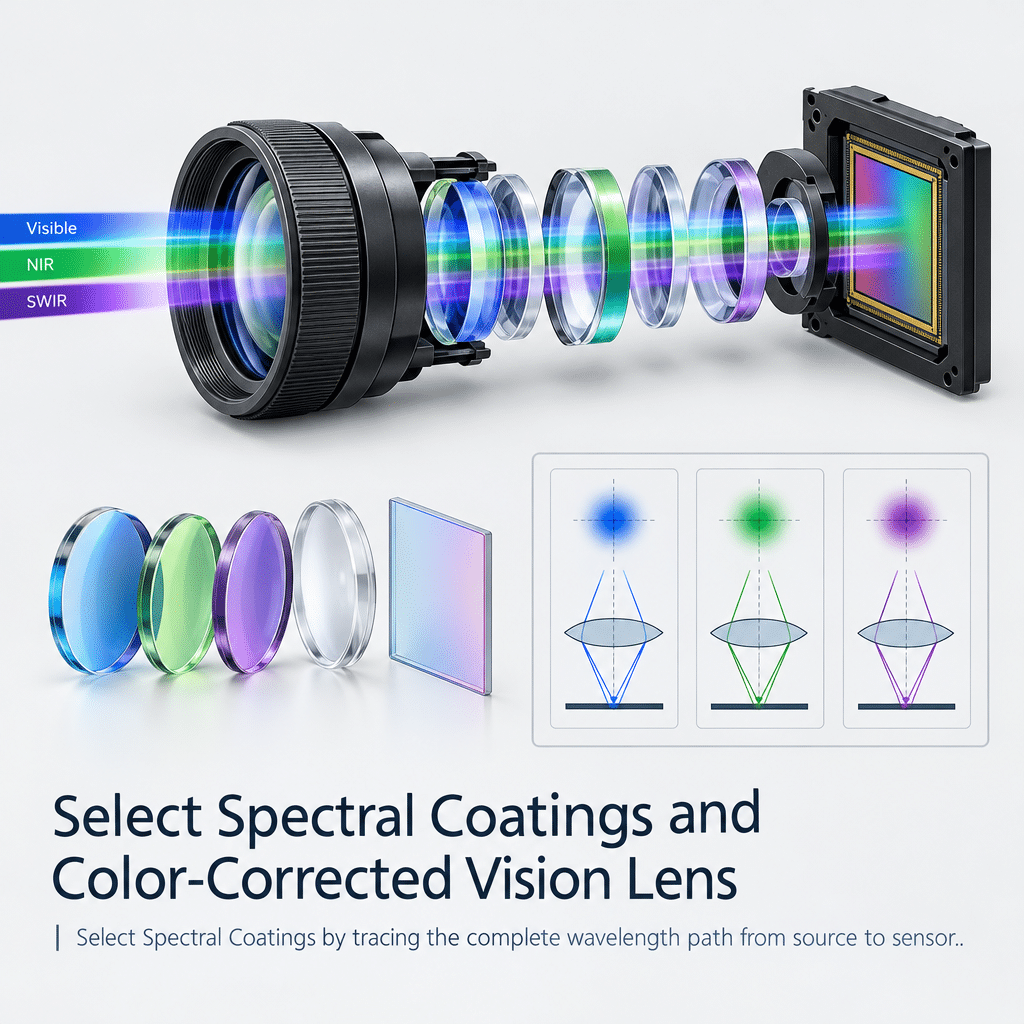
Select Spectral Coatings only after establishing the wavelengths that the illumination emits, the sensor can detect and the filters permit to reach the lens.
- Treat coating transmission and chromatic correction as separate requirements: a lens can transmit a wavelength without focusing it acceptably.
- A controlled narrowband inspection may not benefit from broadband color correction if focus is set at the operating wavelength.
- Compare achromatic and apochromatic options using acceptance data across the required bands rather than relying on the correction label.
- Visible, NIR and SWIR compatibility must include lens-material transmission, coating response, sensor sensitivity and installed windows or filters.
- Validate the assembled imaging path at the intended aperture, working distance, field position and illumination state before approving production.
The Short Answer
Select Spectral Coatings by tracing the complete wavelength path from source to sensor. Record the illumination bands, filters, sensor sensitivity and required focus state, then check whether the lens materials and coating maintain useful transmission across that range. Evaluate color correction separately: narrowband systems can often be focused at one wavelength, while white-light, day/night or multispectral systems may require achromatic, apochromatic or IR-corrected optics. Approve the lens using measured transmission and image-quality results under representative operating conditions, not a visible, NIR or SWIR label alone.
Start With the Full Optical Wavelength Path
A lens marked “visible,” “NIR” or “broadband” cannot establish system compatibility by itself. Begin with three overlapping ranges: what the source emits, what every window and filter passes, and what the sensor detects. The useful operating band is their intersection.
Define the illumination spectrum
Separate four cases in the request for quotation:
- Broadband source: document the required band rather than naming the lamp as “white.”
- Narrowband LED: record the specified emission band, not just its nominal color.
- Laser: identify its operating wavelength and ask how reflections, flare and power density affect the proposed assembly.
- Multispectral system: list every band and state whether one fixed focus must serve all bands.
The final condition changes the lens decision. Sequential bands with permitted refocusing are less demanding than simultaneous bands requiring one focus setting.
Confirm the sensor and filters
Use the exact sensor model, cover glass, protective window, IR-cut filter and any external bandpass filter. A detector may respond outside the intended image band, allowing unwanted radiation to reduce contrast unless filtering and coating behavior are considered together.
Also state whether the image must remain focused when a removable filter changes state. For a security camera, that means treating daytime visible imaging and nighttime infrared illumination as two defined optical conditions—not one broad “day/night” requirement.
How Spectral Coatings Affect Lens Performance
Spectral Coatings influence how much target-band light reaches the sensor and how well interface reflections are controlled. Their value depends on lens materials, illumination wavelength, geometry and the rest of the optical path; they do not correct wavelength-dependent focus by themselves.
Verified evidence: anti-reflection layers are selected to produce destructive interference, and multilayer designs can broaden useful wavelength performance. Reflection losses can accumulate through a multi-element lens, while stray light can reduce contrast. The same source explains that spectral transmission depends on wavelength, material absorption, reflection behavior and coatings. See this technical reference on optical coatings and spectral transmission.
Transmission, reflection and geometry
Ask for a transmission curve over the required band, with the measurement basis identified. A peak value at one wavelength does not describe broadband throughput. Nor does a coating designation show whether the underlying glass absorbs part of the band.
Engineering interpretation: coating data taken under one test condition should not automatically be treated as proof of performance for every ray angle in a finished lens. Buyers evaluating wide fields or fast apertures should request data representative of the proposed geometry, or validate the assembled lens directly.
System throughput is a chain. A suitable coating cannot recover light already rejected by a filter or absorbed by the lens material. Conversely, transmissive glass does not prevent reflection-related flare when the coating is mismatched to the working band.
Use a Wavelength Compatibility Table to Screen Lens Options
Coating selection and color correction must be evaluated together. The following wavelength compatibility guide is a screening tool, not a substitute for supplier curves or application testing.
Wavelength Compatibility Guide for Lens Coatings and Color Correction
| Imaging condition | Typical spectral requirement | Coating and glass consideration | Color-correction requirement | Lens selection guidance |
|---|---|---|---|---|
| Single narrowband LED inspection | One controlled band | Optimize transmission and reflection control around the actual LED band | Usually evaluate focus at that band | Start with a standard lens only if measured image performance is acceptable at the operating wavelength |
| Single laser wavelength imaging | One tightly controlled wavelength | Require wavelength-specific coating data and assess unwanted reflections | Broadband correction may add little value | Select and test at the laser wavelength; address laser safety separately |
| Broadband visible white-light imaging | Visible band used by source and sensor | Require useful transmission across the intended visible range | Color correction may be needed to hold detail across colors | Compare image quality by wavelength and under the complete source spectrum |
| Multi-color LED inspection | Two or more separated visible bands | Check transmission at every LED band | Achromatic correction may be justified if one focus must serve all colors | Test each channel without refocusing and at the production aperture |
| Visible and NIR day/night imaging | Visible daytime band plus the illuminator’s NIR band | Coating and glass must support both conditions | IR correction may be required for fixed-focus operation | Quantify acceptable focus movement and test both filter states |
| Multispectral imaging across separated bands | Multiple non-contiguous bands | Broad coating labels may hide weak regions between endpoints | Achromatic or apochromatic performance must be defined by tested bands | Specify each band, weighting, focus state and image-quality threshold |
| SWIR imaging with an InGaAs sensor | Sensor and illumination operating within SWIR | Verify material, coating, window and adhesive compatibility | Use a design evaluated for the required SWIR bands | Treat visible-lens use as unproven until transmission and imaging are measured |
For InGaAs projects, SWIR lens spectral matching provides a more focused checklist for aligning the detector, illumination and optical train.
Evaluate Chromatic Focus Shift Before Selecting a Lens
Chromatic focus shift is a system acceptance issue: does the best-focus position change enough between required wavelengths to impair the task? The commercially relevant answer depends on the permitted refocus strategy and observed image quality, not merely the presence of some calculated shift.
Set tolerance from the imaging task
Record the aperture, working distance, field of view, sensor format, pixel size and smallest feature that must be resolved. Smaller pixels can reveal deficiencies that a coarser sensor does not, but pixel pitch alone is not a pass/fail criterion. Sampling, contrast, aberrations, processing and the object all affect the result.
A practical acceptance test uses the intended target and illumination sequence. Focus at the designated reference condition, lock the lens, switch through every required band or filter state, and measure the same image-quality metric at the center and required field positions. Repeat at the production aperture and working-distance limits.
Illustrative decision rule, not a universal standard: if a two-color inspection must operate without refocusing, approve only when both channels meet the agreed feature-detection or contrast threshold at one locked focus. If independent refocusing is permitted, the same lens may be acceptable despite a larger focal-position change.
Choose Between Standard, Achromatic, and Apochromatic Lenses
A correction label describes design intent but does not establish application performance. Procurement specifications should translate “achromatic” or “apochromatic” into required bands, one or more focus conditions, field positions and measurable image-quality limits.
Single-wavelength operation
Controlled narrowband lighting can simplify the decision. If the source remains within one qualified band and the lens is focused there, broadband correction may not produce a commercial return. Transmission, resolution, distortion, working distance and stability may deserve priority instead.
This exception fails when ambient light enters the image, LED output varies beyond the qualified range, or a later product variant adds another wavelength.
When achromatic lens correction earns its cost
Achromatic lens correction is commercially defensible when two required wavelength regions must share one focus and a standard lens misses the acceptance threshold. Typical buying evidence would include channel-by-channel images, focus sweeps or an agreed image-quality curve from the assembled configuration.
When to investigate apochromatic lenses
Apochromatic lenses merit evaluation when several separated bands must retain demanding image quality without refocus. Do not assume the name guarantees performance across arbitrary bands. Ask which wavelengths were corrected, how residual focus behavior was evaluated and whether the result applies across the required field and aperture range.
Match Glass Materials and Lens Coatings to the Application Band
The verified coating reference describes normal imaging lenses as mainly designed and corrected for the visible range of 400–700 nm. It also reports that common crown and flint glass transmission falls sharply in deeper UV, illustrating why a visible-lens designation cannot be extrapolated indefinitely.
For visible work, compare full-band transmission and reflection control with the source and sensor. For visible-to-NIR operation, request evidence at both the daytime band and the actual nighttime illumination band. The practical issues behind IR-corrected lens selection include filter-state changes and visible-to-infrared focus stability.
SWIR requires a separate compatibility decision. Conventional visible optics may have unsuitable materials or coatings even if some energy reaches the detector. This comparison of Visible vs SWIR lenses explains why partial transmission should not be confused with qualified imaging performance.
Specify Color-Corrected Vision Lenses for Real Imaging Conditions
A useful specification fits on one controlled worksheet:
- source type and every required wavelength band;
- sensor model, active format, pixel size and sensitivity range;
- filters, windows and their operating states;
- focal length or field of view, working distance and aperture range;
- whether refocusing is allowed between bands;
- center and edge image-quality criteria;
- target transmission or exposure constraint by band;
- environmental and mechanical limits affecting retained focus.
Spectral performance cannot compensate for an undersized image circle or poor edge quality. For larger formats, assess the issues covered in large-sensor machine vision lenses alongside the wavelength requirements.
Production approval should use representative sensors, filters, illumination and samples. Include tolerance units rather than evaluating only a hand-selected lens. If temperature or vibration matters, define the relevant states and repeat the same locked-focus acceptance method under those states; no environmental capability should be assumed without product-specific evidence.
Select a Spectrally Matched Lens for Your Imaging System
An effective technical inquiry includes the illumination wavelengths, sensor model and sensitivity range, filters, working distance, aperture, field of view, resolution target and acceptable focus-shift limit. Add whether bands are simultaneous or sequential and whether mechanical or electronic refocusing is available.
Review standard and custom optical lens and lens assembly options against that specification. A custom assembly becomes reasonable when no standard product satisfies the required band, fixed-focus behavior, sensor format and packaging constraints together. The decision should still be tied to measurable acceptance criteria rather than the custom label itself.
Frequently Asked Questions
Can a lens optimized for one LED wavelength be used with a different LED color?
Possibly, but the second color needs separate verification. Check lens-material transmission and coating response at the new LED band, then refocus and measure image quality. If both colors must operate at one locked focus, test them sequentially without adjustment. A nominally visible lens does not prove equal performance across all visible wavelengths.
Do anti-reflection coatings eliminate chromatic focus shift?
No. Anti-reflection coatings primarily manage interface reflections and target-band transmission; they do not by themselves correct wavelength-dependent focal behavior. Focus correction comes from the optical design and material choices. Evaluate coating throughput and color correction as separate requirements, then test both together in the finished lens, filter and sensor configuration.
How do I know whether focus shift is significant for my sensor pixel size?
Pixel size is only one input. Lock focus at the specified reference wavelength, switch through every required band, and measure the task-relevant image metric without refocusing. Test the center and required field positions at the production aperture and working distance. Focus shift is significant when the resulting image falls below the agreed acceptance threshold.
Is an IR-corrected lens necessary for every day/night camera?
No. It becomes relevant when visible and infrared conditions must remain acceptably focused without adjustment. A camera that refocuses successfully may tolerate more shift. Base the decision on the actual IR illuminator, filter states, sensor and image-quality requirement, then test daytime and nighttime modes at one locked focus if fixed operation is required.
Can a visible machine vision lens be used with an InGaAs SWIR camera?
Only after verification; visible compatibility does not establish SWIR performance. The lens materials, coatings, internal components and protective windows must support the required SWIR bands, and the assembled lens must meet image-quality requirements on the InGaAs sensor. Partial transmission or a visible image alone is insufficient evidence of a production-ready match.
Topics
Related Articles
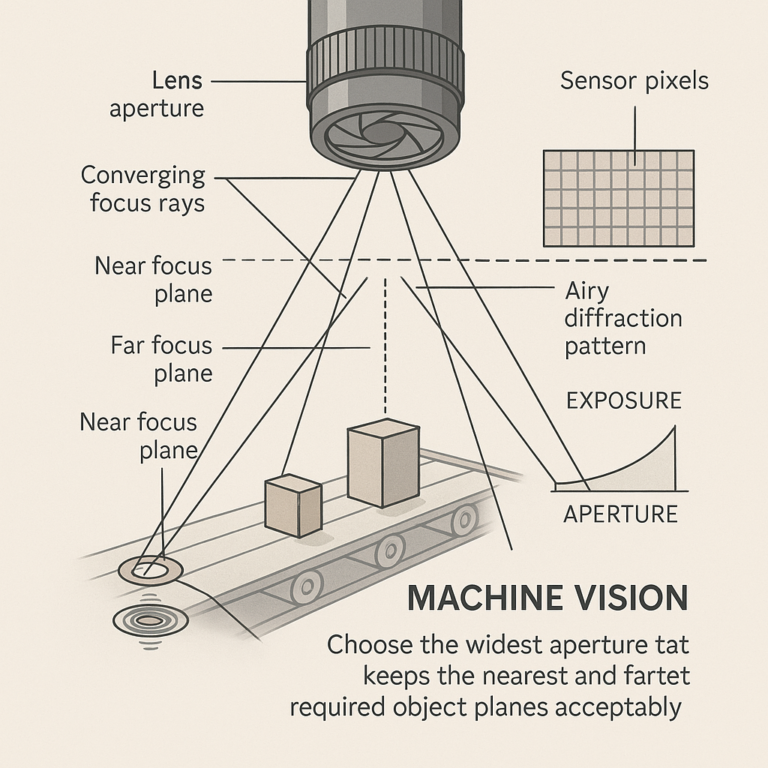
How to Balance Aperture, Depth of Field, and Diffraction in Vision
10 min read
Automotive Lens Manufacturing: Validation and Traceability Programs
11 min read
How to Adjust the Focus of the C-mount CCTV Lens | Capture a Sharp Image
6 min readAbout SUPERIOR OPTICS
SUPERIOR OPTICS specializes in CCTV lenses, machine vision optics, and custom optical solutions for security, industrial imaging, and specialty applications. We also provide professional lens selection and application support.