F-Theta Scan Lens 170mm 1.064μm 110×110mm - SUPERIOR Lenses

F-Theta Scan Lens 170mm 1.064μm 110×110mm | SP-FTH170-1064

  • 1064 nm Design Wavelength for Nd: YAG Laser Systems
  • Focal length 170mm
  • Flat Field at the Image Plane
  • Large Scan Fields Ranging from 110.6 mm x 110.6 mm
  • F-Theta Distortion of <0.1% or <1.3%
  • M85 x 1.0- and M39 x 1.0-Threaded Versions Available

SKU: Laser Optics / F-Theta lenses /F-Theta Scan Lens Category:
General Details

Product Family Description

F-Theta Lenses consist of an air-spaced 2- or 3-element design and are available with one of three focal lengths: 100 mm, 160 mm, or 254 mm. The elements are coated with a high efficiency AR coating for a 1064 nm Nd: YAG laser and for a visible alignment laser (refer to the Graphs tab for details). Each housing has a standard M85 x 1.0 or M39 x 1.0 thread for compatibility with most commercial laser marking systems, including ScanLAB, TRUMPF, and Datalogic, as well as a protective glass window that can be easily changed using the instructions provided below. Replacement AR-coated protective windows are also available.

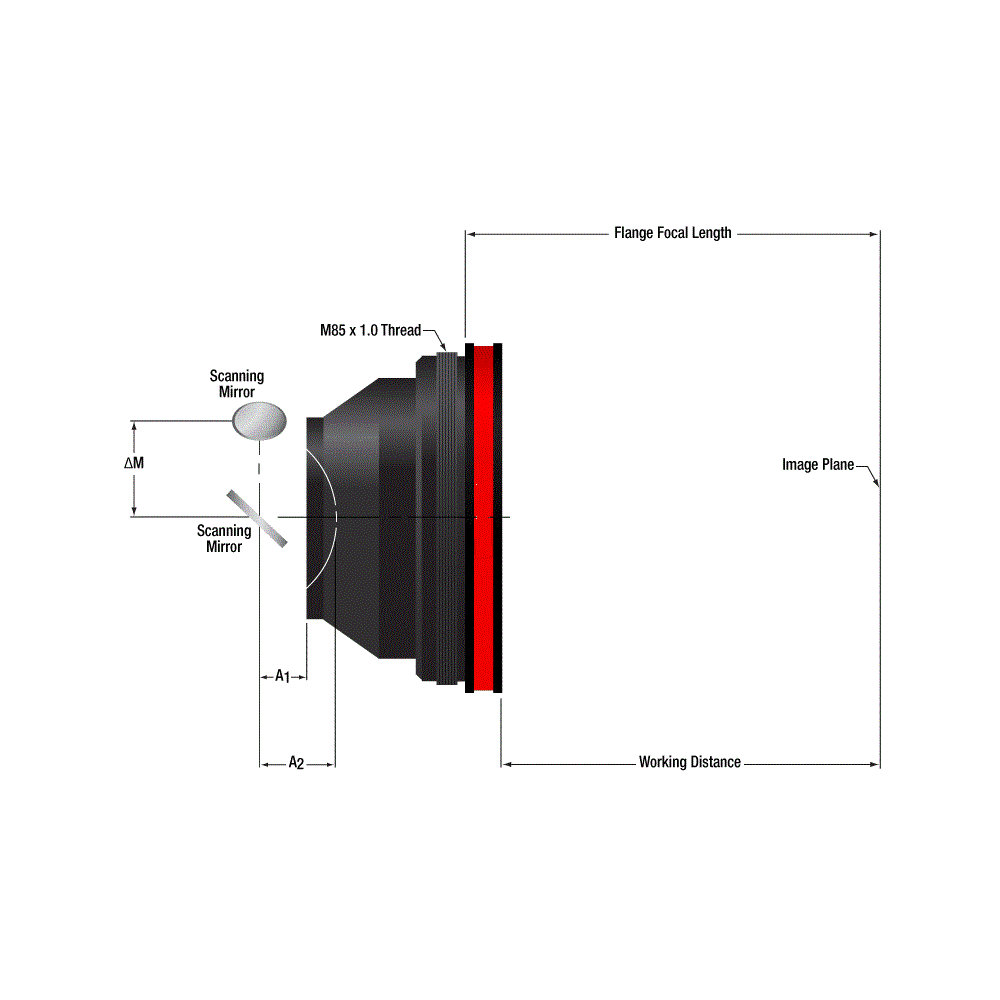
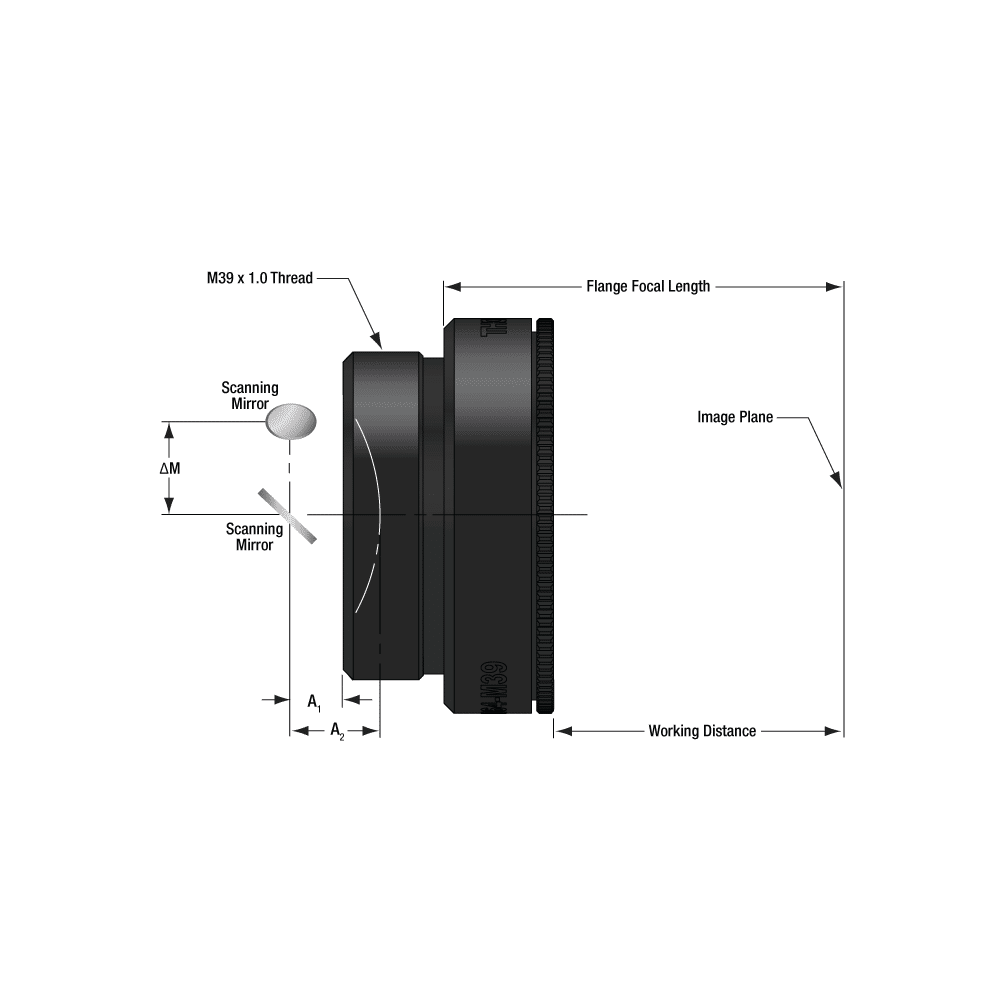
F-theta lenses are the standard lenses for galvo-scanner-based laser marking, engraving, and cutting systems. The diffraction-limited, multiple-element, air-spaced lens design is optimized for a flat field in the image plane and low f-theta distortion. In an f-theta lens, the output beam displacement is equal to f*θ, where θ is the angle of incidence of the input beam (see the diagram above). Thus, the input beam and output beam angular velocities are directly proportional, allowing the scanning mirrors to run at a constant angular velocity, greatly simplifying control electronics. For more details on f-theta lenses, please see the F-Theta Tutorial tab above.

1″
CMANSWIR


  • 1064 nm Design Wavelength for Nd:YAG Laser Systems
  • Flat Field at the Image Plane
  • Large Scan Fields Ranging from 70 mm x 70 mm to 156.7 mm x 156.7 mm
  • F-Theta Distortion of <0.1% or <1.3%
  • M85 x 1.0- and M39 x 1.0-Threaded Versions Available
  • Air-Spaced Design
  • All Optical Elements are AR Coated
  • Accessories Available Below:
    • Replacement Protective Glass Windows
    • Galvo Mirror Mounting Bracket
    • Mounting Adapters for 60 mm Cage Systems, Ø2″ Lens Tubes, or Ø3″ Lens Tubes


DATA SHEET


Model No. SP-FA6056M60F
Effective Focal Length (EFL) 170±5%mm
Scan Angle (Max) ±28°
Scan Length (Max) 156.4 mm
Scan Field (Max) 110.6 mm x 110.6 mm
Beam Diametera 12 mm
Spot Size (Diffraction Limited) 26 µm
F-Theta Distortion (Max) 0.1%
Working Distancea 182.5 mm
Flange Focal Lengtha 191.7 mm
A1a (Typical) 7.5 mm
A2a (Typical) 12.3 mm
ΔMa (Typical) 20 mm
Number of Elements 3 Plus Protective Window
AR Coatingb 1020 nm – 1080 nm: Ravg < 0.3% (per Surface)
450 nm – 700 nm: Ravg < 1.0% (per Surface)
Damage Threshold 5 J/cm2 (1064 nm, Ø1 mm, 10 ns, 10 Hz)
Lens Housing Diameter at Largest Point Ø90 mm
(Ø3.54″)
Mounting Threads M85 x 1.0
Replacement Protective Window Item #c SP-FTHW75-1064


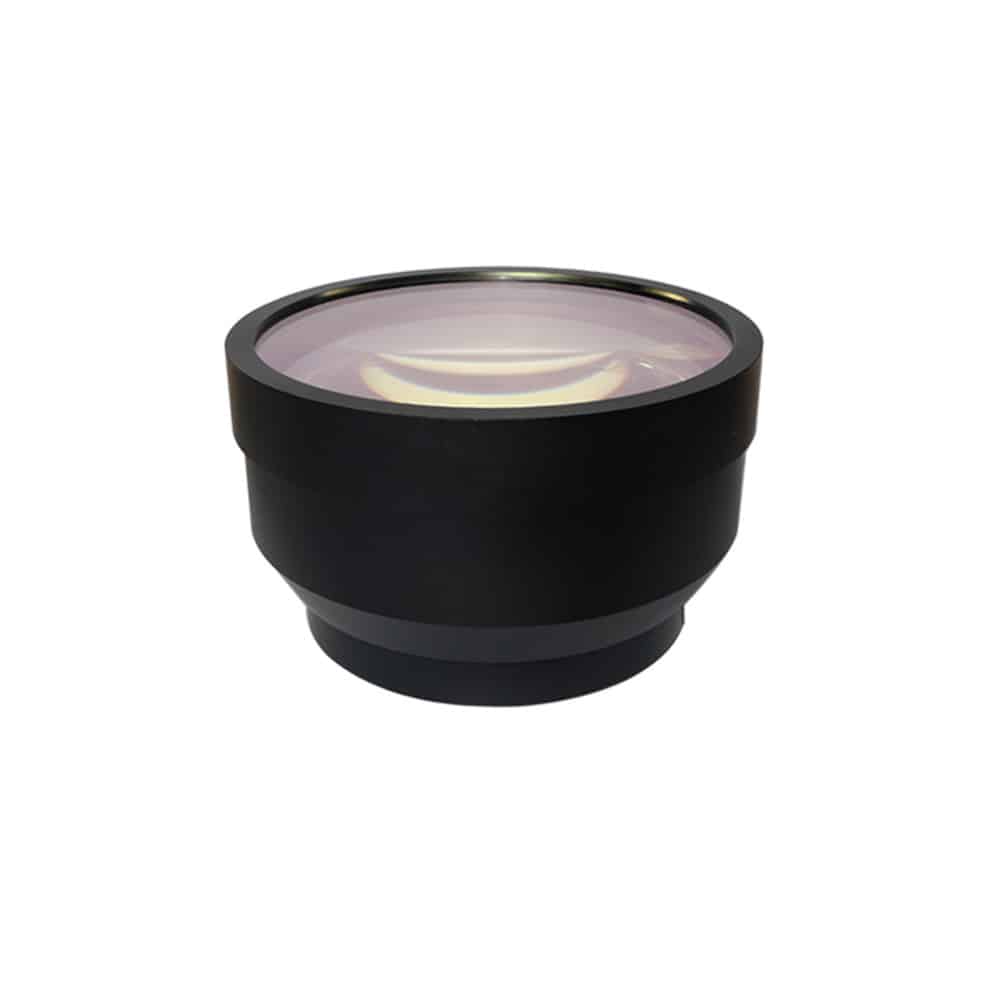
EXTERNAL VIEW

Graphs

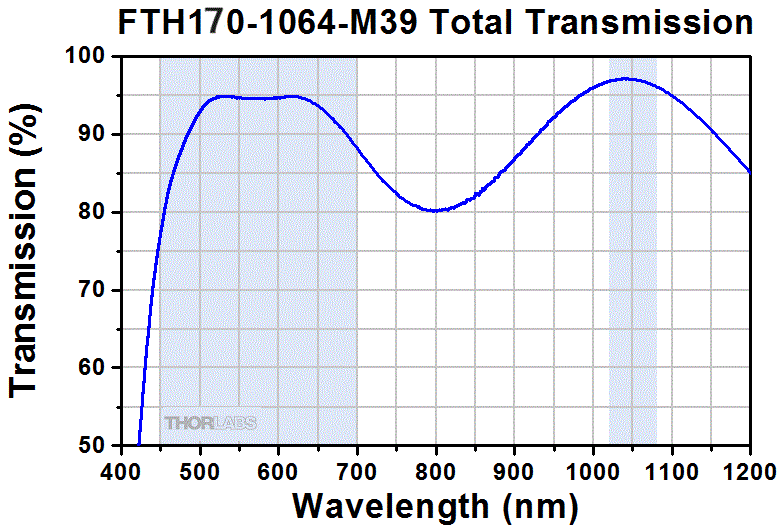
The shaded regions of the plots are the wavelength ranges over which the coating is specified: 450 nm – 700 nm (Ravg < 1.0% per surface) and 1020 nm – 1080 nm (Ravg < 0.3% per surface). Performance outside of these ranges is not guaranteed. The visible AR coating range is intended to allow use with an alignment laser. The other lens specifications are not optimized for performance at visible wavelengths.

F-Theta Scan Lens

The SP-FTH170-1064-M39 lens has two optical elements, not including the protective window.

Applications

F-theta lenses are the standard lenses for galvo-scanner-based laser marking, engraving, and cutting systems.

  • Laser Marking
  • Micromachining
  • Additive Manufacuring (3D Printing)
  • Laser Drilling
  • Laser Welding
  • Laser Cutting
  • Laser Cleaning
  • Laser-assisted Medial Treatments
  • Biomedical and Ophthlmic Imaging
Resources

Application Notes

  1. What is SWIR?
  2. Hyperspectral and Multispectral Imaging?
  3. UV vs. IR Grade Fused Silica
  4. Advantages of Using Meniscus Lenses in Infrared Applications?
  5. The Correct Material for Infrared (IR) Applications?
  6. Resolution and Contrast Comparison?
  7. Lens Performance Curves?
  8. Diffraction Limit?
  9. Object Space Resolution?
  10. Wavelength Effects on Performance?
  11. Comparison of Optical Aberrations?
  12. How to Choose a Fixed Magnification Lens?
  13. Basic Lens Selection?
  14. Lens Spacers and Focal Length Extenders?
  15. Resolution and MTF Testing?
  16. An Introduction to Optical Coatings?
  17. Anti-Reflection (AR) Coatings?
  18. System Throughput, f/#, and Numerical Aperture?
  19. Resolution?
  20. MTF Curves and Lens Performance?
  21. Relative Illumination, Roll-Off, and Vignetting?
  22. Distortion?
  23. Depth of Field and Depth of Focus?
  24. Aberrations?
  25. Aberrational Balancing of MTF in Lens Design?
  26. Lens Mounts?
  27. Lens Spacers, Shims, and Focal Length Extenders?
  28. Types of Machine Vision Lenses?
  29. Advanced Lens Selection?
  30. Machine Vision Filter Technology?
  31. What is Imaging?
  32. Basic Lens Selection?
  33. From Lens to Sensor: Limitations on Collecting Information?
  34. Sensors and Lenses?
  35. Imaging Fundamentals?
  36. Best Practices for Better Imaging?
  37. Contrast?
  38. The Anatomy of a Lens?
  39. Understanding Focal Length and Field of View?
  40. The Airy Disk and Diffraction Limit?
  41. Introduction to Modulation Transfer Function?
  42. The Modulation Transfer Function (MTF)?