
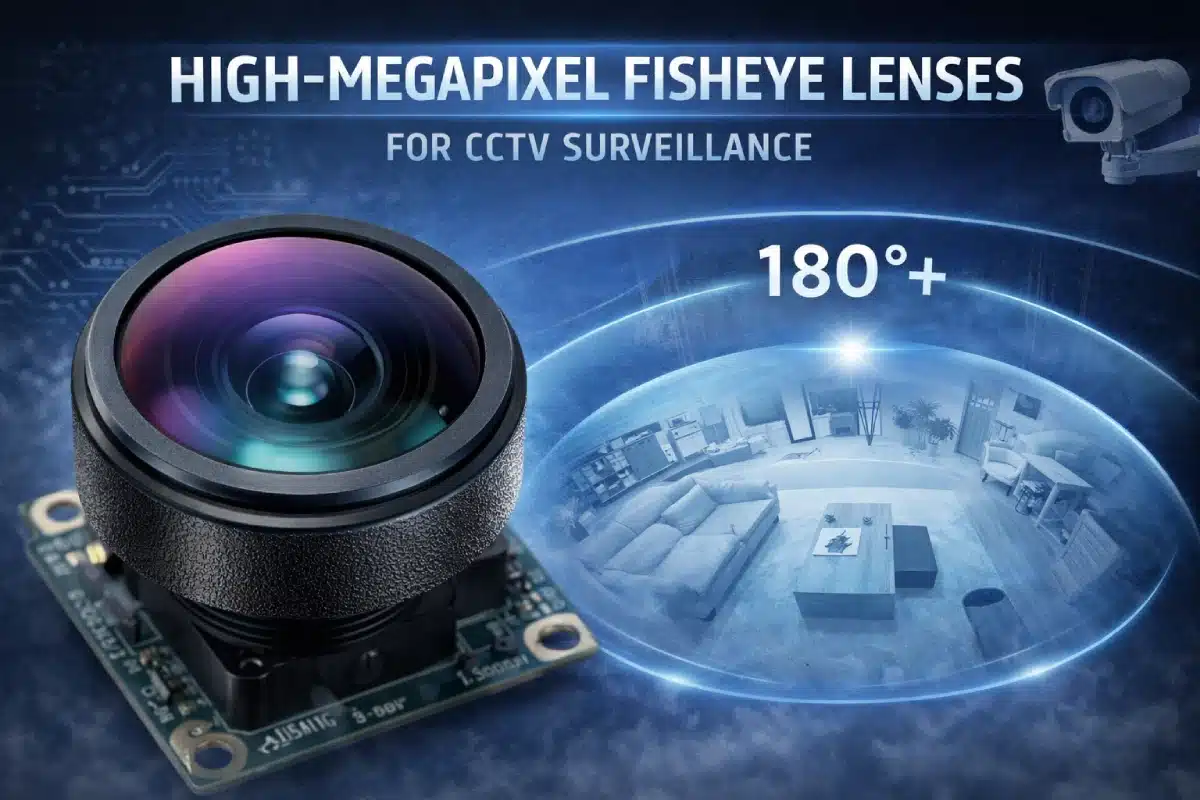
Often, businesses end up using multiple cameras to cover a single warehouse for total security. However, using a fisheye lens for CCTV camera can reduce the need to install multiple cameras, as it captures wide-angle shots with minimal distortion. The integration of advanced technology into optical systems has addressed the primary limitation of fisheye lenses: image distortion in wide-angle shots. These reduce the business owner’s need to install a dozen cameras in the warehouse, ensuring the entire warehouse or retail floor is covered. The preference for fisheye lenses over standard lenses is due to their image-capture capabilities.
When a standard lens acts like a flashlight, illuminating a specific area, a fisheye lens for CCTV camera offers panoramic vision. The panoramic vision results in pixel spread, which stretches the images, making them blurry and unusable for security purposes. However, advanced technology development in the optical system has found a solution for it. Now you can use a single camera to capture a wide shot without image distortion. Let’s understand how they do it through this comprehensive blog.
Why Does High Resolution Matter? Why 1080p Isn’t Enough
To get a high-resolution image without image distortion and crisp imaging, treating a 360-degree camera like a standard bullet camera is a mistake. When resolution and processing power are the most critical factors, they improve image quality and help identify faces captured. The meaning of high definition becomes totally different when using wide-angle optics. The standard lenses use a 2 MP CCTV lens that focuses all pixels onto a narrow 90-degree view. These result in crisp, clear images of the views they capture. However, the same 2MP lens used in a fisheye lens produces a distorted image, as it captures a 360-degree view.
The loss of image quality results from spreading 2 MP pixels across a 360-degree, massive circular image. That’s why the image is distorted. If you use a low-resolution setting on a panoramic camera, zooming in produces a blurry, pixelated image. The best way to avoid this issue is to use a 5MP, 6MP, or 4K sensor with a wide-angle CCTV lens. So that while zooming in on images and pictures, the details remain sharp enough to be used as evidence.
| Comparison Factor | Standard Fixed CCTV Lens | Fisheye Lenses for CCTV |
|---|---|---|
| Pixel Distribution | Concentrated: 100% of pixels focus on a narrow view. | Diluted: Pixels are stretched thin across a 360° circle. |
| Performance at 1080p | Sharp image; easy to identify faces. | Blurry/Pixelated; hard to see details. |
| Digital Zoom Quality | Good clarity on recorded footage. | Poor clarity unless a 4K+ sensor is used. |
| Required Resolution | 2MP to 4MP is usually sufficient. | 6MP to 12MP is required for evidence. |
What is Dewarping? How It Changes the Footage
The raw footage captured by a fisheye CCTV lens is distorted and appears as a bubble or a globe. Footage like this makes it difficult for security guards to monitor. Therefore, while using a fisheye lens, it is crucial to use dewarping software to achieve sharp, crisp images. Modern NVRs and VMS (Video Management Software) use advanced algorithms to take that distorted circle and flatten it out. The process converts the circular bubble feed into a standard rectangular video grid, correcting perspective and converting the view to a traditional grid, which is easy for the human eye to interpret.
NVR and VMS technology also support a powerful feature known as e-PTZ (Electronic Pan-Tilt-Zoom). Unlike a standard mechanical PTZ camera, which must physically turn to track a subject (potentially missing action happening behind it), a 360 degree CCTV lens captures the entire scene simultaneously. This allows you to digitally pan, tilt, and zoom around the footage after it has been recorded. You can virtually look left, right, or down into the footage without the camera ever moving.
However, dewarping requires significant computing power. Because it processes the captured image before it is viewed, unlike the standard lens, which sends ready-to-watch images. SuperiorCCTV ensures that our recording hardware and software solutions are equipped with the necessary processing chips to dewarp these high-resolution images. Ensuring you have full situational awareness without the confusion caused by distorted images on the screen.
Final Words!
Panoramic tools are powerful, laying the foundation for capturing wide shots. A fisheye lens for CCTV camera captures the entire scene in a single shot, rather than using multiple cameras to cover the same area. But for effective results, they need to be equipped with the right tools, such as Network Video Recorders (NVRs) and Video Management Software (VMS). By using panoramic lenses with tools like this, you can achieve the right specifications (High MP) and capture shots. The shots captured with this lens are best for security purposes, as they don’t blur details.
To ensure a robust system across your warehouses and retail locations, it is advisable to adopt a hybrid approach. For a general, wide view, opt for a fisheye lens for CCTV camera and use standard long-range CCTV lenses at entrances for facial recognition. Finally, to ensure a reliable supply and high-quality lenses, contact Superior CCTV. From purchase to installation, we provide guidance and ensure you have the best experience with us.
FAQs
Q.1: Can I replace all my fixed cameras with a single fisheye unit?
A: Not entirely. While the fisheye lenses work well to cover the hidden points in large open areas. It cannot match the long-range details of a focused lens. Therefore, it is recommended to use a focused lens at the entry point where facial recognition is needed, and use a fisheye lens for a general overview.
Q.2: Is the flattening software needed for a 360-degree image provided by SuperiorCCTV?
A: Yes. Our Network Video Recorders (NVRs) and viewing software are equipped with advanced dewarping software technology. These can be used to view a raw wide-angle CCTV lens stream or break it down into multiple flat, perspective-corrected views for easier monitoring on your screen.
Q.3: Do I need a 4K monitor to view footage from a high-resolution panoramic camera?
A: Although the 4K monitor provides the best viewing experience, it is not strictly required. The recording needs to be done in high resolution, as it’s the most important factor. This only allows you to zoom in on specific details without a pixelated image, regardless of monitor size and quality.
Q.4: Is the installation of a fisheye lens harder than a standard bullet camera?
A: Installation of a camera requires precise placement to cover the area and minimize distortion. Superior CCTV offers professional installation services to ensure the cameras are mounted at the optimal height and angle to minimize edge distortion. These installations are typically performed in the center of a cell to be more effective and require professional assistance.
Q.5: How much bandwidth does a high-resolution 360-degree camera use?
A: High-resolution 360-degree cameras typically rely on large sensors in the 6MP-12MP range that demand more bandwidth than 1080p models. To address this issue, the SuperiorCCTV system uses H.265+ compression. The sausage significantly reduces bandwidth usage and storage requirements without sacrificing image quality.