
CCTV cameras have now become an indispensable part of security monitoring and surveillance across different application areas. In addition to offering remote monitoring services, modern security cameras now have the luxury to use different types of lenses. Consequently, you can perfectly match the CCTV camera lens with the application type to get the best output. This also offers you flexibility to capture different fields of view, get adequate zooming capabilities, and ensure a blind-spot-free coverage.
However, the benefits of CCTV cameras depend on how well you pair the cameras with the lenses. Mismatching the camera with an incorrect security camera lens type can lead to subpar security monitoring, which in turn results in lower image quality. As a result, it can compromise the area’s overall security, creating blind spots and coverage gaps that do not help identify the invaders/culprits.
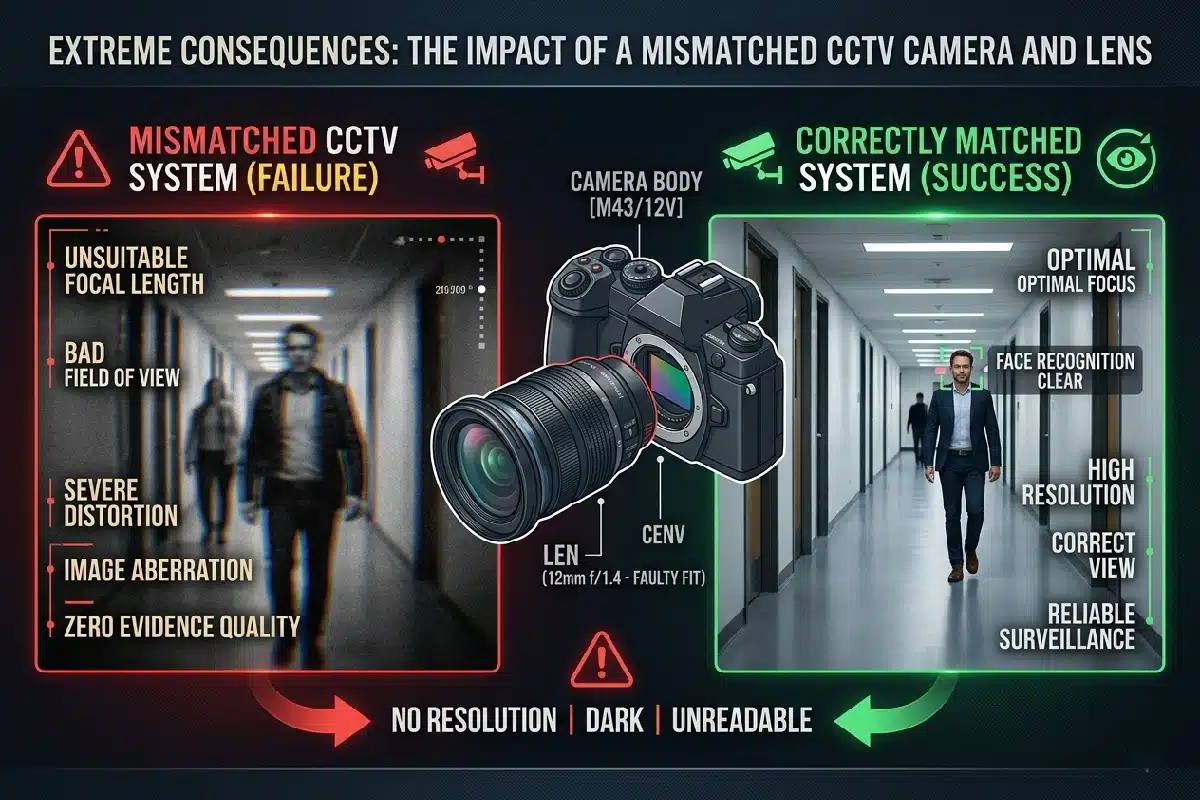
Poor Field of View, Reduced Image Quality, and Other Negative Effects of Choosing the Wrong Lens
Lenses are expensive optical components, and thus, purchasing multiple lenses is not a sustainable solution. Thus, choosing the right CCTV camera lens helps you achieve better coverage and avoid unnecessary expenses. On the contrary, when you choose the wrong lens, it can affect image quality and lead to significant other disastrous consequences. The following points will help you understand these points better:
1. Lower Image Quality
It results in degraded image quality when the camera’s sensor size does not match the lens’s size. Regardless of how expensive the lens is, you cannot use it to its full potential unless it fits the camera perfectly.
2. Dark Corners Due to Imperfect Lens Fitting
Using a smaller CCTV camera lens for a larger camera sensor does not project the images properly, leaving unilluminated corners. Another reason behind the dark corners or vignetting is the mismatched CRA or Chief Ray Angle. The lens’s CRA should match that of the camera’s sensor. In the case of a mismatch, the corners do not receive sufficient light, causing the image to become gradually dark around the corners.
3. Limited Functionalities
The mismatch limits the camera’s and lens’s functionalities. For example, in case the lens does not fit well with the camera, the distance between the lens and the sensor becomes a problem. This prevents the camera from focusing on distant or nearby objects. Additionally, poorly fitted lenses cannot use functionalities such as autofocus and other electronic controls, compromising the image quality and overall surveillance.
4. Damaged Lenses After Prolonged Use
When lenses are forcibly fitted into mounts they are not compatible with, it can permanently damage the lens and adapter. Moreover, using loosely fitted or poorly attached security camera lens increases the risk of lens detachment, damaging the lens beyond repair. Hence, by using a mismatching lens, you not only risk the lens, but also the camera.
5. Inadequate Field of View Coverage
An incorrect focal length prevents you from covering the required field of view, which in turn leads to coverage that is too far, too wide, or too narrow. This is a major flaw in the security monitoring, as the main subjects might not be captured properly and may not enter the field of view.
How to Choose the Right CCTV Camera Lens?
Now that we understand that using the wrong lens can affect image quality and damage the camera and lens. Now, the opposite of this is also true, as using the right type of CCTV camera lens saves you from unnecessary expenses and also ensures great quality for your surveillance and monitoring services. Here are some critical factors that will help you choose the right lens.
- Before choosing the lens, you must be clear about the goal and application you need it for. Defining the monitoring goals beforehand allows you to get a clear picture of what you need to capture, thereby reducing the effort in decision-making.
- Choose the lens that effectively captures the required field of view. For example, CCTV camera varifocal lenses allow you to adjust the focal length to capture multiple fields of view without changing the camera or the lens.
- When choosing a security camera lens, make sure the camera’s resolution matches the lens to get the best results and use the lens optimally.
- You should also consider the lighting conditions before choosing the lens to get the correct coverage. For example, you will need additional components for effective night monitoring.
- Another critical aspect is durability and water resistance, which are significant for industrial applications. The camera and lens must be durable enough to endure the harsh industrial environment and should have the appropriate IP rating.
Types of Lens and Their Uses in Security Monitoring
| Lens Type | Field of View (FOV) | Adjustment Capability | Best Used For | Key Advantage |
|---|---|---|---|---|
| Fixed Lens | Pre-defined (wide to moderate) | No adjustment | Small shops, homes, hallways | Simple setup and cost-effective |
| Varifocal Lens | Adjustable | Manual zoom & focus | Offices, warehouses, parking lots | Flexible field of view |
| Motorized Varifocal Lens | Adjustable | Remote zoom & focus | Large commercial sites | Easy fine-tuning after installation |
| Zoom Lens (Optical Zoom) | Adjustable (long distance) | Optical zoom | Long-range surveillance | Clear image without digital distortion |
| Wide-Angle Lens | Very wide | Fixed | Retail floors, reception areas | Covers large areas |
| Telephoto Lens | Narrow | Fixed or adjustable | Perimeter security, gates | Captures distant objects clearly |
| Fisheye Lens | 180°–360° panoramic | Fixed | Large halls, warehouses | 360° area coverage |
| Pinhole Lens | Narrow to moderate | Fixed | Covert surveillance | Discreet and compact design |
| IR-Corrected Lens | Varies | Fixed or varifocal | Day/night cameras | Maintains focus in infrared mode |
| Megapixel Lens | Varies | Fixed or varifocal | HD/IP cameras | Supports high-resolution sensors |
Get the Exact Lens For Your Particular Coverage Requirements
SuperiorCCTV is the leading CCTV lens manufacturer, capable of designing optimal optical solutions for a wide range of applications. Here, we aim for 100% customer satisfaction by delivering high-quality security camera lenses for superior monitoring services. And our experts solve the major problem for you and help you choose the right type of security camera lens that satisfies all your particular requirements. On top of that, if standard lenses do not meet your requirements, we will manufacture custom lenses.
With SuperiorCCTV, you get the following benefits:
- On-time delivery of high-quality lenses
- Production of lenses in bulk quantities without compromising the quality
- ISO-certified manufacturing facilities
- Wide range of lenses, including varifocal, fixed focal length, and a CCTV camera wide angle lens.
Contact SuperiorCCTV for a Professional Consultation
Our experts are always ready to answer your questions and offer professional advice during consultation sessions. To book a consultation session, contact us, and our customer support will guide you through the hassle-free process.
FAQs
What is a CCTV camera wide angle lens, and why should I use it?
A CCTV camera wide angle lens specializes in covering a broader area that generally requires using multiple standard camera lenses. They can cover a FOV up to 80 degrees, which is extremely helpful in airports, larger commercial warehouses, and residential areas. You can use them to cover a wider area without leaving any blind spots.
What are the different mount types for security camera lenses?
There are different mount types available, including:
- C-Mount – Standard industrial mount with 17.526 mm flange distance, widely used in machine vision.
- CS-Mount – Similar to C-mount but shorter flange distance (12.5 mm), common in CCTV cameras.
- M12 (S-Mount) – Compact board-level mount used in small IP and embedded cameras.
- F-Mount – DSLR-style mount supporting large sensors and high-resolution imaging.
Is the camera placement important for CCTV installation?
Yes, absolutely, the camera placement plays a critical role in CCTV installation as it ensures that you cover the right field of view and there are no restrictions in front of the camera. There are multiple factors to consider when choosing the best location for camera placement. For detailed information on the camera placement for your particular space, feel free to contact SuperiorCCTV.
What is the difference between a varifocal lens and a fixed focal length lens?
As the name suggests, CCTV camera varifocal lenses have an adjustable focal length, which is used to capture different fields of view. You do not have to change the lens or the camera placement to get the best FOV. On the other hand, a fixed focal-length lens has a non-adjustable focal length, which means it can only capture a fixed field of view. But, lenses with fixed focal length are comparatively more affordable and offer high-resolution imaging.
Why are industrial lenses manufactured differently from regular lenses?
Industrial camera lenses, whether used for security monitoring or for other industrial applications, are manufactured differently due to the following reasons:
- Higher Optical Precision – Designed for measurement accuracy, not just visual appeal.
- Low Distortion Design – Minimizes geometric distortion for precise inspection and metrology.
- High Resolving Power (MTF) – Built to match high-resolution industrial sensors with small pixel sizes.
- Mechanical Robustness – Made with a metal housing to withstand vibration, dust, and harsh environments.
- Locking Mechanisms – Focus and aperture can be locked to prevent shifts during operation.
- Thermal Stability – Engineered to maintain focus and calibration across temperature variations.