M12 Fisheye vs Rectilinear Lenses: Matching Coverage to Camera Tasks
Fisheye and rectilinear M12 lenses can fit the same mount yet produce fundamentally different image geometry. This buyer’s guide compares coverage, field-of-view specifications, correction requirements and application limits before design approval.
Key Takeaways
Choose projection from the required output, not from focal length or enclosure fit alone: fisheye favors angular awareness, while rectilinear favors straight-line appearance and easier geometric interpretation.
- Approve horizontal, vertical and diagonal field of view against the actual active sensor area, not a nominal sensor format alone.
- Treat raw coverage and usable corrected coverage as separate acceptance requirements.
- Use fisheye optics when broad situational awareness matters more than natural line geometry.
- Favor rectilinear optics for geometry-sensitive inspection, measurement or corridor views, subject to application-level validation.
- Freeze the lens, sensor, focus position, correction profile and operating conditions together when calibration is part of the delivered output.
The Short Answer
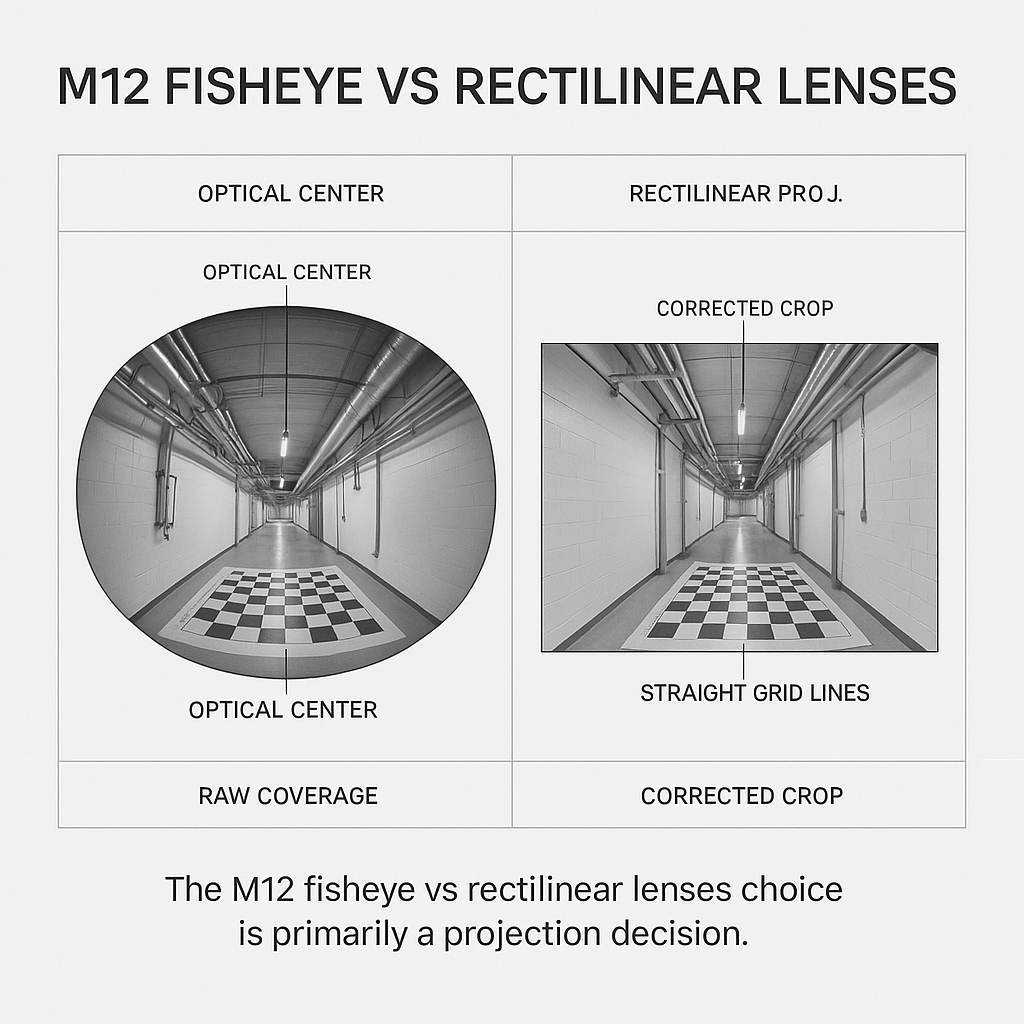
The M12 Fisheye vs Rectilinear Lenses choice is primarily a projection decision. A fisheye design accepts intentional geometric distortion to capture broad angular coverage, making it useful for situational awareness. A rectilinear design keeps straight scene lines looking straight, which generally makes images easier to interpret for inspection, corridors and geometry-sensitive tasks. Compare the architectures using the active sensor area, horizontal and vertical coverage, raw versus corrected output, edge detail and available processing—not focal length or M12 thread compatibility alone.
M12 Fisheye vs Rectilinear Lenses: The Practical Difference
How do fisheye and rectilinear lenses differ for camera coverage?
An M12 fisheye lens prioritizes angular coverage by intentionally curving lines away from the image center. An M12 rectilinear lens is designed to retain the straight-line appearance of scene features. Those characteristics, including the surveillance applications commonly associated with each architecture, are described in this fisheye and rectilinear surveillance comparison.
The engineering question is therefore not simply which lens is wider. It is whether the raw or processed image preserves the information needed by an operator, detector or measurement algorithm.
Why similar focal lengths can produce different usable scenes
Focal length influences magnification and field of view, but it does not fully define projection, distortion or sensor coverage. The selected sensor and lens design also affect the delivered view. An embedded-camera selection guide from e-con Systems identifies sensor size, focal length, field of view and distortion as linked compatibility factors.
Engineering inference: two nominally similar focal lengths should not be treated as interchangeable when their projection models or supported sensor areas differ. Compare sample images and measured coverage on the production-intent sensor.
Start with the task, not the barrel
An M12 thread confirms a mechanical interface, not application suitability. Begin with the scene boundaries, working distance, smallest relevant feature, required line geometry and final output. Only then check barrel clearance, back-focus adjustment, sealing and assembly controls.
M12 fisheye and rectilinear integration trade-offs
| Selection factor | M12 fisheye lens | M12 rectilinear lens | OEM and integrator implication |
|---|---|---|---|
| Primary objective | Broad angular awareness | Natural-looking geometry | Choose by delivered task output |
| Scene coverage | Often wider for a given design envelope | Usually more constrained at extreme angles | Verify on the intended sensor |
| Projection | Intentional nonlinear mapping | Straight-line preservation | Do not compare focal length alone |
| Off-center straight lines | Commonly appear curved | Intended to remain straight | Inspect edges, not only the center |
| Edge interpretation | Scene content is compressed or remapped | Features can appear stretched in very wide views | Test target features across the frame |
| Raw geometry use | Usually unsuitable without a calibrated model | Often easier to interpret, but not automatically measurement-grade | Set numerical acceptance tests where measurement matters |
| Correction burden | Dewarping may be required | Residual distortion may still need calibration | Budget processing and calibration together |
| Corrected output | Can lose coverage through remapping or cropping | May also require crop margins | Specify usable output dimensions |
| Processing | Compatible dewarping and rendering may be needed | Often simpler, depending on accuracy target | Confirm camera, recorder or host support |
| Typical constraint | Distorted raw geometry | Harder optical design at very wide angles | Balance coverage against edge quality |
| Approval evidence | Raw and dewarped samples plus calibration data | Grid images and residual-distortion evidence | Evaluate production-intent assemblies |
Compare Fisheye vs Rectilinear Projection for Coverage and Image Interpretation
Fisheye prioritizes maximum angular coverage
A fisheye projection allocates sensor pixels according to an intentionally nonlinear mapping. This permits broad scene capture, but objects and straight boundaries away from the optical axis no longer retain a conventional perspective appearance. That may be acceptable for presence detection, occupancy awareness or operator navigation.
It becomes a problem when software assumes straight lines, uniform scale or an ordinary perspective camera model. A wide raw image is not automatically a larger usable image.
Rectilinear projection preserves straight-line appearance
Rectilinear optics are preferable when door frames, conveyor rails, shelves or machine edges must look straight. This does not mean distortion is zero or that dimensions can be read directly from an uncalibrated frame. It means the projection objective is better aligned with natural perspective and geometry-sensitive interpretation.
At extreme angles, buyers should examine edge sharpness, feature size and illumination rather than approving a lens from a center crop.
What edge stretching, compression and curved lines mean
Fisheye output can compress scene angles near the perimeter. Rectilinear wide-angle output avoids curved straight lines but can render off-axis objects with a stretched appearance. The buyer-facing consequence is task dependent: an operator may accept either, while an algorithm trained on one projection may fail when the lens architecture changes.
Recommended comparison image: photograph the same grid, corridor or machine scene from one fixed camera position. Label the optical center, perimeter features, raw boundaries and corrected crop. This separates projection effects from changes in camera placement.
How to Specify Camera Lens Field of View Consistently
Separate horizontal, vertical and diagonal claims
A single diagonal value can conceal insufficient width or height. For an entrance, horizontal coverage may control; for a ceiling camera, both axes may matter. Record all three values and identify whether each is measured, calculated or nominal.
The M12 Fisheye vs Rectilinear Lenses comparison is only meaningful when both candidates use the same active sensor area and orientation. This guide to M12 lens field of view and sensor coverage explains why sensor-facing specifications must be evaluated together.
Match claims to the active sensor area
The relevant dimensions are the pixels actually read in the operating mode. Cropped readout, electronic stabilization margins or a changed aspect ratio can alter delivered coverage even when the physical sensor and lens remain unchanged.
For procurement, record sensor model, active width and height, orientation, readout mode and required image circle. Treat compatibility with another sensor as unverified until coverage and image quality are checked.
Raw coverage is not corrected coverage
An RFQ should distinguish among:
- scene visible in the raw frame;
- scene retained after dewarping;
- crop used by analytics or display software;
- masked or low-quality edge regions;
- final output resolution and aspect ratio.
A useful acceptance statement names required scene landmarks that must remain visible in the final output. This avoids approving impressive diagonal coverage that loses a doorway, gauge or conveyor edge after processing.
Choose the Right Architecture for the Camera Task
Surveillance and broad situational awareness
A fisheye architecture fits ceiling-mounted or central viewpoints where observing activity across a broad area has priority over undistorted raw geometry. The software chain must support the intended full-frame, panoramic or dewarped view. Buyers evaluating CCTV fisheye lenses should include recorder and client compatibility in optical approval.
Machine vision and geometric interpretation
Rectilinear or low-distortion designs are generally better aligned with inspection tasks that depend on straight boundaries and stable geometric interpretation. Measurement still requires a suitable camera model, calibration and acceptance limit; “rectilinear” is not a metrology certificate.
Working distance, sensor dimensions and inspection width should be frozen before focal length. The process for how to select a machine vision lens by FOV, sensor, and distance provides the broader sizing context.
When wide rectilinear is the better compromise
Choose wide rectilinear when operators need a familiar perspective, analytics assume conventional geometry, or straight structures carry meaning. Before approval, test whether the required width forces unacceptable edge softness, stretching or illumination loss. If it does, repositioning the camera may be more defensible than specifying a more extreme lens.
When multiple cameras are preferable
Multiple moderate-angle cameras may outperform one extreme-wide camera when the task requires useful feature detail across several directions. That architecture adds synchronization, cabling, processing and calibration interfaces. The decision should compare delivered information and integration burden—not camera count in isolation.
Plan Lens Distortion Calibration and Downstream Processing Before Approval
When calibration is required
Calibration is required when software must convert image coordinates into dependable geometric information or correct a projection for display. The model must match the lens architecture. A generic correction profile copied from another lens or sensor should be treated as unverified.
In an M12 Fisheye vs Rectilinear Lenses evaluation, define the allowed residual error and where it applies in the image. Without an acceptance metric, “low distortion” and “dewarped” remain descriptive labels rather than production controls.
Raw fisheye versus dewarped output
Dewarping converts fisheye imagery into a flatter view but adds software and processing considerations, according to the verified surveillance source cited above. It can support easier viewing, yet it does not create detail that the sensor did not capture.
Engineering inference: because remapping redistributes sampled image data, apparent detail will not be uniform everywhere in the corrected frame. Cropping blank or unreliable regions can further reduce retained coverage.
Validate the complete imaging state
Check calibration with the production-intent sensor, lens holder, focus position and processing settings. Focus-adjustable M12 assemblies can change state during integration, so mechanical retention belongs in the calibration plan.
Temperature range and spectral mode also need review. Day/night products may require infrared camera lenses designed around visible and near-infrared focus behavior. Validate focus and calibration in every required operating mode rather than assuming a daylight result transfers.
M12 Lens Selection Checklist for OEM Design Reviews and RFQs
Optical and sensor definition
- Sensor model, active area, pixel readout and orientation
- Required image circle and permitted corner shading
- Working distance and scene boundaries
- Horizontal, vertical and diagonal field of view
- Raw and final output resolution
Projection and edge behavior
- Required projection model
- Acceptable straight-line behavior and distortion metric
- Smallest relevant feature at center and edge
- Permitted crop, mask or dewarping region
- Sample scene and calibration target
Operating and production controls
- Focus setting and retention method
- Visible, infrared or day/night operating modes
- Temperature and environmental range
- Calibration ownership, file format and lens-to-profile traceability
- Lot acceptance method and change-control requirements
Evidence to request before approval
Request production-intent raw images, corrected images where applicable, test conditions, sensor identification and the correction profile used. Translate successful evaluation results into an M12 lens selection RFQ and approved purchase specification so later substitutions cannot silently change projection or coverage.
For a suitability review, provide the active sensor dimensions, required horizontal and vertical scene coverage, working distance, raw versus corrected output, operating spectrum and calibration expectations. Request an M12 wide-angle lens evaluation only after those inputs are controlled.
Frequently Asked Questions
Can a rectilinear M12 lens provide a wide-angle view without fisheye distortion?
Yes, but the achievable result depends on sensor size, lens design and required field of view. A rectilinear lens is designed to keep straight scene lines straight, although residual distortion and edge-quality limits can remain. Evaluate full-frame samples rather than treating “rectilinear” as a guarantee of measurement accuracy.
Does a fisheye lens always require dewarping software?
No. If the task is broad awareness, presence detection or recording the complete raw scene, curved geometry may be acceptable. Dewarping becomes relevant when operators or algorithms require a flatter perspective. Confirm that the camera, recorder or host processor supports the selected lens model and intended output format.
Why can dewarping reduce usable area or apparent resolution?
Dewarping remaps a nonlinear fisheye image into another projection. That process redistributes sampled image information, enlarging some regions and compressing others. Blank, unreliable or highly stretched areas may then be cropped. The corrected image can therefore retain less scene coverage and uneven apparent detail despite having fixed output dimensions.
Can the same M12 lens be used on different sensor sizes?
Possibly, but thread compatibility alone is insufficient. A larger active area may extend beyond the lens image circle or expose weaker edge performance; a smaller area usually captures a narrower portion of the image. Recheck field of view, corner illumination, focus and resolution on every intended sensor and readout mode.
What should an OEM request before approving a wide-angle M12 lens?
Request sensor-specific raw images, measured horizontal and vertical coverage, projection identification, full-frame quality evidence and corrected-output samples where applicable. The approval package should also define focus position, working distance, operating spectrum, temperature conditions, calibration files, permitted crop and acceptance limits that can be repeated on production assemblies.
Topics
Related Articles
M12 Sensor Coverage and Field of View: Comparing Lens Specifications
10 min read
M12 Lens Selection: Building RFQ and Approved Purchase Specification
10 min read