


Optical Design
Translate imaging targets into a lens configuration that can be modeled and tested.
Explore Optical DesignSUPERIOR OPTICS / CAPABILITIES
Optical assembly brings lenses, spacers and mechanical parts together into an imaging unit. SUPERIOR reviews your drawings, component responsibilities, alignment and focus requirements, then agrees on the tests and records needed to assess the finished assembly.
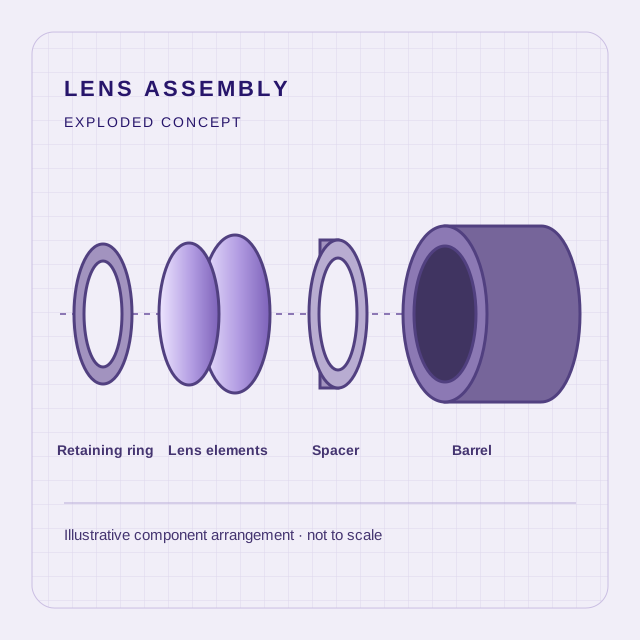
Start with the approved design and identify which parts, interfaces and adjustments the build depends on. The scope review assigns responsibility for incoming components and defines how the finished unit will be checked before it moves to pilot production.
Confirm who supplies optics and mechanical parts. Agree on incoming criteria, handling precautions, surface cleanliness and protection for coated optics.
Identify the datums, spacing, centering or tilt limits, focus setting and retention method. Agree on the alignment approach before preparing fixtures.
Confirm which dimensional and imaging checks apply, who approves deviations and which results or lot records must accompany the finished assembly.
Share the latest drawings and bill of materials, and flag open specifications or buyer-supplied parts. The table shows what each input helps the assembly team define, from incoming acceptance and alignment references to the final test record.
| Review item | Inputs / scope | Review output |
|---|---|---|
| Component responsibility | Buyer-supplied, supplier-supplied or mixed components | Approved bill of materials and incoming acceptance responsibilities. |
| Mechanical references | Mount datums, spacing, centering and axial position | Assembly drawing with controlled interfaces. |
| Alignment and focus | Sensor position, tilt, focus condition and locking method | Agreed adjustment procedure and verification criteria. |
| Handling requirements | Surface cleanliness, cosmetic criteria and material compatibility | Specified handling, inspection and packaging procedure. |
| Validation and release | Imaging checks, dimensional checks and traceability needs | Project-defined test record and approval process. |
Different assemblies need different setup and verification conditions. Use these examples to identify the interface and alignment details that matter for a compact camera, a machine vision station or a line scan system, then confirm the acceptance criteria for your project.
Review sensor position, barrel fit, back clearance and access for focus adjustment. Recheck focus after the agreed locking step.
Use the intended working distance, aperture and field positions to define how the assembled unit will be checked for focus and image detail.
Review the mechanical references between lens and sensor line. Define how to check focus and image performance across the required scan width.
Agree on which decisions and records are needed before each stage begins. The workflow connects the incoming review, trial assembly and verification results so both teams can resolve open issues before approving a pilot build or planning the production handoff.
Review drawing and BOM revisions, component ownership, critical interfaces and inspection responsibilities. Resolve open inputs before preparing the build.
Agree on handling, fixture references, assembly sequence, alignment or focus adjustments and the retention method.
Check the sample using the agreed conditions and compare results before and after retention where required. Record deviations and proposed corrective actions.
Confirm the accepted revision, release criteria, lot records and change approvals. Discuss volume production separately with the OEM / ODM team.
Set acceptance criteria before the first build so sample results can be compared on the same basis. Review the applicable conditions and records for each check; numeric limits and sampling plans belong in the agreed project documentation.
| Verification area | Conditions to agree | Acceptance evidence |
|---|---|---|
| Mechanical fit | Datums, axial spacing, mount and applicable tolerances | Dimensional results against the approved revision |
| Alignment and focus | Sensor or reference camera, distance, wavelength, aperture and field points | Alignment or focus results under the agreed setup |
| Cleanliness and appearance | Inspection lighting, surfaces to inspect and allowable cosmetic defects | Visual inspection results and any approved deviations |
| Retention and traceability | Locking method, recheck timing and lot identification | Post-retention check where required and build or lot records |
BUYER QUESTIONS
Clarify what to send if you already have components, when active alignment needs to be specified, and how focus is checked after retention. Confirm the applicable process and release records for your build before placing an order.
Submit the drawings, bill of materials, component condition, and required process. Feasibility depends on handling, alignment, materials, inspection, and responsibility for incoming defects; these terms should be confirmed in the scope and quotation.
Do not assume it is. Specify the required degrees of freedom, image-quality metric, cycle, retention method, and validation needs. Ask the supplier to confirm the proposed alignment process and evidence for the project.
Define target distance, wavelength, aperture, camera or test sensor, field positions, and the image-quality criterion. Verify focus after the retention or curing step and under any agreed environmental conditions.
Agree on drawing and BOM revisions, lot identification, incoming inspection, assembly parameters, final test results, and approved deviations. The required record set depends on the project and should be included in purchasing and quality agreements.
PROJECT INQUIRY
Planning custom optical assemblies? Send the latest drawings, component list, sample quantity and target schedule. Include the alignment, focus and inspection criteria you already know so the team can identify missing inputs and confirm what the first build should prove.
Include a model number or the information currently available:
You do not need a complete optical specification to start. Send the information currently available, along with your delivery destination and preferred schedule.