Telecentric vs Conventional Lenses: Cost, Accuracy, and Calibration
A buyer-focused comparison of telecentric and calibrated conventional optics, covering depth-related magnification, parallax, calibration exposure, integration constraints, and total system cost.
Key Takeaways
Telecentric vs Conventional Lenses is primarily a choice between controlling depth-driven perspective optically and managing a more condition-dependent measurement system through calibration, fixturing, software, and validation.
- Choose object-space telecentric optics when changes in object distance could move reported dimensions outside the available uncertainty allowance.
- Treat low distortion and low perspective error as separate requirements; correcting a distortion map does not by itself prove stable magnification across changing object depth.
- Use a calibrated conventional lens when parts remain near the calibration plane and the fixture, focus, working distance, and recalibration process can be controlled.
- Compare total system cost rather than lens price alone, including calibration engineering, validation, maintenance, software ownership, mounting, and the cost of measurement escapes.
- Before requesting a recommendation, document sensor format, field of view, working distance, part-height range, tolerance, lighting, mechanical envelope, and production volume.
The Short Answer
Telecentric vs Conventional Lenses should be decided from the measurement uncertainty budget, not lens price alone. Object-space telecentric lenses maintain more consistent magnification as object distance changes within their usable inspection range and reduce perspective or parallax error. Conventional lenses can be the better-value option when the object stays near a controlled calibration plane and recalibration is manageable. Telecentric optics generally cost more and occupy more space, so buyers should balance optical behavior against mounting limits, validation effort, maintenance exposure, and the financial consequence of an incorrect measurement.
The practical question is not whether one architecture is universally more accurate. It is whether the complete imaging station can hold uncertainty below the application limit through production, maintenance, and field service.
Telecentric vs Conventional Lenses: At-a-Glance Comparison
| Decision Factor | Telecentric Lens | Calibrated Conventional Lens | System-Level Implication |
|---|---|---|---|
| Perspective and parallax | Reduces or can eliminate perspective error relative to conventional optics | Perspective remains part of the image-forming geometry | Depth and viewpoint require closer control with conventional optics |
| Magnification with object depth | Object-space designs maintain consistent magnification within their usable inspection range | Magnification changes as object distance changes | Height variation can become dimensional error |
| Lens distortion | Designed for low-distortion imaging | A fixed distortion pattern may be mapped in software* | Distortion and depth-driven perspective must be budgeted separately |
| Calibration workload | Calibration may still be required for traceability and system scaling* | Usually carries more correction and validation work* | Compare engineering effort, not merely component count |
| Fixture or distance change | Less exposed to depth-driven magnification change within the specified range | More condition-dependent* | Service procedures need defined acceptance checks |
| Edge measurement | Well suited to applications where perspective obscures edge location* | Can be sufficient for controlled, nearly planar targets* | Validate against representative part geometry |
| Illumination | Lighting must still create measurable contrast* | Lighting must still create measurable contrast* | Lens choice does not replace lighting trials |
| Mechanical envelope | Commonly larger or bulkier | Often easier to package* | Check mass, diameter, access, and support structure |
| Upfront optical cost | Generally higher | Generally lower* | Purchase price is only one cost category |
| Software and validation | May reduce dependence on perspective correction* | May require more condition-specific correction* | Software ownership can offset optical savings |
| Maintenance exposure | Potentially lower where depth variation drives error* | Recalibration controls may be more significant* | Include field-service labor in the business case |
| Best fit | Variable-height metrology and perspective-sensitive inspection | Controlled planar inspection with adequate uncertainty margin* | Select against the worst permitted production condition |
*Marked statements are engineering inferences from the verified optical differences, not quantified performance claims. Actual results depend on the selected lens, sensor, mechanics, lighting, calibration model, and acceptance method.
Short decision rule: choose telecentric optics when depth-driven magnification or parallax threatens tolerance compliance. Choose calibrated conventional optics when object depth is controlled and the remaining calibration and service burden fits the uncertainty and cost budgets.
How the Two Architectures Form an Image
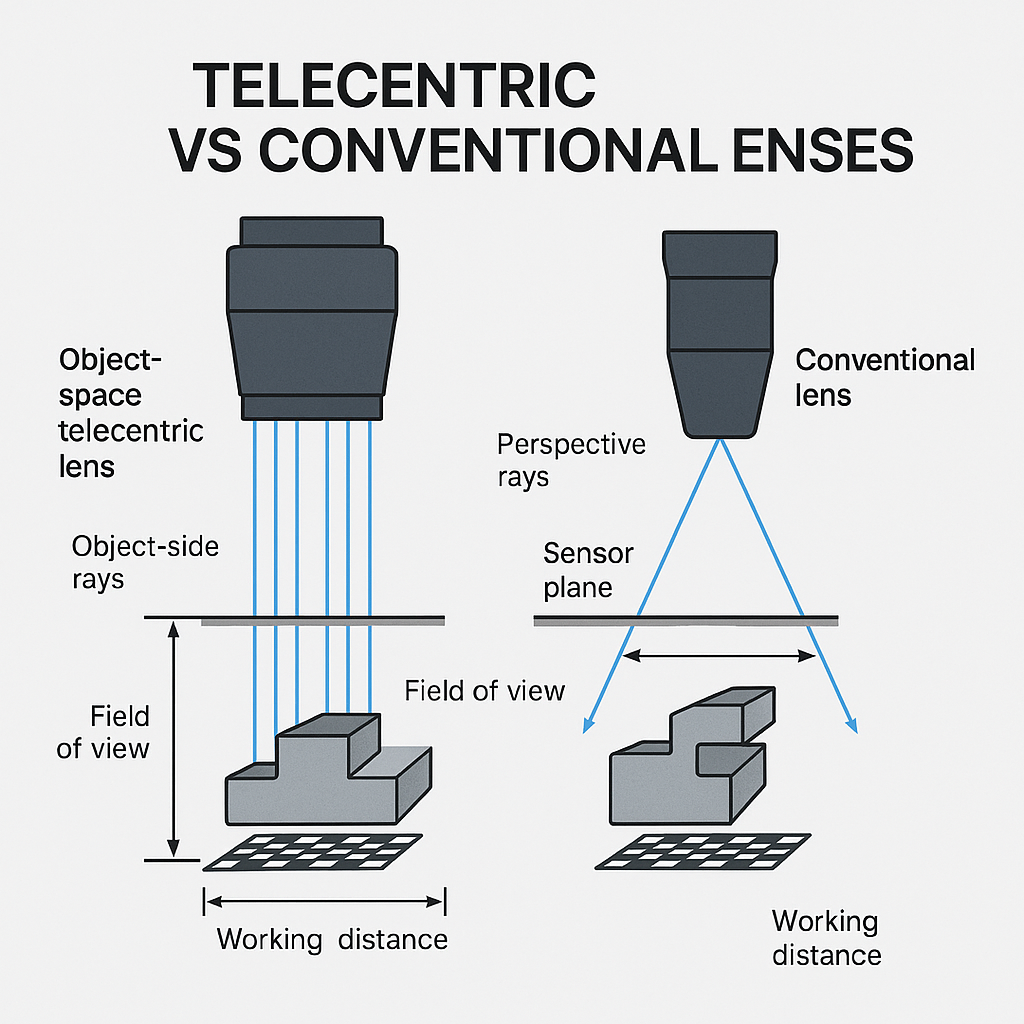
A conventional lens views an object with perspective: features closer to the lens appear at a different scale from otherwise identical features farther away. The verified technical reference from Shanghai Optics states that telecentric designs minimize incoming-ray edge angles, produce low-distortion images, and reduce or eliminate parallax or perspective error relative to conventional lenses. It also identifies object-space, image-space, and bi-telecentric classifications according to aperture placement. See its technical discussion of telecentric lens design.
Object-space, image-space, and bi-telecentricity
Object-space telecentricity is the directly relevant property when an inspection must hold magnification more consistent as object distance changes within the lens’s usable inspection range. Image-space and bi-telecentric lenses are separate classifications; their value should be assessed against the sensor-side and object-side requirements rather than inferred from the word “telecentric” alone.
A buyer should therefore request the applicable telecentricity type, usable object-depth range, field of view, working distance, distortion specification, and test conditions. “Telecentric” without those boundaries is not a complete measurement specification.
Accuracy Trade-Offs: Parallax, Distortion, and Depth Variation
Parallax error in machine vision becomes commercially relevant when an apparent edge or feature location changes because the part sits higher, lower, or off axis. Low distortion does not automatically remove that perspective behavior. Distortion describes how image position departs from the intended mapping under stated conditions; perspective reflects the viewing geometry and object depth.
That distinction sets a limit on software correction. Engineering inference: a calibration map derived from a target at one plane can model repeatable image-coordinate behavior at that condition, but it does not prove that scale remains unchanged for features at other heights. A multi-plane or application-specific model may improve results, yet it also increases validation scope and dependence on stable mechanics.
For depth variation measurement accuracy, test at the minimum and maximum permitted part heights—not only at nominal focus. Include edge positions across the field, representative surface finishes, fixture tolerances, and temperature conditions required by the application. This is a validation recommendation, not a claim that a particular lens will pass.
Telecentric lens accuracy has its greatest potential value where the remaining error allowance is small and object-height variation cannot be removed economically. Examples identified by the verified source include machine vision, inspection, metrology, automotive manufacturing, medical-device production, electronics, and pharmaceutical production. Suitability still depends on the actual uncertainty analysis.
What Conventional Lens Calibration Can—and Cannot—Establish
A defensible conventional lens calibration plan records the lens, camera, focus setting, aperture, working distance, target, target plane, illumination, software version, and acceptance limits. The approved evidence does not provide a universal calibration procedure, so the exact target geometry and model should come from the metrology method, software provider, or system validation plan.
A practical workflow is to capture a traceable or otherwise controlled target, estimate pixel scale and the selected mapping model, calculate residuals, and verify the result using independent images. Engineering inference: moving the fixture, changing focus, replacing optical components, or altering working distance can invalidate assumptions embedded in that model. Recalibration triggers should therefore be written into service documentation.
Consider a simple procurement screen. If a project allows 100 µm of total error and conservatively reserves 60 µm for sensor sampling, edge detection, mechanics, and other contributors, only 40 µm remains for lens- and geometry-related effects. That subtraction is an illustrative allocation—not a statistical uncertainty calculation or a prediction of either lens type. It shows why a lens decision needs a budget before a quotation.
Illumination, Contrast, and Inspection Robustness
The verified source supports telecentric imaging behavior but does not establish that every telecentric lens requires special illumination. Lighting should be treated as a separate, coupled design decision.
For silhouette measurement, evaluate whether the source size, collimation, part thickness, edge profile, and reflections produce a stable threshold. Reflective or low-contrast surfaces may require a different arrangement from opaque backlit parts. Aperture, exposure, motion, and required depth range also belong in the test matrix. No optical architecture eliminates the need to verify contrast on representative parts.
Integration Constraints: Space, Working Distance, and Sensor Fit
Telecentric optics are commonly larger and bulkier, according to the verified source. That affects more than enclosure clearance: the machine design may need adequate mount stiffness, adjustment access, cable clearance, guarding, and support for the lens-camera assembly.
Start with sensor format, active pixels, field of view, working distance, permitted object depth, and available envelope. Superior’s machine vision lens options provide a starting point for standard industrial optics, while this guide to how to select a machine vision lens covers the relationship among field of view, sensor, and distance.
Pixel count alone should not be treated as guaranteed measurement accuracy. The buyer’s acceptance test should examine the complete chain: optical image quality, sampling, edge algorithm, part contrast, mechanics, and calibration residuals under allowed production conditions.
Telecentric Lens Cost vs Total System Cost
The verified technical source identifies higher cost and physical bulk as disadvantages of telecentric lenses, but it provides no universal price ratio. Any fixed claim that telecentric optics cost a particular multiple would therefore be unsupported.
A useful Telecentric vs Conventional Lenses business case separates five cost groups:
- lens, camera, mount, lighting, and enclosure;
- calibration software and engineering;
- validation across field position and object depth;
- production maintenance and field recalibration;
- false rejects, measurement escapes, downtime, and redesign exposure.
Engineering inference: the higher optical expenditure can be justified when it removes enough condition-dependent correction, fixture precision, or recurring validation work. Conversely, a conventional lens can deliver the stronger commercial result when the target is effectively planar, the station is mechanically stable, and its verified residual uncertainty remains comfortably inside the limit.
For OEMs weighing non-recurring engineering against component price and lifecycle control, the related discussion of custom optical lens cost and performance trade-offs provides a broader procurement framework. Its SWIR context should not be treated as telecentric performance evidence.
When Should I Use a Telecentric Lens?
Use telecentric optics as a serious candidate when:
- permitted part-height variation could change apparent dimensions;
- perspective hides or shifts the edge being measured;
- several feature planes must be compared in one view;
- mechanical control of object distance is expensive or impractical;
- repeated calibration and field validation dominate lifecycle cost.
A calibrated conventional lens remains a rational candidate when the object is nearly planar, working distance is fixed, required tolerance leaves adequate margin, and the organization can control recalibration after service. These are decision criteria, not guaranteed outcomes.
At design review, ask one decisive question: has each architecture been evaluated at the worst allowed object position, field position, fixture condition, and lighting condition? A nominal demonstration cannot answer that.
How to Specify the Right Lens Architecture
A useful request for quotation includes sensor make and format, pixel size or resolution, required field of view, working distance, part-height range, smallest feature, measurement tolerance, wavelength, lighting concept, frame or line rate, environmental limits, mounting envelope, production volume, and the required calibration or traceability method.
Standard optical lens assemblies may be appropriate where available formats and mechanics satisfy the requirement. A non-standard field, package, wavelength, mount, illumination interface, or production-volume target may warrant evaluating custom optical assemblies. Customization should follow a quantified gap, not replace requirements definition.
For a lens architecture and total-system-cost review, submit the sensor format, field of view, working distance, object-height variation, measurement tolerance, lighting conditions, mechanical envelope, and expected volume. The recommendation should state its evidence, assumptions, and validation boundaries.
Frequently Asked Questions
Can a conventional lens achieve accurate dimensional measurement after calibration?
Yes, when the object remains close to the calibrated condition and the verified residual uncertainty fits the measurement budget. Calibration can support pixel scaling and a selected correction model, but accuracy must be demonstrated across permitted field positions, fixture states, and object heights. A nominal calibration image alone is insufficient evidence.
Does a telecentric lens eliminate all measurement error?
No. Telecentric optics can reduce perspective or parallax error and object-space designs can maintain more consistent magnification over a usable depth range. Sensor sampling, distortion, focus, edge contrast, mechanics, lighting, software, and calibration can still contribute error. Acceptance testing must cover the assembled system rather than the lens specification alone.
How does object height affect measurements made with a conventional lens?
A conventional lens forms a perspective image, so a feature’s apparent scale can change when its distance from the lens changes. The resulting dimensional effect depends on the optical geometry and feature location. Software correction at one plane does not, by itself, verify measurements at every permitted part height.
Do telecentric lenses require special illumination?
Not in every application, based on the available evidence. The verified source supports telecentric imaging behavior but does not establish a universal lighting requirement. Backlighting, collimation, diffuse lighting, or directional lighting should be selected from the part material, edge geometry, reflections, exposure, and contrast needed by the measurement algorithm.
Can telecentric lenses be used with line-scan cameras?
Compatibility cannot be concluded from the supplied verified source alone. For a line-scan project, provide sensor length, pixel size, scan direction, object speed, field width, working distance, wavelength, object-height range, and mounting envelope. The lens supplier should confirm image coverage, telecentric behavior, resolution, illumination geometry, and operating limits.
Topics
Related Articles
Telecentric Lens Selection for Dimensional Metrology Systems
12 min read
Telecentric Imaging Lens for Automation and Enhanced Operational Efficiency
5 min read