


M12 Catalog vs Custom Lenses: Justifying Development for OEM Cameras
A requirements-based framework for deciding whether an OEM camera needs a catalog, modified-standard or custom M12 lens—and what evidence should support the investment.
Key Takeaways
The M12 Catalog vs Custom Lenses decision should be based on a documented failure against a mandatory camera-system requirement, not a general preference for bespoke optics.
- Use a catalog lens when testing confirms every mandatory optical, mechanical, spectral and lifecycle requirement.
- Treat a modified-standard lens as a controlled engineering change, with its scope, interfaces and revalidation work documented.
- Escalate to custom development only after catalog and modified-standard options fail a measurable requirement.
- Set acceptance limits and test conditions before approving development so prototype performance can be transferred into production inspection.
- Evaluate lifecycle control, tolerances, qualification work and unresolved system costs alongside quoted unit price.
The Short Answer
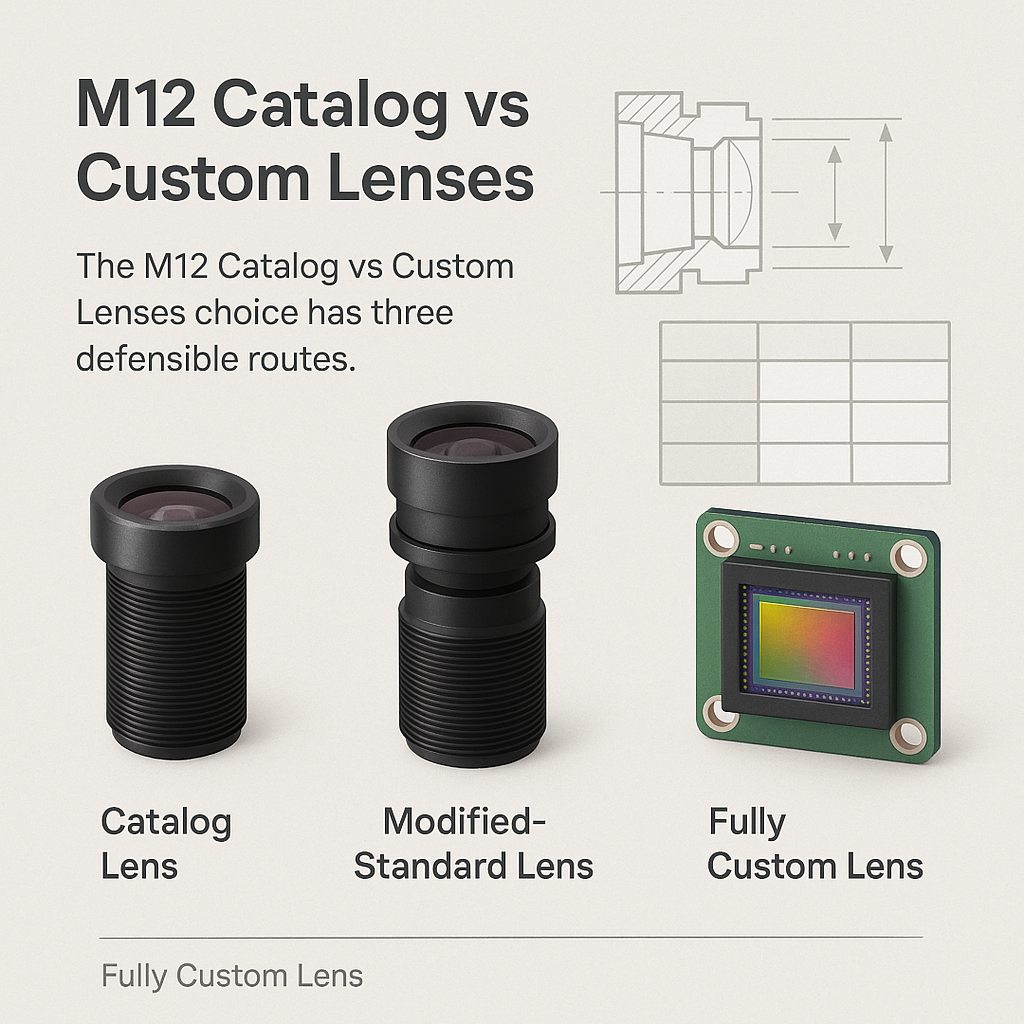
The M12 Catalog vs Custom Lenses choice has three defensible routes. Select a catalog product if it passes every mandatory system requirement under representative test conditions. Choose a modified-standard lens when a bounded change—such as a barrel, lock ring, filter, marking or assembly adjustment—closes the gap without redesigning the optical prescription. Fund a custom design only when measured evidence shows that existing products cannot satisfy an essential aperture, field-of-view, working-distance, spectral, packaging or image-quality requirement. Before approval, define acceptance criteria, development scope, qualification work, production controls and the business cost of leaving the gap unresolved.
M12 identifies an interface, not guaranteed camera performance. According to Commonlands’ M12 technical guide, an M12 or S-mount lens uses an M12 × 0.5 thread, but that interface does not define focal length, sensor coverage or image quality. Thread compatibility is therefore the start of selection, not proof of suitability.
Start With the Requirement Gap, Not a Preference for Customization
Define mandatory versus preferred requirements
A mandatory requirement determines whether the camera can perform its intended function or fit its approved enclosure. Examples include sensor coverage, field of view at the specified working distance, an aperture target, spectral band, maximum distortion, mechanical clearance and environmental limits. Preferred requirements—smaller size, an alternate finish or extra performance margin—should not independently trigger optical redesign.
Each requirement needs a limit, test condition and decision owner. “Good low-light performance” is not an acceptance criterion. The RFQ should identify the illumination and spectral conditions, camera settings, target scene and image metric used to judge it.
Document where the catalog option fails
Test the lens with the intended sensor, holder, cover glass or filter, image pipeline and mechanical stack. M12 lenses are commonly focused by threading them into a holder and locking their position. Holder travel, thread engagement, sensor-plane location and rear-element clearance can determine whether the available focus position is usable.
Record the catalog part number, sample configuration, focus method, test setup and failure. This separates a lens limitation from a holder, assembly or image-processing problem.
Translate the gap into system impact
Connect each failure to a buyer-facing consequence: an enclosure change, rejected images, reduced operating range, added illumination, calibration work or an unsupported lifecycle. This translation is partly a commercial inference; its value must be calculated from the OEM’s own volumes, warranty exposure and redesign costs.
M12 Catalog vs Custom Lenses: Requirements-Based Decision Matrix
Custom development is justified only when a catalog or modified-standard route cannot meet a mandatory, measurable requirement.
| Requirement gap or trigger | Catalog | Modified Standard | Custom | Typical scope | Evidence required |
|---|---|---|---|---|---|
| All mandatory requirements pass | Preferred | Unnecessary | Unnecessary | Qualification only | System test report and supply review |
| Marking, lock ring or bounded barrel change | Check first | Preferred | Rarely justified | Mechanical or assembly change | Interface drawing and validation plan |
| Focus or field adjustment within an existing family | Compare available parts | Possible | Only if still unresolved | Spacing, barrel or related configuration | Sensor-stack data and measured images |
| Aperture or low-light target is missed | Test alternatives | Possible if an existing variant works | Consider | Aperture change or optical redesign | Controlled image results and exposure conditions |
| Visible/IR behavior or coating is unsuitable | Check spectral variants | Often possible | Consider if prescription must change | Filter, coating, glass or optical design | Wavelength band, source and detector response |
| Coverage, distortion, shading or resolution fails | Test qualified alternatives | Limited | Consider | Optical prescription and tolerance work | Field-based image-quality data |
| Back-focus or envelope causes interference | Try compatible holders or parts | Often possible | Consider | Barrel, holder or optical redesign | Mechanical stack-up and CAD envelope |
| Continuity or production control is unsupported | Review sourcing route | Possible with direct control | Consider | Qualification and lifecycle agreement | Forecast, traceability and change-control needs |
Use the table as an escalation gate. If the catalog route passes, development adds avoidable scope. If a modification is proposed, identify exactly what changes and what must be retested. A custom route requires evidence that the less complex options were examined and failed.
Requirements-review CTA: submit the sensor, working distance, field of view, aperture target, mechanical envelope, spectral range, image-quality limits, expected volume and catalog test results for an M12 lens requirements review.
When Catalog M12 Lenses Are the Right OEM Camera Lens Choice
Requirements met without optical redesign
Catalog M12 lenses are appropriate when a listed configuration covers the sensor and passes the application tests without changing its optical prescription or mechanical interfaces. The M12 Catalog vs Custom Lenses review should favor this route when the evidence is complete, even if a bespoke design could offer unused margin.
Benefits of a qualified catalog route
The practical benefit is reduced development scope: the OEM can concentrate on integration and qualification instead of funding a new prescription and its manufacturing controls. This does not guarantee supply continuity. A Sunex sourcing-strategy article distinguishes prototype-friendly sourcing from direct OEM relationships that can offer process control, validation and lifecycle planning; that framework reflects the supplier’s stated approach rather than independent proof for every vendor.
Validation still required
Confirm image-circle coverage, corner response, distortion, relative illumination, focus range and mechanical clearance on the actual camera. Chief-ray-angle compatibility may affect CMOS corner response and color shading. Assembly also matters: a technical article from the Edge AI and Vision Alliance notes that incompatible torque can tilt the image plane and blur part of the image.
When Modified Standard M12 Lenses Can Close the Gap
Common customization options
A modified-standard route may change the barrel, lock ring, external geometry, marking, filter, coating or assembly method while retaining an existing optical design. The supplier must confirm which elements remain unchanged; “modified standard” is a sourcing description, not proof of limited technical impact.
Changes can propagate
A shorter barrel may solve interference but alter accessible focus travel or thread engagement. A filter or coating change may require renewed spectral and image testing. Holder material and dimensional stability can influence focus across temperature, so a mechanical substitution should not be approved from a drawing alone.
Verify that risk remains bounded
Request a change list, interface drawing, optical-impact assessment and validation matrix. Compare prototype samples with the original lens and with the intended production limits. If the modification requires a new optical prescription, broad tolerance redevelopment or extensive new tooling, procurement should reassess whether it is effectively custom M12 lens development.
When to Use Custom Camera Lenses Instead of a Standard M12 Option
Aperture and operating conditions
A custom route becomes credible when no available lens meets a mandatory aperture or image target under controlled operating conditions. The case should include the tested exposure, illumination spectrum, camera settings and acceptance metric. Without those controls, an apparent lens deficiency may be attributable to the sensor or processing pipeline.
Working distance, field of view and distortion
Evaluate these requirements together on the intended sensor. A part that reaches the requested field may still fail distortion or edge-quality limits. Conversely, a catalog result may be acceptable after measurement even when nominal specifications appear marginal. Procurement should use system data rather than focal length alone.
Packaging and back-focus
Keep the M12 × 0.5 interface if it benefits the camera architecture, but verify the full stack: sensor plane, cover glass, holder height, adjustment travel, rear-element clearance and lock method. A custom optical design can retain an M12 thread, yet its internal elements and barrel may be entirely different.
Spectral response and IR focus
An IR-sensitive camera may expose focus or transmission gaps that are not visible in a daylight-only evaluation. Define the wavelength bands, illuminators, filters and whether visible and IR scenes must share one focus setting. Projects with a documented gap can review IR focus and infrared camera lenses as a relevant product path.
Image quality beyond existing designs
Coverage, resolution, contrast, distortion, shading and corner behavior should be evaluated by image field and under stated test conditions. Customization is warranted when a mandatory limit remains unmet after reasonable catalog alternatives, holder corrections and processing options have been assessed.
How to Justify Custom Lens Development for OEM Cameras
Build a quantified case
To explain how to justify custom lens development for OEM cameras, compare the development route with the verified cost of the unresolved gap. Relevant project inputs include enclosure redesign, added illumination, calibration, processing load, field risk, rejected units and lifecycle exposure. These are project-specific estimates, not universal outcomes.
A useful approval statement is: “Existing options fail requirement X under test condition Y; the failure creates system consequence Z; the proposed design will be accepted at limit A.” This M12 Catalog vs Custom Lenses record gives engineering, purchasing and management the same decision basis.
Compare scope with unresolved cost
Separate non-recurring engineering, tooling, samples, qualification and inspection from unit pricing. Then compare those costs with the alternative system change over the expected program volume. For another spectral example, the framework used in custom optical lens design for specialized imaging shows why wavelength requirements belong in the initial route decision.
Fix acceptance criteria before approval
Acceptance criteria should identify the test chart or target, distance, spectrum, illumination, sensor, processing state, focus method, field positions, environmental conditions and sampling plan. Agree which limits apply to prototypes and which become production controls. Otherwise, a promising prototype can be approved without a reproducible purchase specification.
Evaluate Development Scope, Cost Drivers, and Supply-Chain Risk
Separate optical and non-optical changes
Ask whether the project changes the prescription, glass, coating, filter, barrel, holder, assembly process or inspection method. Each category creates different validation work. The broader COTS lenses vs custom lenses cost comparison can support procurement discussions about lifecycle, lead-time and development exposure beyond the M12 format.
Tolerances and manufacturability
Tighter limits can increase manufacturing and inspection demands, but their actual cost effect depends on the design and supplier process. Allocate tolerance only where system analysis shows it is needed. The guide to optical lens tolerances and coating cost explains why coatings, tolerances and verification methods belong in the economic review.
Qualification and change control
Plan explicit gates for feasibility, design review, samples, camera-level testing, pilot production and release. Production approval should establish traceability, approved materials and processes, notification rules, requalification triggers and handling of nonconforming units. A low prototype price does not resolve these lifecycle controls.
Create an RFQ Package for Catalog, Modified, or Custom M12 Lenses
Inputs suppliers need
Include the sensor model and active area, pixel information, cover-glass and filter stack, target field of view, working-distance range, focus method, aperture target, spectral band, mechanical envelope, holder interface, environment, expected volume and regulatory constraints relevant to the camera.
Evidence to request
Ask for drawings, defined optical conditions, sample test data, tolerance assumptions, production acceptance methods and disclosure of any differences between prototype and production construction. The M12 lens specification and RFQ checklist provides a structured path from system inputs to an approved purchase specification.
Decision gates
Gate one asks whether a catalog part passes. Gate two determines whether a bounded modification closes the documented gap. Gate three approves custom development only with measurable acceptance criteria and a viable production-control plan. At every gate, retain the test evidence and rejected alternatives.
RFQ CTA: request an M12 lens requirements review with the sensor, target geometry, aperture or low-light target, spectral range, mechanical stack, image-quality criteria, volume forecast and existing test results. The objective is to select the lowest-risk viable route, not to presume customization.
Frequently Asked Questions
Can an M12 lens keep the same thread interface while using a custom optical design?
Yes. The M12 × 0.5 thread defines the mechanical interface, not the internal optical prescription. A custom lens can retain that thread while changing elements, spacing, aperture, coatings or barrel geometry. The OEM must still verify rear-element clearance, focus travel, thread engagement, sensor coverage and holder compatibility.
What information should an OEM provide before requesting a modified standard M12 lens?
Provide the sensor and stack, field of view, working distance, focus method, aperture target, spectral range, mechanical envelope, environment, image-quality limits, expected volume and catalog test results. Identify the failed requirement and proposed modification. This lets the supplier judge whether the change remains bounded or requires optical redesign.
How should camera manufacturers compare prototype results with production acceptance criteria?
Use the same defined sensor, processing state, target, distance, illumination, spectrum, focus method and field positions. Prototype data should be reported against numerical limits intended for production, while distinguishing design characterization from lot inspection. Also document sampling, measurement uncertainty, allowed adjustments and treatment of nonconforming units.
Can an IR-sensitive camera require a different M12 lens approach than a visible-light camera?
Yes. A lens suitable for visible imaging may not meet the camera’s transmission, coating or focus requirements in its infrared band. Specify wavelengths, illuminators, filters and whether visible and IR operation must share a focus setting. Test both modes on the intended sensor before choosing catalog, modified or custom optics.
What should be included in an M12 lens change-control plan after production approval?
Include the approved drawing, optical and material specifications, critical processes, inspection methods, traceability rules and notification periods. Define which changes require OEM consent or requalification, including glass, coatings, filters, tooling, assembly sites and test equipment. The plan should also address deviations, nonconforming product and lifecycle discontinuation notices.
Topics
Related Articles
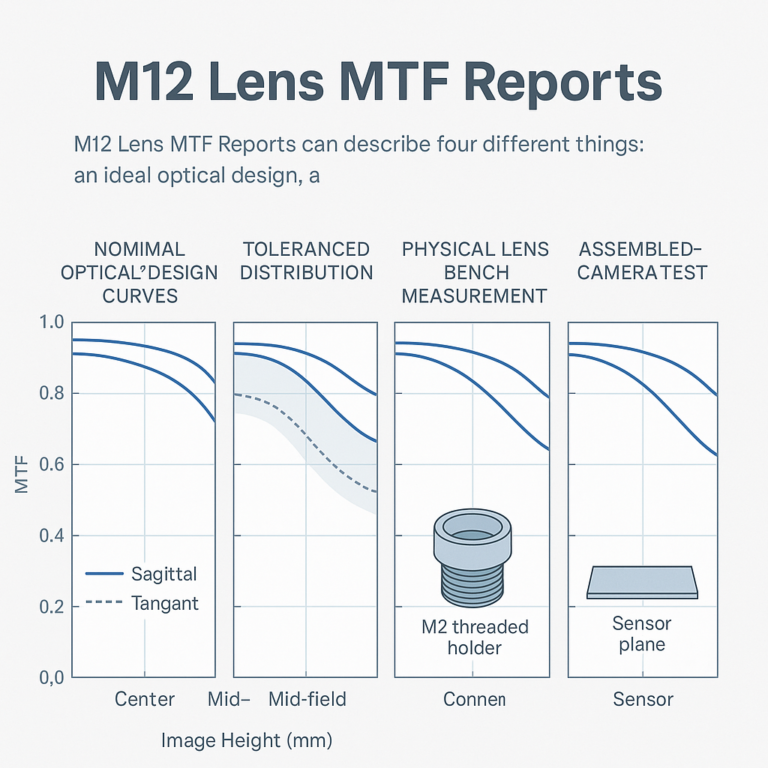
M12 Lens MTF Reports: Comparing Nominal, Toleranced, and Measured Data
10 min read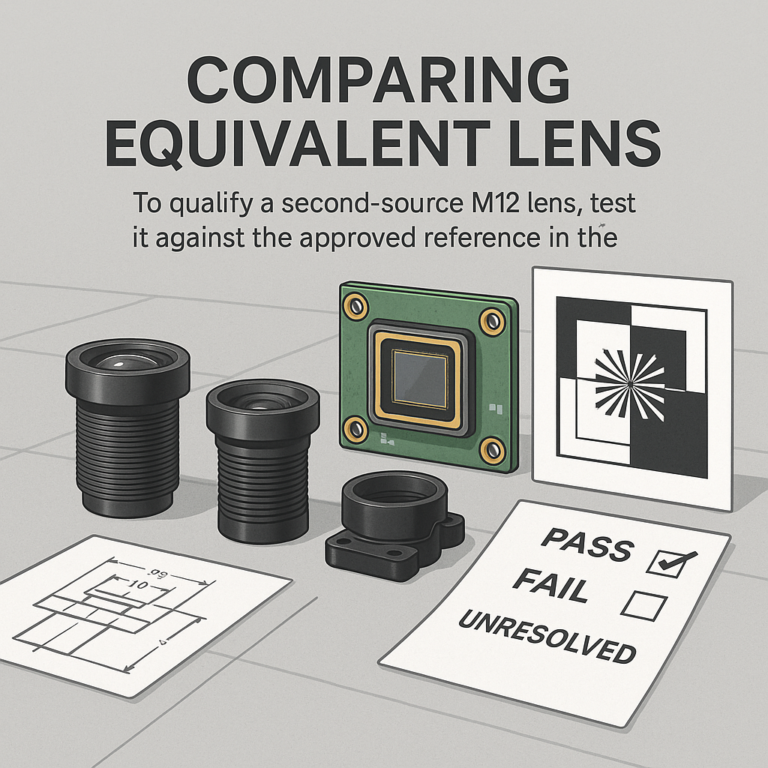
M12 Sample Approval and Second Sources: Comparing Equivalent Lenses
10 min read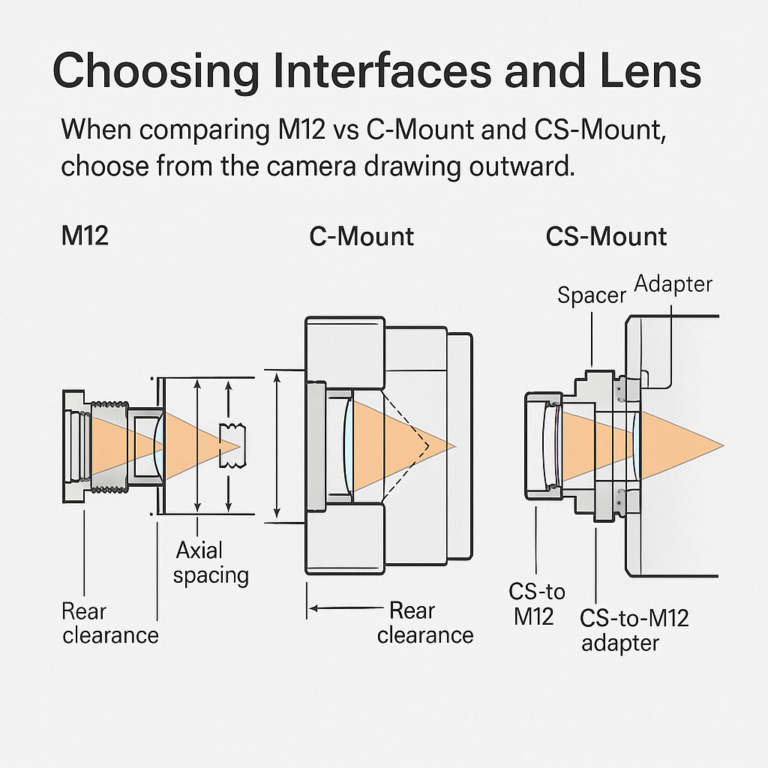
M12 vs C-Mount and CS-Mount: Choosing Interfaces and Lens Adapters
10 min readAbout SUPERIOR OPTICS
SUPERIOR OPTICS specializes in CCTV lenses, machine vision optics, and custom optical solutions for security, industrial imaging, and specialty applications. We also provide professional lens selection and application support.