Optical Supply Chain Risk: Dual Sourcing and OEM Change Control
A buyer-focused framework for qualifying alternate optical sources, controlling supplier changes, planning long-lead inventory and managing component discontinuation.
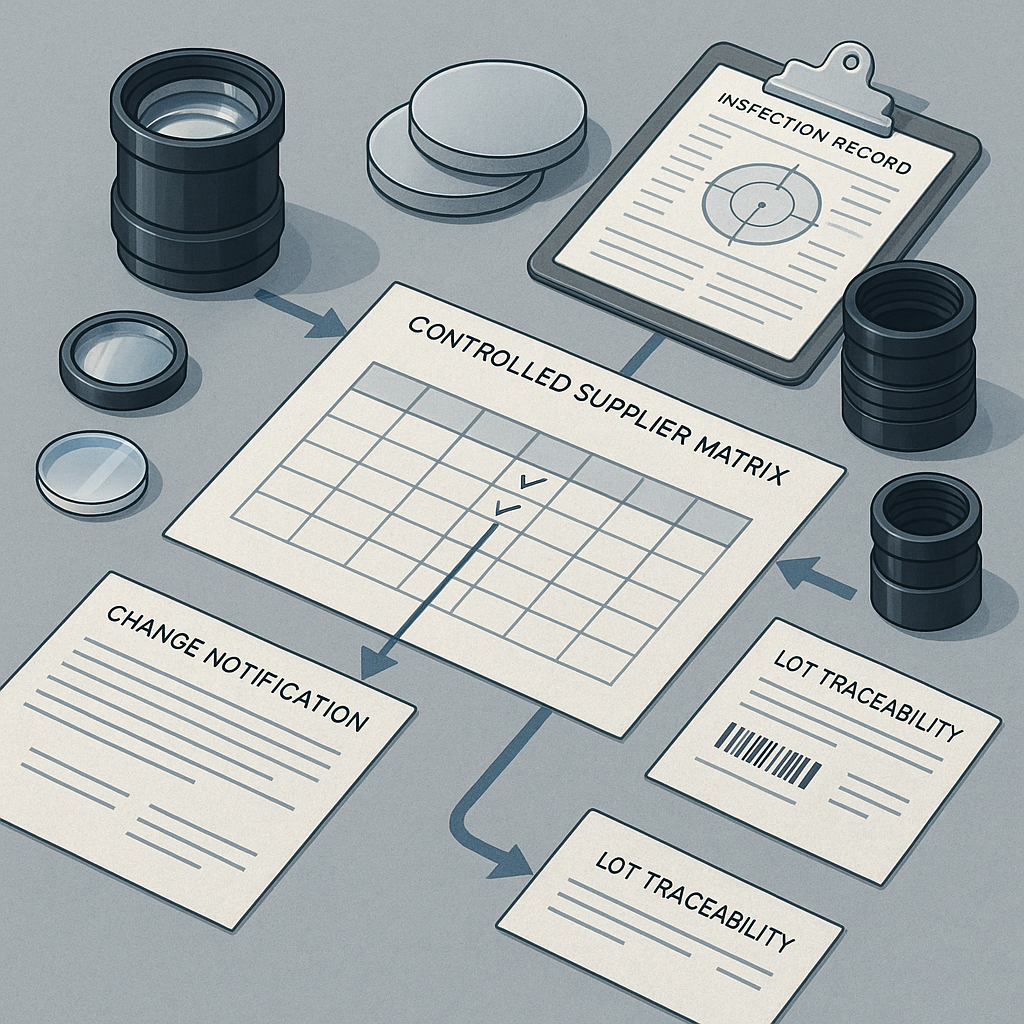
Key Takeaways
Optical Supply Chain Risk is best managed by controlling the product configuration, qualifying alternatives before a shortage, and connecting procurement decisions to engineering evidence.
- Map the actual manufacturing sites, glass, coatings, mechanics and test dependencies behind every approved lens or assembly.
- Distinguish truly interchangeable parts from controlled equivalents that require system-level validation.
- Complete second-source qualification with production-representative samples, lot controls and commercial continuity terms.
- Require written approval before suppliers change materials, processes, facilities, assembly methods or acceptance tests.
- Base safety stock, lifecycle reviews and last-time-buy decisions on replenishment exposure and validated redesign time.
The Short Answer
OEMs reduce optical sourcing exposure by establishing a controlled configuration baseline, mapping dependencies below the finished lens, and qualifying alternate sources before disruption occurs. Dual sourcing is useful only when both sources meet the same measurable system requirements. Written change notification should cover materials, coatings, facilities, assembly processes and test methods. Long-lead items need demand visibility and risk-based inventory, while golden samples, lot records and retained data help identify drift. Discontinued components require an explicit last-time-buy, requalification or redesign decision rather than an informal substitution.
Optical Supply Chain Risk is the possibility that supplier dependence, material lead times, coating constraints, process changes, lot variation or discontinuation will interrupt an OEM program. The practical response is not simply to add vendors. Buyers need qualified alternatives, controlled specifications, traceable evidence and predetermined escalation rules.
Optical Supply Chain Risk-Mitigation Table
| Supply Chain Risk | Typical OEM Impact | Recommended Control | Evidence or Record to Maintain | When to Escalate |
|---|---|---|---|---|
| Single-source lens or assembly | Production interruption and weak recovery options | Qualify another source or document a continuity plan | Approved-source matrix, qualification report, supply agreement | Capacity, financial or delivery risk rises |
| Long glass lead time | Delayed builds and customer commitments | Forecast releases, risk-based stock and assessed alternatives | Lead-time tracker, inventory rule, material assessment | Lead time exceeds the planning window |
| Coating constraint | Requalification or unavailable product configuration | Control the coating specification and assess another route early | Coating specification, validation data, approved-process list | Material, process or coating facility changes |
| Undocumented process change | Unplanned optical or mechanical variation | Require written notification and approval | Change agreement, deviations, revision history | Material, geometry, assembly or test changes |
| Batch variation | Image-quality drift, fit problems or inconsistent output | Measurable acceptance limits, lot traceability and references | Inspection data, golden-sample log, lot records | Trends approach or exceed limits |
| Discontinuation | Last-time-buy exposure, redesign or service shortage | Maintain lifecycle reviews and an approved exit plan | End-of-life notice, lifecycle register, inventory plan | Support is reduced or withdrawn |
Why Optical Supply Chain Risk Is Different for OEM Programs
A purchased lens may depend on a specific optical prescription, glass route, coating process, machined barrel, adhesive, assembly facility and test setup. A second distributor for the same finished part does not remove risk if both channels ultimately depend on one manufacturer or site. General supply-chain guidance similarly recommends mapping dependencies beyond the immediate vendor to expose hidden single points of failure, as described in this vendor supply-chain risk playbook.
Fit is only one acceptance condition. A replacement can mount correctly yet still require validation against the OEM’s image-quality, spectral, environmental or mechanical requirements. The operative question is therefore not “Can purchasing obtain it?” but “Does the approved evidence show that the system remains compliant?”
Discontinuation creates a different failure mode. An optics-industry source notes that buyers may first search for equivalent components, including parts sold under different identifiers, before committing to redesign. It also identifies second sourcing and supplier-held inventory as possible responses to availability problems. Those are options, not proof of interchangeability; drawings and validation still govern. See the discussion of optical-component availability and alternative sourcing.
Identify the Highest-Risk Optical Components Before a Disruption
Start with the finished product and trace downward. For each lens or assembly, record the approved supplier, actual manufacturing site, critical materials, coating source, mechanical subcomponents, tooling ownership, test location and known alternates. Mapping CCTV lens and machine vision lens options at product level helps reveal where several sellable configurations rely on one underlying source.
A useful classification uses three dimensions:
- Technical uniqueness: Is the item catalog-standard, modified standard or built to a controlled custom design?
- Exposure: Does replenishment fit inside the OEM’s reliable planning window, and is confirmed capacity available?
- Replacement difficulty: Can another part be approved by document review, or are new samples, tooling, system tests or regulatory work required?
Assign an owner as well as a rating. Procurement tracks supply and commercial signals; engineering owns equivalence; quality controls evidence and deviations; operations owns build impact and inventory disposition. One named decision owner should resolve conflicts during a shortage.
Build a Dual Sourcing Optics Strategy That Protects Performance
Dual sourcing is most practical when the requirement package is complete, tests are transferable and annual demand justifies maintaining two qualified routes. It is harder when the product depends on supplier-owned design details, dedicated tooling, proprietary processes or volumes too low to sustain both sources.
The distinction between COTS vs custom optical lenses changes the sourcing decision. A catalog part may offer more replacement candidates, but its lifecycle and revision control may remain supplier-led. A custom design gives the OEM more configuration authority only if design rights, tooling access, specifications and test methods are contractually available.
Two approval classes prevent ambiguity:
- Interchangeable: Either approved part may be used without changing the OEM part number or build instruction.
- Controlled equivalent: The alternative meets an agreed purpose but requires a source-specific part number, bill-of-material revision, validation route or customer approval.
Optical Supply Chain Risk can increase when a nominal second source is approved on dimensions alone. For example, if supplier B meets the barrel drawing but uses another material or coating route, treat the build as controlled-equivalent until the specified optical, environmental and lot criteria are passed. This is an engineering inference from configuration-control principles, not evidence that every process difference changes performance.
How Do OEMs Qualify a Second Source for Optical Components?
- Freeze the baseline. Release the drawing, bill of materials, optical and mechanical requirements, approved materials, test methods, packaging and revision status.
- Compare capabilities. Review the candidate’s material route, geometry controls, coating and assembly processes, metrology, capacity, traceability and subcontracted operations.
- Inspect first articles. Check documentation, dimensions, workmanship and specified optical characteristics before a system build.
- Run a pilot build. Use production-intent processes and samples from a traceable lot, not hand-selected demonstration pieces.
- Validate the system. Test mechanical fit, image quality, environmental requirements and interfaces under the OEM’s released protocol.
- Close commercial controls. Agree on capacity, lead-time communication, continuity responsibilities, change notification, end-of-life notice and record retention.
A broader optical component second-source qualification should also examine quality-system execution and whether the supplier can reproduce the approved configuration over successive lots. Approval remains conditional until technical and commercial controls are both closed.
Use OEM Change Control to Prevent Unapproved Optical Changes
The supply agreement or quality agreement should identify changes requiring advance notice and written disposition. The controlled list commonly includes glass or material source, optical prescription, coating material or process, manufacturing site, tooling, adhesives, assembly sequence, cleaning method, inspection equipment, sampling plan and acceptance method.
An optical supplier change notification should state:
- the affected supplier and OEM part numbers;
- the current and proposed configurations;
- the reason for change and intended effective date;
- affected lots, orders and inventory;
- the supplier’s comparison or validation evidence;
- proposed first-article, pilot or requalification activity;
- last-order and last-ship dates when applicable.
Silence must not mean approval. Set response owners, review deadlines and disposition choices: approve, reject, request evidence, qualify under a new revision, or authorize a temporary deviation. Emergency deviations need an expiry date, quantity limit, traceability rule and plan for returning to the released baseline.
Mitigate Optical Glass Lead Time and Coating Availability Risk
Demand visibility is the first control. Share forecast ranges separately from firm releases, identify the planning horizon and compare it with current replenishment exposure. The discussion of custom optical lenses lead-time tradeoffs explains why custom configurations may require different planning decisions from stocked catalog products.
Required coverage = expected demand during replenishment + risk buffer − confirmed usable supply.
Set the buffer from demand variability, supplier performance, replacement time, shelf-life or storage constraints, and the cost of a stopped build. Hold material or components when they can serve multiple configurations and remain usable after downstream changes. Hold finished assemblies when final build capacity is itself the bottleneck or immediate service replacement is required.
For alternate glass or coating routes, assess options before allocation occurs. Engineering inference: matching a few catalog properties does not establish drop-in equivalence because the released optical design and system acceptance criteria determine sensitivity. The decision may range from document review to prescription adjustment and full requalification.
Coating availability planning should preserve the actual requirement—such as the released spectral, durability and cosmetic criteria—rather than a supplier’s marketing name. If a route disappears, compare the alternative against those controlled limits and verify the manufacturing facility as part of approval.
Control Batch Variation With Golden Samples and Acceptance Criteria
A golden sample is a physical reference, not a substitute for a specification. Identify it by part number, revision, serial or lot, approval date, storage location and permitted use. Separate references may be needed for mechanical fit, cosmetic workmanship and system image quality because one sample cannot define every measurable limit.
Incoming and production acceptance should rely on released criteria. Depending on the program, these may cover dimensions, centering, distortion, transmission, coating condition, focus position or system-level image measures. The selected tests must match the product requirement; the overview of optical lens quality control methods provides additional context for building an inspection plan.
Retain lot identity for critical glass, coatings, purchased mechanics and completed assemblies. Trend results rather than waiting for outright rejection. When drift appears, compare the affected lot with retained data and approved references, then check whether any material, site, equipment or process change occurred.
Create a Long-Term Optical Configuration Management Plan
The controlled record should connect the approved manufacturer list to each part revision and manufacturing site. Preserve design files, drawings, bills of materials, material and coating specifications, test methods, acceptance limits, qualification reports, deviations, change notices, tooling records and approved reference-sample status.
A complete package also improves sourcing efficiency. The custom optical assemblies RFQ requirements can be used to check whether a new supplier receives enough controlled information to quote the same requirement rather than an assumed substitute.
Review high-exposure items more often than stable, replaceable parts. Trigger an additional review after delivery deterioration, facility changes, mergers, tooling problems, capacity constraints, material notices or product-roadmap changes. The output should be a dated action: retain, qualify another source, increase coverage, negotiate continuity terms, redesign or execute a last-time buy.
Optical Supply Chain Risk-Mitigation Checklist for OEM Buyers
During an active constraint
- Freeze unauthorized substitutions and identify affected orders, lots and customers.
- Confirm on-hand, work-in-process and in-transit inventory by configuration.
- Compare recovery time for allocation, alternate qualification, last-time buy and redesign.
- Route temporary deviations through engineering and quality, with quantity and expiry limits.
For qualified production programs
- Reconcile the approved-source matrix with actual purchase and receiving records.
- Review lead times, capacity signals, lifecycle notices and open supplier changes.
- Audit golden-sample status, lot traceability and acceptance-data trends.
- Recalculate inventory coverage when demand or replenishment assumptions change.
For strategic assemblies
- Secure design data, tooling rights and transferable test methods where commercially feasible.
- Pre-assess alternate materials, coating routes and manufacturing sites.
- Align last-time-buy coverage with production and service obligations.
- Budget requalification before the incumbent source becomes unavailable.
OEM buyers, security integrators, machine builders and optical engineers can request an optical supply-risk review for a CCTV lens, machine vision lens, automotive lens or custom optical assembly program. The useful starting package is the current drawing, forecast, approved-source list, open change notices and known lifecycle constraints.
Frequently Asked Questions
What information should an OEM keep in a controlled optical configuration record?
Keep the approved drawing, optical prescription where ownership permits, bill of materials, material and coating specifications, manufacturing site, test methods, acceptance limits and revision history. Add qualification reports, approved deviations, change notices, tooling ownership, reference-sample records and links between supplier part numbers and the OEM’s released numbers.
When should an OEM hold safety stock for optical components rather than finished lens assemblies?
Hold components when they serve several configurations, have longer replenishment exposure than final assembly, and can be stored without creating usability problems. Finished assemblies are more appropriate when assembly capacity is constrained, immediate service demand matters, or component inventory cannot be converted quickly. Model both options against obsolescence and redesign risk.
Can an alternate optical glass material be approved without redesigning the entire lens?
Possibly, but approval depends on the released design and its sensitivity to the changed material. Matching selected catalog properties alone does not demonstrate equivalence. Engineering should evaluate the prescription, tolerances, coating compatibility and system criteria, then determine whether document review, sample testing, prescription adjustment or full requalification is required.
What should be included in a supplier last-time-buy notification for an optical component?
The notice should identify affected part numbers, current revision, reason for discontinuation, final order and shipment dates, available capacity, minimum-order constraints and remaining inventory. It should also disclose relevant material or tooling limitations, recommended replacements, data-retention arrangements and whether service or quality support will continue after the final shipment.
How often should OEMs review optical supplier and material lifecycle risk?
Use a risk-based schedule rather than one universal interval. High-exposure, sole-source or long-replenishment items may justify quarterly review, while stable and readily replaceable parts can be reviewed less often. Reassess immediately after lifecycle notices, facility changes, delivery deterioration, ownership changes, demand shifts or revisions to the OEM product roadmap.
Topics
Related Articles
Better CCTV Lenses: High Resolution, Wide Angle, and More for Improved Surveillance
6 min read
Choose One of the Best CCTV Lens Manufacturers
7 min read