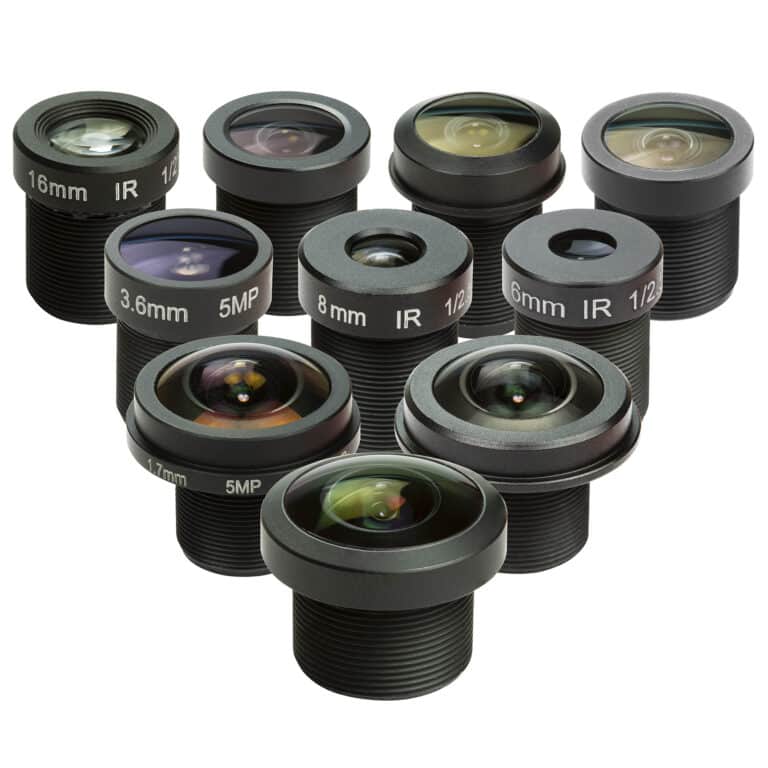
Custom Lens RFQ Checklist: Requirements OEM Buyers Must Define
A buyer-focused checklist for defining lens performance, integration constraints, volumes, schedules and acceptance criteria before requesting a custom quotation.
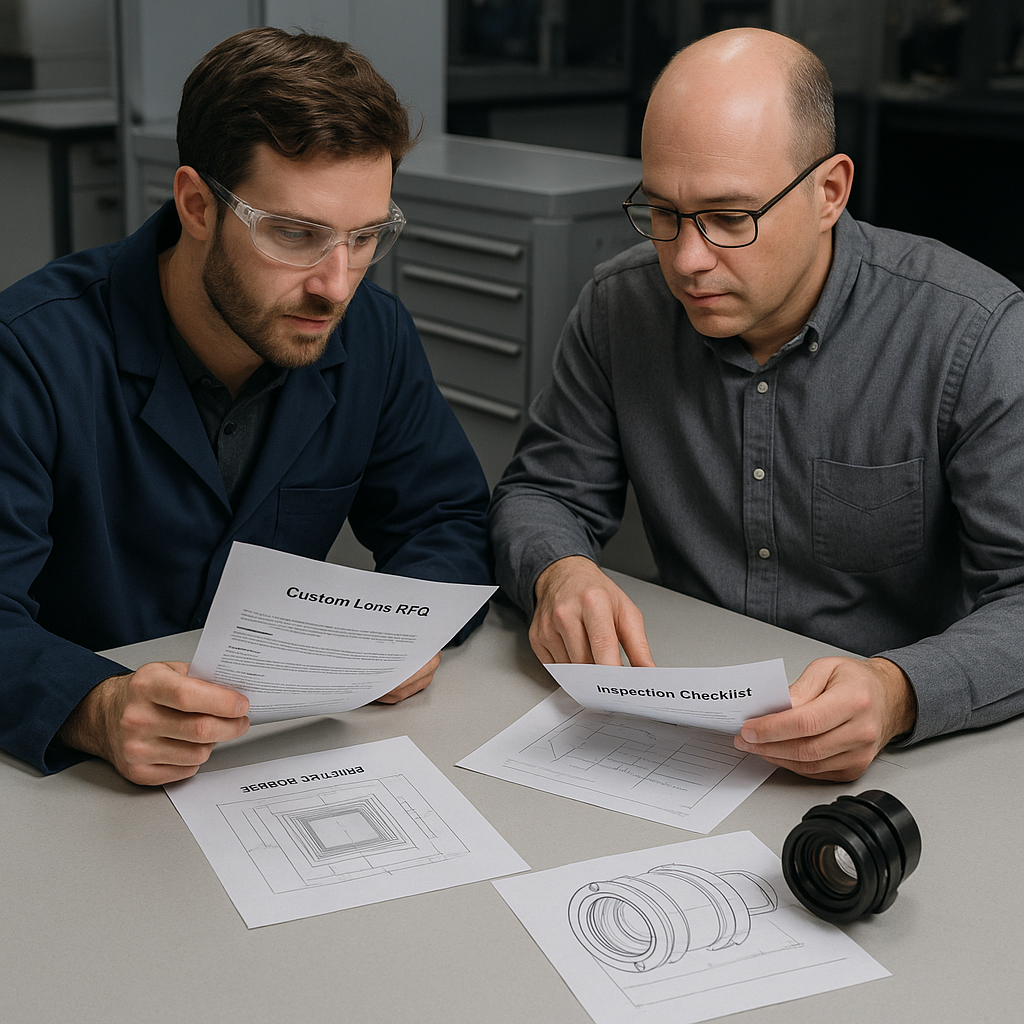
Key Takeaways
A dependable Custom Lens RFQ Checklist connects the required imaging result to optical, mechanical, environmental, commercial and validation inputs.
- Define the sensor, target, field of view, working distance and illumination together instead of specifying focal length alone.
- Label each requirement as mandatory, target, preferred or open so suppliers can evaluate practical trade-offs.
- Provide the mechanical envelope, mount, flange relationship and reference files before requesting firm tooling or delivery commitments.
- State prototype quantities, production forecasts, cost assumptions and design ownership because each changes the quotation basis.
- Set measurable acceptance criteria, test ownership and change-control gates before prototype work begins.
A Custom Lens RFQ Checklist should explain what the complete imaging system must accomplish. A request for a focal length or resolution alone leaves the supplier to infer the scene, sensor, illumination, packaging and test method—and different suppliers may price different interpretations.
Related reading: COTS vs Custom Optical Lenses.
What Information Is Needed for a Custom Lens RFQ?
Buyers do not need a finished optical prescription to start a quotation. They do need enough information to distinguish a modified standard lens, a build-to-print component and a design-to-spec assembly. These sourcing paths assign design, tooling and metrology responsibilities differently, as outlined in the RP Photonics custom-optics purchasing guide.
Custom Lens RFQ Checklist: quick-use summary
- Application, target object and intended imaging result
- Camera, sensor, pixel, interface and illumination information
- Field of view, working distance, focal length and focus range
- Image-quality, wavelength, aperture and coating requirements
- Mechanical envelope, mount and assembly interfaces
- Environmental, reliability and compliance conditions
- Prototype volume, production forecast, target cost and schedule
- Validation criteria, drawings, CAD files and reference samples
| Requirement Category | Information to Provide | Why the Manufacturer Needs It | Priority or Status |
|---|---|---|---|
| Application and use case | Target, scene and imaging task | Establishes the performance objective | Must/target/open |
| Camera and sensor | Format, active area, pixels and cover glass | Defines coverage and sampling conditions | Must confirm |
| Optical performance | FOV, distance, focus, aperture and wavelength | Guides design and trade-offs | Rank priorities |
| Mechanical constraints | Envelope, mount, flange and clearances | Determines physical integration | Hard limit/target |
| Environment | Temperature, shock, moisture and contaminants | Informs materials and qualification | State test basis |
| Prototype and volume | Samples, annual quantity and forecast | Supports process and cost planning | Estimate/range |
| Commercial needs | Target cost, tooling and delivery dates | Establishes quotation assumptions | Required date |
| Validation | Metrics, thresholds and test setup | Defines acceptance and reporting | Owner/status |
| Supporting files | Drawings, CAD, images and samples | Reduces interpretation risk | Attached/pending |
Open requirements need not prevent a feasibility discussion, but they reduce confidence in price and schedule. A budgetary quotation should list unresolved assumptions rather than present them as approved specifications.
Define the Application and Imaging Task
Name the end product, target and required result. “Security camera lens” is too broad: the system might need to identify a face, detect motion, read a code or monitor an area. For inspection equipment, specify the smallest relevant feature and how far the object may move or rotate.
Provide minimum, nominal and maximum working distances; the required horizontal, vertical or diagonal field of view; camera orientation; and every window, dome or cover in the optical path. For a replacement lens, include the existing drawing or sample and explain the failure mode. Fit compatibility and equivalent image performance are separate requirements.
Camera data should cover the sensor model when it can be disclosed, active area, resolution, pixel size, frame rate, interface and image processing used during evaluation. Identify whether illumination is daylight, controlled visible light, near-infrared or another defined band. OEM imaging RFQ guidance similarly connects application, lighting, field of view, mechanics, quantity and sample validation. Because that source concerns camera modules, it supports the RFQ process rather than a specific lens-manufacturing claim.
Specify Optical Performance
Geometry, coverage and focus
Give the required field of view at a stated working distance. Focal length may be a target, but it cannot replace scene geometry. Sensor format, active image area and allowable corner shading determine the image-circle requirement. Pixel size and the smallest feature of interest help establish whether higher optical resolution would improve the system result.
For machine vision lens requirements, include magnification or object-space coverage, focus range, depth-of-field needs and allowable perspective error. State whether focus is fixed, manual, motorized or expected to follow a moving target.
For example, “8 mm, high resolution” does not define a testable scene. “Cover 240 mm horizontally at a 300 mm nominal working distance on the specified sensor, with target movement of ±20 mm” does. The final focal length will still depend on the sensor and distortion limits.
Aperture, spectrum and image quality
State the required F-number or throughput objective, exposure limits and expected illumination range. If the aperture is adjustable, identify whether control is manual or actuated. A lower F-number is not always the best trade-off: depth of field, aberration correction, package size and cost also matter.
Define wavelength bands, source spectra, sensor filters and day/night operation. For optical component sourcing for infrared camera lenses, identify the actual infrared band and whether visible-to-IR focus shift will be tested. A coating request should state the spectral band, relevant incidence conditions and required verification record.
Rank center and edge resolution, distortion, relative illumination, chromatic performance, flare and chief-ray behavior. The Custom Lens RFQ Checklist should show which thresholds are mandatory. The RP Photonics guide notes that unnecessarily restrictive tolerances can increase custom-optics cost, so drawing limits should be tied to system performance.
Document Mechanical and Integration Limits
Specify maximum diameter, installed length or total track, weight, keep-out zones and moving-part clearances. Include mount type, thread designation, thread engagement, flange reference, back-focus limits and clocking requirements. “M12” alone does not define the thread tolerance, shoulder position or relationship to the sensor.
Describe housing and retention requirements, material restrictions and locking methods. Clarify whether the deliverable is a loose lens, housed lens or aligned camera assembly. Supply dimensioned drawings and neutral CAD files where possible, along with mating camera modules, windows or reference hardware.
Hard envelope limits should be settled before detailed design when feasible. Otherwise, an optically viable prescription may not fit the product. Nonfunctional housing details can remain open if that gives the supplier room to improve cost or manufacturability.
Define Environmental and Compliance Conditions
List operating and storage temperatures separately. Include dwell times, ramp assumptions and whether image performance must be measured during exposure or only afterward. Describe vibration, shock, humidity, dust, water, salt, cleaning agents, oils and other chemical exposure using the product’s test method where one exists.
For automotive lens requirements, identify vehicle position, thermal cycling, vibration, contamination, documentation and the applicable customer qualification plan. The word “automotive” does not define those conditions. The same caution applies to outdoor security, factory automation and mobile equipment.
Also identify stray-light sources, reflective surfaces and protective windows. Name required restricted-material or regulatory documentation explicitly, including the intended market or customer submission package.
Set the OEM Lens Quotation Basis
Provide prototype and pilot quantities, expected annual volume, lifetime forecast and a plausible demand range. These figures affect whether modified stock, custom tooling or dedicated fixtures make commercial sense. The RP Photonics guide notes that engineering, tooling and metrology setup can materially affect low-volume custom-optics cost.
Pair any target unit price with volume and inclusions. State whether it covers tooling, qualification, packaging, assembly, freight or amortized engineering. Keep prototype charges, non-recurring engineering and recurring production price separate.
Include the quotation due date, prototype need date and production launch window. Assign responsibility for optical design, mechanical design, test samples, validation and final assembly. The Custom Lens RFQ Checklist should also identify ownership of buyer-supplied drawings, controls for confidential files and changes that require written approval.
State How the Lens Will Be Validated
Replace adjectives with testable criteria. “Low distortion” needs a metric, field region and limit. “Sharp corners” needs a target, sensor, focus condition and evaluation method. If formal metrology is required, request the specific output—such as a dimensional report, coating data or interferogram—instead of asking for an undefined “full report.”
Document the camera body, sensor settings, illumination, target distance, temperature and image-processing state used for prototype testing. Name the test owner and pass-fail authority. Approval should not depend on images viewed on an unspecified display or processed with different software.
Use gates for feasibility, design review, prototype release, validation and production approval. When a requirement changes, record the revision, reason and effects on cost, schedule and revalidation. This keeps an accepted prototype from being judged later against a requirement introduced after it was built.
Build the Optical Lens Specification Sheet
The RFQ package should contain a revision-controlled specification, completed Custom Lens RFQ Checklist, system layout, mechanical drawing, CAD model, sensor data, representative images and relevant reference hardware. This optical lens specification sheet guidance can help buyers confirm terminology before setting values.
Mark each requirement as mandatory, target, preferred or open for supplier proposal. Maintain an assumptions register for unresolved inputs and identify who can close each item. This makes trade-offs visible instead of giving every line equal weight.
Engineering and sourcing should answer three questions before release: What result must the product deliver? Which limits cannot move? Which values may be traded for price, size, schedule or manufacturability?
Avoid Common Custom Optics RFQ Errors
Frequent problems include omitting sensor or field-of-view data, treating preferences as hard limits and leaving out production volume. Changing the target distance, enclosure or illumination after prototype release is equally consequential because it can invalidate the original design and test basis.
Do not ask a supplier to guarantee system-level performance while withholding the camera, processing settings or test method. Record quotation assumptions and resolve them before authorizing tooling or production material.
Review the Custom Lens RFQ Checklist Before Submission
Complete a cross-functional review of the application, optics, mechanics, environment, commercial basis and validation plan. Confirm that all drawings use the same revision and that units, tolerances and priority labels are unambiguous.
If the scene is defined but the prescription or architecture remains open, request custom lens requirements and optical design support before seeking a fixed production price. A complete Custom Lens RFQ Checklist cannot guarantee feasibility, cost or lead time. It gives suppliers a shared quotation basis and exposes exceptions before prototype spending begins.
Frequently Asked Questions
Can a manufacturer provide an OEM lens quotation if some requirements are still unknown?
Yes, but it will usually be a feasibility discussion or budgetary quotation based on stated assumptions. Identify every open item, its owner and the date it should be resolved. A firm production quotation generally requires confirmed performance, mechanical, volume, validation and responsibility boundaries.
Should an OEM buyer submit a target price with a custom lens RFQ?
Yes, when the target is tied to annual volume, forecast duration and inclusions such as tooling, assembly, testing and packaging. It helps suppliers compare modified-stock and fully custom options. Keep prototype charges, non-recurring engineering and recurring production prices separate.
When should a buyer provide a sample lens, camera module or mechanical reference part?
Provide references when drawings cannot adequately capture fit, image appearance or replacement compatibility. Samples can reveal interfaces and failure modes, but they do not replace written acceptance criteria. Label each item, record its revision and state whether the supplier may disassemble it.
How should buyers communicate requirement changes after an RFQ has been submitted?
Issue a numbered revision identifying the changed requirement, reason, effective date and affected files. Ask the supplier to confirm effects on feasibility, tooling, price, schedule and completed validation. Written authorization should reference the controlled specification before design or purchasing work continues.
What is the difference between a budgetary custom lens quote and a production quotation?
A budgetary quote supports early planning and usually relies on assumptions, estimated volumes and incomplete design information. A production quotation should define the deliverable, revision, quantities, tooling, recurring price, schedule, validation and commercial terms. In either document, ask the supplier to list exclusions and unresolved dependencies.
Topics
Related Articles
Choosing the Right Surveillance Camera Lens for Optimal Security Coverage
11 min read