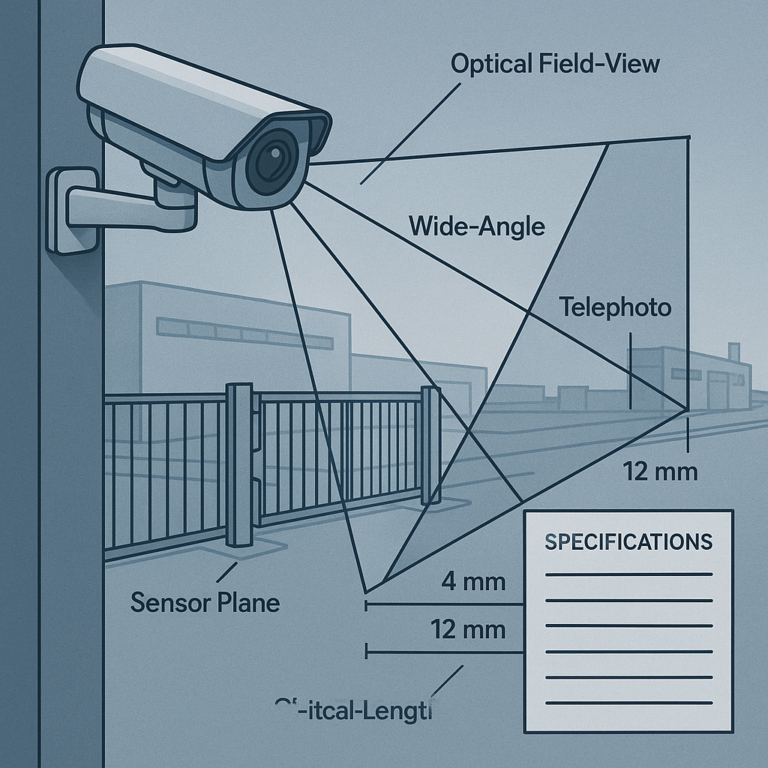
Custom Lens Development: From Feasibility to Mass Production
A buyer-focused guide to the engineering gates, deliverables, approvals and change risks involved in moving a custom lens from requirements review into controlled production.
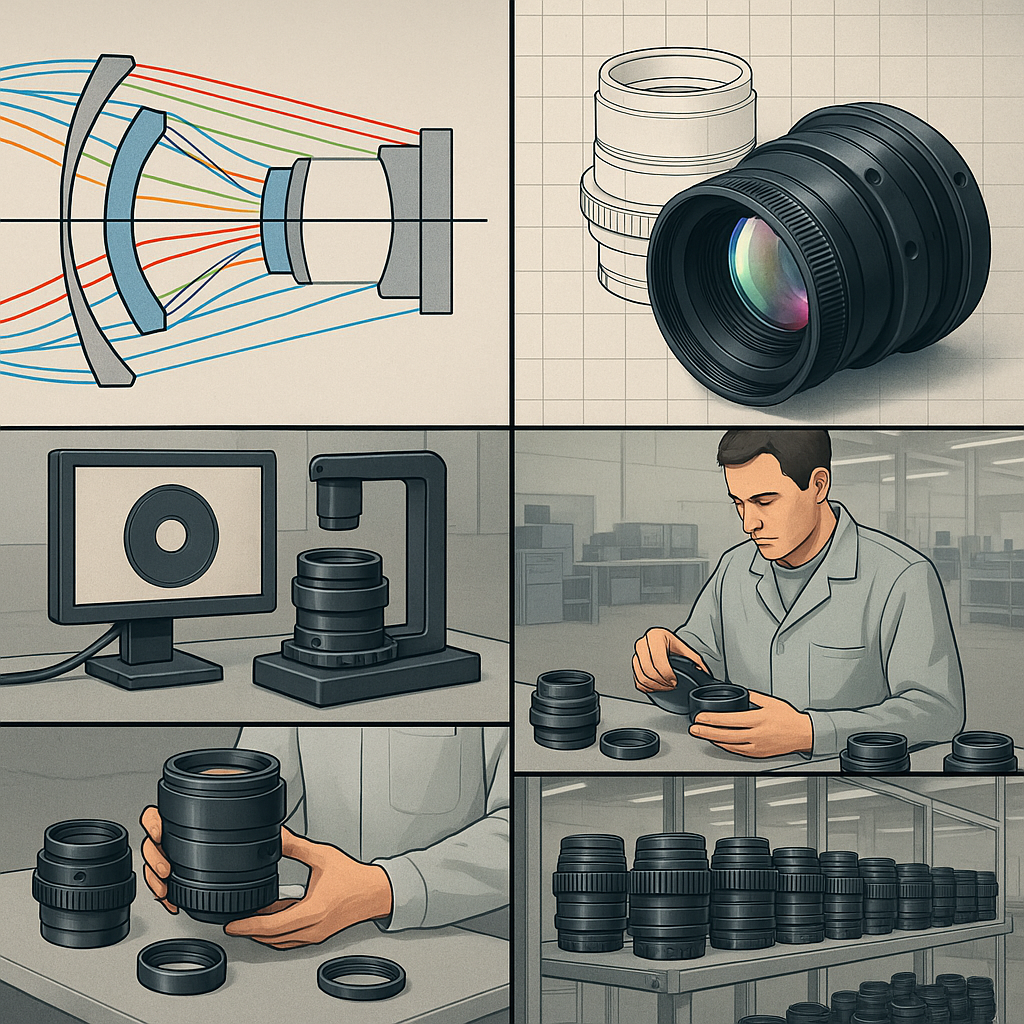
Key Takeaways
Custom Lens Development succeeds when optical targets, mechanical interfaces, commercial assumptions and approval authority are settled before tooling or production commitments.
- Freeze the sensor, spectral band, field of view, working distance and mechanical envelope—or document which inputs remain negotiable—before final optimization.
- Treat feasibility, design release, prototype approval and pilot acceptance as separate decision gates with named OEM approvers.
- Use tolerance analysis and design-for-manufacturability review to expose specifications that may be difficult or costly to reproduce.
- Revalidate changes according to their effect on optical performance, fit, tooling, materials and the approved manufacturing process.
- Do not release volume orders until drawings, acceptance criteria, inspection controls, traceability and change-notification rules are agreed.
The Short Answer
A custom lens moves through seven connected stages: requirements definition, feasibility, optical and mechanical design, prototyping, design validation, pilot production and volume manufacturing. Each stage should end with an explicit decision and controlled deliverables. The OEM owns application inputs and approval decisions; the optics supplier develops the design, evidence and production process defined by the contract. Sensor, packaging or performance changes become progressively more disruptive after design approval, tooling and process validation. The safest program therefore freezes high-impact interfaces early and releases production only after representative builds meet agreed acceptance criteria.
A custom program is not merely a longer lens quotation. It is a sequence of technical and commercial decisions in which incomplete requirements can reappear as redesign, unusable tooling or disputed acceptance results. The objective is not to eliminate change. It is to discover consequential changes while they can still be evaluated in models, drawings or low-volume builds.
Custom Lens Development Timeline: From Requirements to Volume Production
- Define requirements. Establish the application, sensor, optical targets, packaging, environment, forecast and commercial constraints; approve a requirements baseline.
- Assess feasibility. Compare the requested combination with available materials, architectures and manufacturing routes; proceed, revise the specification or examine a stock option.
- Design the system. Optimize optical and mechanical elements, analyze tolerances and review manufacturability before releasing prototype data.
- Build prototypes. Evaluate image performance, focus, alignment, fit and application behavior; record deviations and engineering changes.
- Validate the design. Test the agreed configuration against acceptance criteria and release controlled production documentation.
- Run a pilot. Exercise production tooling, sourcing, assembly and inspection using a limited build; approve the process or require corrective work.
- Control volume production. Monitor incoming components, assembly, final inspection, traceability and authorized changes throughout the product lifecycle.
Custom Lens Development Stages, Deliverables, Decision Gates, and OEM Inputs
| Development stage | Primary objective | Typical supplier deliverables | OEM inputs and approvals | Decision gate | Change exposure |
|---|---|---|---|---|---|
| Requirements | Establish measurable need | Requirements review, open-item list | Application data and priorities | Baseline approved | Low |
| Feasibility | Test technical and commercial fit | Concept, risks, assumptions | Trade-off decisions | Proceed, revise or stop | Low |
| Optical/mechanical design | Define a buildable system | Models, drawings, tolerance review | Interface approval | Design release | Rising |
| Prototype | Test design intent | Samples and test results | Evaluation hardware and feedback | Prototype accepted | Moderate |
| Validation | Verify the agreed configuration | Verification record, controlled files | Acceptance decision | Design frozen | High |
| Pilot | Verify repeatable manufacture | Pilot units, inspection and process records | Pilot approval | Manufacturing release | High |
| Mass production | Sustain conformity and supply | Production lots, traceability, change notices | Forecasts and change decisions | Continued acceptance | Highest |
The exposure labels are editorial inference rather than universal industry classifications. They express a practical pattern: later changes can touch more released assets, inventory and approvals.
What Starts a Successful Custom Lens Program
Application and optical inputs
The requirements set should describe what the imaging system must do, not only nominal focal length. Relevant inputs commonly include sensor format and package data, cover glass, pixel pitch, wavelength range, field of view, working distance, aperture, distortion, resolution target and focus strategy. For machine vision, review the relationship between sensor sampling and lens performance rather than treating megapixels as a lens specification; this guide to matching lens MTF to camera pixel size explains that decision.
Visible and near-infrared operation also needs an explicit focus requirement. A day/night security program should document illuminator wavelengths, sensor response and acceptable focus behavior; see IR-corrected lens selection for day/night cameras.
Requirements vary by optical category. For example, the manufacturer-authored custom LED optics process identifies LED package, PCB arrangement, target distribution, installation space and operating environment as relevant illumination inputs. Those details should not be generalized to every imaging lens, but they show why the source and mechanical stack must be defined together.
Mechanical, environmental and commercial boundaries
Record the available envelope, mount, flange or sensor relationship, retention method, sealing interface, allowable adjustment, operating environment and mating-part tolerances. Commercial inputs belong in the same baseline: forecast ranges, launch expectations, target cost, service life, desired ownership rights and likely end-of-life obligations.
A useful RFQ separates mandatory limits from preferences and negotiable targets. The custom lens requirements for an RFQ provide a structured handoff for engineering and procurement.
Stage 1: Lens Feasibility Analysis and Program Definition
A feasibility review asks whether the full requirement set can coexist. Engineering may compare candidate architectures, materials, coatings, element count, adjustment strategy, packaging and manufacturing method. Procurement simultaneously needs to test whether forecast, non-recurring work and supply assumptions justify that route.
The result should not be a vague declaration that the project is possible. A useful output identifies assumptions, unresolved inputs, major trade-offs, expected development activities and the next approval. A Custom Lens Development program can then proceed, revise conflicting requirements, or evaluate an existing or modified product.
The OEM’s designated technical owner should approve the requirements baseline, while procurement and quality acknowledge the commercial and acceptance assumptions. That approval does not prove performance; it confirms which problem the design team has authorization to solve.
Stage 2: Custom Optical Lens Design and Mechanical Engineering
Performance, packaging and manufacturability
Optical optimization balances image quality, field coverage, aperture, distortion, spectral behavior, size and sensitivity to variation. Mechanical engineering determines how elements are located, retained, focused, sealed and connected to the camera or instrument. These disciplines cannot be released independently when barrel tolerances or adjustment features affect alignment.
A tolerance analysis estimates how permitted variation may influence the modeled result. A manufacturability review asks whether the geometry, tolerances, coatings and assembly method can be reproduced and inspected. The commercial consequences are examined in optical design for manufacturability and unit cost.
According to Optics for Hire’s description of custom lens engineering, provider workflows may include optical simulation, tolerance and stray-light analysis, opto-mechanical design, prototyping, testing and production support. That is evidence of a provider-described workflow, not proof that every project requires every activity.
Release decision
Design review outputs should identify the controlled optical model, mechanical drawings, critical characteristics, unresolved risks and prototype plan. Before release, the OEM verifies interfaces and priorities; the supplier confirms that the released data are suitable for the agreed prototype route. Tooling authorization should be a separate commercial decision where tooling is required.
Stage 3: Optical Prototyping and Design Verification
Prototypes answer defined questions. One build may test image quality and focus adjustment; another may test sealing, assembly fit or an application-specific detection pattern. Buyers should ask which materials, processes and tooling differ from intended production because a hand-adjusted sample does not by itself demonstrate production repeatability.
Evaluation can include dimensional inspection, optical performance, focus range, alignment, field coverage, distortion, stray-light behavior where specified, and environmental fit. Test methods, fixtures, sample configuration and pass/fail limits need agreement before results are interpreted.
Prototype findings become controlled engineering changes rather than informal instructions. If a requirement changes, the team records the affected model, drawing, test and commercial assumption. A prototype is ready for validation when its configuration is known, major deviations are resolved, and the parties agree that the next build represents the candidate production design.
Stage 4: Production Validation, Pilot Builds, and Manufacturing Release
Validation asks whether the frozen design meets its agreed requirements. Pilot production asks a different question: can the intended tools, suppliers, operators, assembly instructions and inspection methods reproduce it?
For a scoped example, the PIR Fresnel lens development process describes design approval before mold fabrication, followed by DFM, trial molding, dimensional and fit checks, sample approval and production preparation. That sequence applies specifically to molded PIR Fresnel programs, but it illustrates why design validation and manufacturing approval are distinct gates.
The release package may include controlled drawings, bills of material, approved sources, assembly instructions, tooling records, inspection characteristics, test methods, acceptance criteria, packaging requirements and revision history. The exact package is contractual. Pilot approval should identify who accepts technical performance, process evidence, quality records and commercial readiness.
Stage 5: Mass Production and Lifecycle Management
Production control typically combines incoming-component checks, in-process controls and final acceptance defined by the released inspection plan. Traceability depth should match the program’s risk and contract: it may connect finished assemblies to component, coating, assembly or test records where those links are required.
Supplier, material, coating and process substitutions should enter formal change control before shipment. The review determines whether equivalence can be documented or whether testing, samples, revalidation or customer approval is needed. Corrective action follows the same discipline: contain affected material, define the issue, investigate cause, implement action and verify the agreed evidence.
Forecasts matter because custom components can have dedicated materials, purchased parts or capacity constraints. OEMs should distinguish launch demand, ongoing consumption, service demand and end-of-life needs instead of presenting one unsupported annual number.
How Engineering Changes Affect the Custom Lens Development Timeline
During concept design, engineers can often compare alternatives without scrapping physical assets. After prototype release, a change may require updated drawings, parts and tests. After tooling or manufacturing approval, the same request may also affect tools, inventory, qualification evidence and delivery commitments.
A useful change assessment asks:
- Which requirement or interface changed?
- Does the optical model, tolerance analysis or mechanical stack need revision?
- Are existing parts, tooling and inspection fixtures still usable?
- Which verification results remain valid?
- Who approves cost, schedule and residual risk?
Worked inference: if an OEM changes the sensor package while retaining the same field-of-view target, engineering may need to revisit image circle, chief-ray assumptions, back focal clearance and mount geometry. The actual effect depends on both sensor specifications; it cannot be determined from resolution alone.
Custom Lens Development Deliverables and Approval Responsibilities
The OEM supplies accurate application data, mating interfaces, evaluation hardware where required, forecast assumptions and timely decisions. Its engineering, quality and procurement owners should agree internally before communicating approval.
The supplier is responsible for the contracted design work, risk disclosure, configuration control, prototype or production evidence and manufacturing controls. Intellectual-property ownership, source-file access and production-transfer rights are not implied by technical approval; they belong in the agreement.
A simple responsibility matrix can prevent silent gaps:
| Gate | Supplier evidence | OEM decision |
|---|---|---|
| Feasibility | Concept, assumptions and risks | Accept direction and trade-offs |
| Design release | Models, drawings and tolerance review | Approve interfaces and prototype release |
| Prototype | Samples, configuration and results | Accept changes or request correction |
| Validation | Evidence against agreed criteria | Freeze the design |
| Pilot | Process and inspection records | Authorize manufacturing release |
Request a custom lens feasibility review: share the application, sensor details, optical targets, mechanical constraints, forecast and production objectives so the initial discussion can identify missing inputs and credible next decisions.
When to Use a Custom Lens Instead of a Stock Lens
Customization is defensible when a required performance, package, spectral band, environmental condition or controlled supply need cannot be met acceptably by an available product. A stock lens is usually the lower-development-risk starting point when it meets the critical requirements without compromising the system.
Compare alternatives using the same requirement baseline. The COTS vs custom optical lenses framework covers cost, schedule and supply questions. Infrared programs can also use the narrower comparison of stock versus custom SWIR lenses when bandwidth, image circle and packaging drive the decision.
A modified stock assembly can be an intermediate route when the existing optical core is suitable but the mount, housing, aperture, filter or interface needs revision. Feasibility still matters: an apparently minor mechanical change can alter spacing, clear aperture, alignment or environmental behavior.
For a qualified RFQ, submit the fixed requirements, negotiable targets, expected quantities and approval schedule—not only a desired focal length.
Frequently Asked Questions
Who owns the optical design files in a custom lens development program?
Ownership depends on the contract, not on a universal industry rule. The agreement should separate background intellectual property, newly created prescriptions and mechanical files, manufacturing drawings, tooling, simulation data, and the OEM’s right to transfer production. Resolve access, license, escrow, and release conditions before authorizing non-recurring engineering.
Can an OEM begin custom lens development before the final camera sensor is selected?
Yes, but only as a risk-managed concept phase. Engineers can explore architecture using candidate sensor dimensions, cover glass, pixel pitch, and chief-ray assumptions. Final optimization and tolerance release should wait for sensor selection; changing active area, package geometry, or interface assumptions later may trigger redesign and another prototype cycle.
What information should be included in a custom lens RFQ?
Include the application, sensor and cover-glass data, spectral band, field of view, working distance, image-quality target, aperture, distortion limit, envelope, mount, environment, compliance needs, quantities, forecast, target cost, schedule, inspection expectations, and ownership terms. Mark every input as fixed, preferred, or negotiable so feasibility trade-offs are explicit.
How should OEMs plan forecasts for a lens that is moving into production?
Use a rolling forecast with separate prototype, pilot, launch, and steady-state assumptions. Share upside and downside ranges, expected order cadence, service demand, and any seasonality. Ask the manufacturer which materials, coatings, tooling capacity, and purchased parts create the longest commitments, then align purchase authorizations with the agreed change-control process.
What should procurement teams ask about component availability before approving a custom lens program?
Ask for the approved manufacturer and material list, single-source dependencies, minimum buy constraints, normal replenishment assumptions, storage-life considerations where applicable, and last-time-buy or substitution procedures. Procurement should also establish how component changes are disclosed, qualified, traced to production lots, and approved before they enter shipped assemblies.
Topics
Related Articles

How to Qualify a Custom Lens Manufacturer for Global OEM Programs
10 min read
What lens is used in CCTV?
11 min read