


How to Qualify and Compare Machine Vision Lens Suppliers for OEMs
A production-focused framework for evaluating lens suppliers through controlled optical data, drawings, quality systems, validation evidence, capacity and change control.
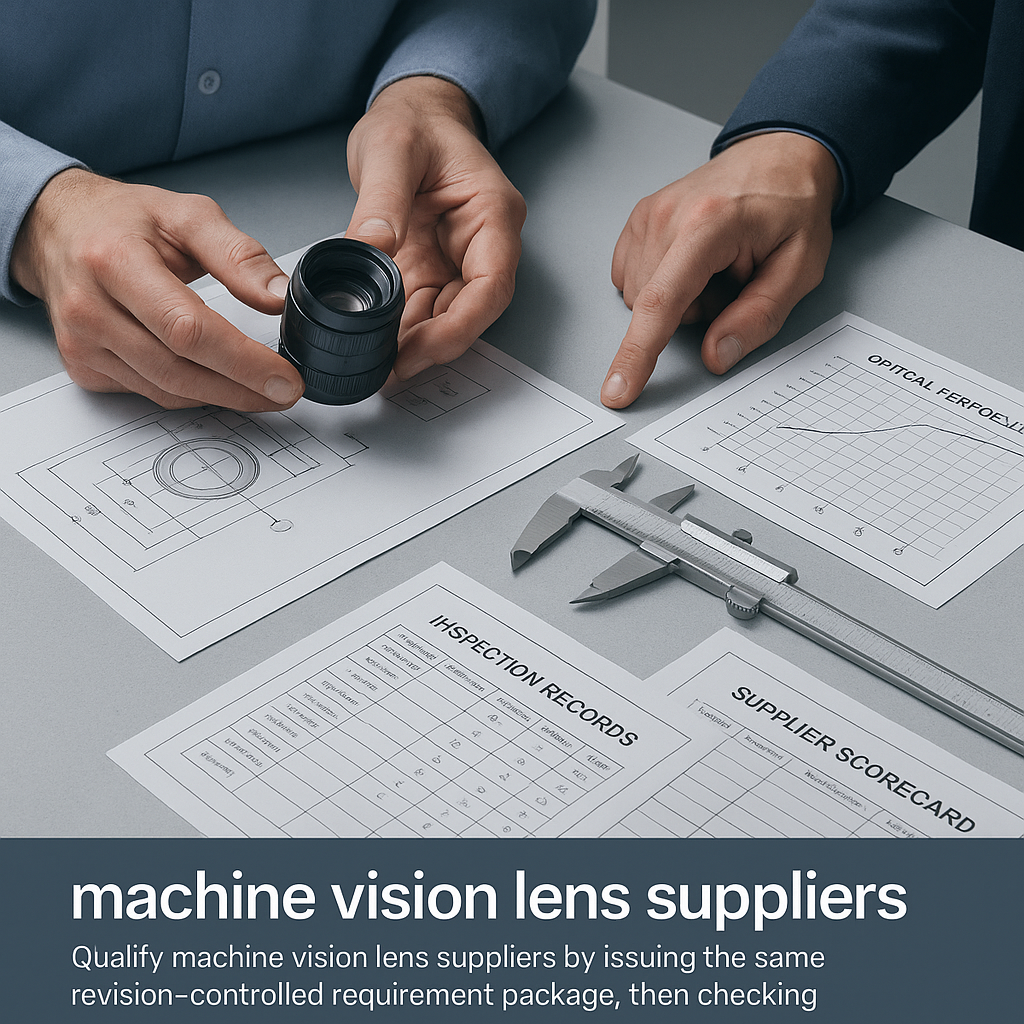
Key Takeaways
Comparing machine vision lens suppliers requires evidence that the approved optical and mechanical configuration can be reproduced, traced and supported throughout the OEM program.
- Freeze application, interface, environmental and acceptance requirements before requesting quotations.
- Treat controlled drawings, traceability and application fit as pass-fail gates rather than optional scorecard points.
- Score documented measurement methods and production controls, not unsupported performance or capacity claims.
- Validate samples and pilot units under representative operating and inspection conditions before production approval.
- Include capacity, material dependencies, change notification and lifecycle support in the total sourcing decision.
The Short Answer
Qualify machine vision lens suppliers by issuing the same revision-controlled requirement package, then checking optical evidence, controlled drawings, manufacturing controls, traceability, environmental validation, capacity and lifecycle support. Samples establish application potential, not production readiness. Use pass-fail gates for configuration control, critical interfaces and acceptance criteria; score the remaining evidence with consistent weights. Approval should record open risks, permitted configurations and change-notification duties. Requalification is appropriate when materials, design, process, manufacturing location, inspection methods or operating conditions change in ways that could affect fit or image performance.
A lens can form an acceptable image on an engineering bench and still create sourcing risk. The unresolved questions are often whether later lots will match the sample, whether interfaces are controlled, and whether a material or process change will be disclosed before shipment.
Why OEMs Need a Production-Readiness Process for Machine Vision Lens Suppliers
Why catalog specifications and sample appearance are not enough
Catalog data helps narrow the field, but it rarely defines the complete acceptance basis. Relevant variables can include focal length, aperture, magnification, sensor format, mount and construction. Supplier documentation may also include MTF and distortion charts; Schneider-Kreuznach provides examples of such industrial lens selection data.
The buyer still needs the measurement context. An MTF curve, for example, is difficult to apply without knowing the tested configuration and whether it represents nominal design data or measured hardware. A sharp-looking sample is similarly incomplete evidence unless image acceptance is tied to a repeatable setup.
Risks between prototype approval and volume production
Production exposes conditions that a small sample may not reveal: wider component variation, alternate material lots, assembly adjustments, rework and demand changes. These are risk categories, not assertions that every supplier will encounter them. Qualification should determine which controls would detect and contain a deviation if one occurs.
Who participates in the evaluation
Optical and mechanical engineering should own application performance and interfaces. Quality reviews inspection, traceability and corrective action. Operations assesses assembly and delivery constraints, while procurement examines commercial assumptions and continuity. Product-safety or regulatory specialists may need to participate where the end product requires them. This cross-functional RFQ approach is supported by SUPERIOR’s machine vision lens RFQ checklist.
Define Your Qualification Requirements Before Comparing Suppliers
Optical, mechanical, interface and illumination requirements
Start with the object size, required field of view, working distance, sensor format, pixel size, spectral band, illumination geometry and acceptable image output. Then capture mount, back-focus constraints, envelope, connector or motor requirements, focus retention and mating datums. The appropriate category among machine vision lenses for industrial applications depends on this combined system definition.
Lens type is an application decision. Opto Engineering describes telecentric optics for non-contact measurement where perspective effects matter, while macro and fixed-focal-length products address different working-distance, distortion and sensor requirements. Its machine vision optics overview illustrates why a category label alone cannot establish fit.
Application and environmental operating conditions
Document operating and storage conditions relevant to the product: temperature exposure, vibration, humidity, contamination, cleaning agents, duty cycle and mounting orientation. Avoid demanding tests simply because they are familiar. Each test should correspond to a credible failure mode and produce an agreed acceptance result.
Volume, delivery, lifecycle and change control
Provide forecast ranges, pilot timing, production ramp assumptions, expected program life and service demand. Ask which materials or subcomponents have long or concentrated supply paths, what lead-time assumptions underpin the quotation, and which changes require notice or approval.
Mandatory requirements versus preferences
Create two lists. Mandatory items are disqualifying: sensor coverage, mechanical fit, critical image performance, drawing control or required traceability. Preferences can be traded against cost, lead time or engineering effort. Keeping them separate prevents a high aggregate score from concealing a failed interface.
Verify Optical Data, Drawings and Technical Documentation
Review performance against the application
Request data in the operating configuration rather than accepting the nearest catalog condition. The review may cover field coverage, distortion, relative illumination and resolution or contrast response where these affect the inspection task. Require the bidder to identify assumptions and exceptions instead of silently substituting a similar condition.
Drawing control, tolerances and revision history
A controlled drawing should identify the assembly, revision, critical dimensions, tolerances, interfaces and approval status. Check that the quotation, sample and proposed production item all reference the same configuration. If adjustment ranges or locking features matter, their production state belongs in the controlled definition.
Measurement methods and limits
For each critical output, record the metric, test setup, responsible party, sampling expectation, report format and pass-fail rule. A supplier that can explain fixture alignment, equipment limits and data interpretation gives the OEM more usable evidence than one that supplies an unexplained pass result.
Custom and modified assemblies
Documentation depth should increase when a standard product is modified. Clarify ownership and control of drawings, tooling, coatings, mechanical parts and approved substitutions. Compare the available optical lens and lens assembly options against the required deliverables, not merely the part description.
Assess Machine Vision Lens Quality Control and Manufacturing Controls
Incoming, in-process and final controls
Map each critical characteristic to the stage where it can be controlled most effectively. Incoming inspection may address purchased materials or components; in-process checks can detect assembly drift; final inspection verifies the released lens. Ask for methods, records and reaction plans rather than a generic statement that products are inspected.
Lot traceability
Traceability should connect the finished assembly to the records needed for containment and investigation. Depending on program risk, that may include material or component lots, assembly route, inspection status and shipment identification. The required retention period and labeling format should be agreed before approval.
Nonconformance, rework and corrective action
Review who can authorize deviations, how affected product is segregated, and whether rework returns the unit to the controlled specification. Corrective-action expectations should distinguish immediate containment from root-cause analysis and prevention. An OEM also needs a defined escalation route when shipped product may be affected.
Production changes
Specify which changes require notification, supporting validation or written approval. Candidates include optical materials, coatings, adhesives, housings, tooling, process sequence, inspection method, software used for acceptance, manufacturing location and sub-tier source. The list should be tailored to product risk rather than copied indiscriminately.
Validate Environmental Performance and Application Fit
Match evidence to the operating exposure
Environmental qualification is useful only when the sample configuration, exposure and post-test measurements correspond to the application. Ask what was tested, how many configurations were represented, what acceptance criteria were applied and whether the evidence covers the offered revision.
Coatings, adhesives, housings and focus locks
These elements can affect spectral behavior, mechanical stability and serviceability. Review them as part of the assembly, particularly where vibration, cleaning, contamination or temperature exposure is credible. Supplier claims about ruggedized or stabilized products are useful screening inputs, but they don’t replace evidence for the purchased configuration.
Samples and pilot builds
Use samples to verify optical fit and assembly compatibility. A pilot build then tests the proposed production route, inspection flow, packaging and records. Representative validation should use the intended camera, illumination, mounting method, object range and image-analysis settings; otherwise the buyer may approve a condition that production never sees.
Programs requiring tighter evidence can borrow principles from validation and traceability programs for automotive lens manufacturing, while adapting the controls to their own product and risk level.
Evaluate Capacity, Supply Continuity and Lifecycle Support
Capacity and scale-up
Ask for the planned production route, shift or equipment constraints, inspection bottlenecks and ramp assumptions. Capacity statements are more credible when tied to the quoted configuration and required inspection load. The buyer should also establish how backlog, lead-time changes and allocation decisions will be communicated.
Material and component dependencies
Identify single-source optical glass, coatings, mechanical parts, electronics and outsourced processes where applicable. The aim isn’t to demand a second source for every input; it is to know where substitution could affect the controlled design and how continuity would be managed.
Obsolescence and second-source readiness
Lifecycle support should cover last-time-buy communication, replacement evaluation, record retention and change notification. A second source isn’t interchangeable merely because its basic catalog specifications match. Guidance on optical supply chain risk and OEM change control explains why alternate configurations need their own comparison and approval evidence.
Use an OEM Lens Supplier Scorecard to Compare Suppliers Consistently
A weighted scorecard converts comparable evidence into a documented decision. It does not override mandatory requirements. Use this sequence:
- Freeze the requirement revision.
- Set weights from application and supply risk.
- Collect equivalent evidence from every bidder.
- Score against written definitions.
- Apply pass-fail gates.
- Record approval conditions and unresolved risks.
To compare machine vision lens suppliers fairly, score the quality and relevance of the evidence—not presentation quality or the volume of documents supplied.
OEM Lens Supplier Scorecard: Weighted Evaluation Criteria
| Evaluation Category | What to Verify | Suggested Weight | Supplier Score | Evidence or Notes |
|---|---|---|---|---|
| Optical performance and data | Application-relevant results, context, tolerances and explanation | High | Enter score | Reference report and revision |
| Drawings and configuration | Controlled interfaces, tolerances, history and approval route | High | Enter score | Record exceptions |
| Quality controls | Incoming, in-process and final controls; nonconformance process | High | Enter score | Identify control records |
| Traceability | Lot identity, production records and retention | High | Enter score | State trace depth |
| Environmental validation | Relevant exposure, assembly materials and post-test acceptance | Medium–High | Enter score | Note coverage gaps |
| Capacity and delivery | Scale-up plan, constraints and lead-time visibility | Medium–High | Enter score | Capture assumptions |
| Continuity and lifecycle | Dependencies, obsolescence and change notification | Medium | Enter score | List critical sources |
| Engineering communication | Technical clarity, response ownership and escalation | Medium | Enter score | Cite review evidence |
| Commercial fit | Pricing assumptions, tooling, terms and total program risk | Medium | Enter score | Separate pilot and production |
Weights are editorial recommendations, not universal industry values. For a metrology system, optical evidence may dominate. For a high-volume embedded product, traceability, continuity and controlled change may carry equal decision weight. Drawing control, application fit and required traceability are usually better handled as gates because averaging cannot correct a fundamental failure.
Run the Supplier Evaluation From RFQ Through Production Approval
Request comparable information
Issue the same revision-controlled package to each bidder. Require a compliance matrix identifying compliant, partially compliant and noncompliant requirements, plus assumptions and proposed alternatives. Separate prototype, pilot and production quotations when tooling, materials or inspection routes differ.
Use gated reviews
A practical sequence is document review, technical review, sample evaluation, pilot approval and production release. Add a manufacturing review or audit when remote evidence cannot resolve a high-impact concern, when the process is unusually dependent on operator control, or when the OEM’s quality system requires it.
Document approval conditions
The supplier file should identify the approved part and revision, applicable drawings, test reports, accepted deviations, inspection obligations, packaging, traceability and change-notification terms. Open actions need owners and due dates; conditional approval should not become silent permanent approval.
Requalification triggers
Requalification scope should follow the potential effect of a change. A label-format revision may need document review, while a new coating, adhesive, production site or optical design may require samples and renewed validation. Periodic review can also address delivery performance, corrective actions and lifecycle status.
Choose a Machine Vision Lens Supplier Based on Verifiable Readiness
Lowest unit price can be outweighed by additional inspection, unstable lead times, undocumented substitutions or engineering effort required to resolve ambiguous data. That does not mean selecting the highest quotation. It means comparing total program exposure under the same technical and commercial assumptions.
The final decision should match the OEM’s tolerance for image-performance, schedule and continuity risk. Maintain the scorecard, source records, approved configuration and review history as a living supplier file.
For a production-readiness discussion with qualified machine vision lens suppliers, provide SUPERIOR with the application requirements, available drawings, expected volumes, validation needs and lifecycle expectations. Those inputs allow the technical and commercial questions to be addressed before quotation and sample approval.
Frequently Asked Questions
What documents should an OEM request before approving a machine vision lens supplier?
Request the controlled drawing, specification and compliance matrix; application-relevant optical data; inspection and acceptance methods; traceability plan; environmental evidence; packaging requirements; approved-deviation record; capacity assumptions; and change-notification process. Custom programs may also need tooling ownership, material declarations, sub-tier controls and configuration-specific validation reports.
How many machine vision lens suppliers should an OEM evaluate for a production program?
There is no universal minimum. Evaluate enough credible candidates to test technical, commercial and continuity assumptions without consuming resources on unsuitable bidders. A specialized application may have few viable sources. Where continuity risk is high, assess an alternate source early, but qualify it independently rather than assuming catalog equivalence.
When should an OEM perform a supplier manufacturing review or audit?
Use a manufacturing review when documents cannot resolve a material production risk, the process relies heavily on operator-controlled steps, traceability is uncertain, or volume expansion could change the production route. An on-site audit may also be required by the OEM’s quality system or end-market obligations; it should have a defined scope.
What should trigger requalification of an approved optical lens supplier?
Requalification should follow changes that could affect fit, image output, durability or traceability. Typical triggers include revised optical materials, coatings, adhesives, housings, tooling, assembly processes, inspection methods, manufacturing locations or sub-tier sources. Significant application changes, prolonged production gaps or recurring nonconformance can also justify a documented review.
Should a prototype lens supplier automatically be approved for production supply?
No. Prototype acceptance demonstrates that evaluated samples can meet defined needs under the test conditions; it does not establish repeatability, capacity, traceability or controlled change. Production approval should additionally verify the manufacturing route, inspection plan, approved configuration, packaging, pilot results, issue-escalation process and lifecycle commitments.
Topics
Related Articles
Machine Vision Lens RFQ Checklist for OEM Production Programs
11 min read
Large-Sensor Machine Vision Lenses: Image Circle and Edge Quality
12 min read
Machine Vision Lens MTF: Match Resolution to Camera Pixel Size
14 min readAbout SUPERIOR OPTICS
SUPERIOR OPTICS specializes in CCTV lenses, machine vision optics, and custom optical solutions for security, industrial imaging, and specialty applications. We also provide professional lens selection and application support.