


Machine Vision Lens RFQ Checklist for OEM Production Programs
A production-focused RFQ framework for aligning optical, mechanical, quality, commercial and supply-chain requirements before machine vision lens suppliers quote.
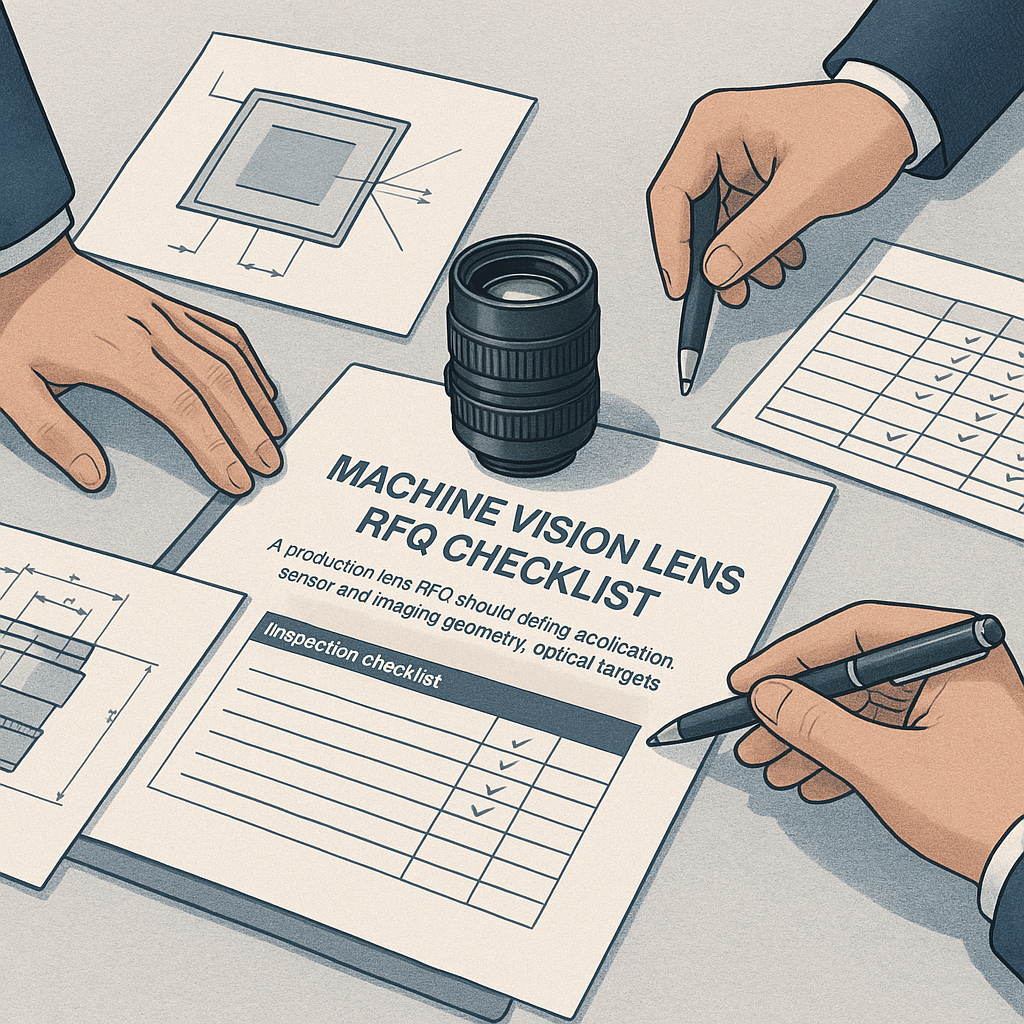
Key Takeaways
A Machine Vision Lens RFQ Checklist turns application needs into one controlled package that engineering, quality, procurement and prospective suppliers can interpret consistently.
- Identify the sensor, field of view, working distance, illumination and focus conditions before treating a quotation as production-ready.
- Control the mount, mechanical datums, envelope and drawing revisions alongside optical requirements.
- Connect each critical characteristic to a measurement method, acceptance rule and responsible party.
- Request separate prototype, pilot and production pricing when tooling, materials or inspection routes may change.
- Compare quotations through an assumptions-and-exceptions matrix rather than unit price alone.
The Short Answer
A production lens RFQ should define the application, sensor and imaging geometry; optical targets; mechanical interface; materials and coatings; operating environment; tolerances; inspection and acceptance methods; packaging; traceability; forecast volume; pricing structure; lead time; and change-control expectations. A Machine Vision Lens RFQ Checklist also needs a status for every field: approved, pending or supplier-proposed. Issue the same revision-controlled package to each bidder, then compare stated compliance, exceptions, measurement methods, tooling assumptions and production capability—not only sample price or nominal focal length.
An RFQ is not merely a request for a unit price. It is the controlled baseline against which suppliers judge feasibility and buyers later assess samples, production lots and engineering changes. It should also reveal whether the program needs an available lens, a modified platform or custom optical lens assemblies.
Why a Machine Vision Lens RFQ Checklist Matters for Production Programs
How incomplete RFQs create quotation gaps, redesign risk, and cost disputes
Focal length alone does not establish image performance or mechanical compatibility. Missing sensor, field, working-distance, spectral or acceptance inputs force bidders to make assumptions. Quotations may then describe different products even when their price tables look comparable.
The difference between a concept-stage inquiry and a production-ready RFQ
A concept inquiry may contain open geometry, volume and validation questions. That is acceptable if the response is labeled budgetary. A production RFQ needs controlled requirements, declared open items and a defined route for approving supplier proposals or deviations.
Who should contribute requirements before the RFQ is released
Optical and mechanical engineers own functional inputs; quality defines evidence and disposition rules; operations reviews installation and packaging; procurement supplies demand, cost and commercial terms. Regulatory or product-safety specialists should contribute when those obligations apply.
Machine Vision Lens RFQ Checklist: Information to Include Before Requesting Quotes
Program and commercial requirements
Name the application, program stage, prototype quantity, annual forecast, ramp assumptions, target dates and requested price breaks. Separate non-recurring tooling or engineering charges from recurring unit prices.
Optical performance requirements
Record field of view, working distance, sensor format, pixel information, focus range, aperture, wavelength band, distortion expectation and measurable image-quality criteria.
Mechanical interface and envelope requirements
Reference the mount, thread, flange relationship, allowed envelope, mass constraint, datums, clearances and retention method. Attach controlled CAD or drawings where available.
Coating, material, and cosmetic requirements
List restricted or preferred materials, coating band, angle and environmental exposure. Cosmetic limits need an inspection method; subjective terms such as “clear” or “premium” are not acceptance criteria.
Operating environment and reliability requirements
Describe operating and storage conditions, shock or vibration exposure, contamination, cleaning agents and expected service life where these are program requirements. Do not import automotive or outdoor tests into an industrial RFQ without an application basis.
Tolerances and critical-to-function characteristics
Mark characteristics that affect fit, focus, field coverage or image acceptance. Tight controls should be justified because optical tolerances and coating cost may influence tooling, yield, inspection and quotation assumptions.
Inspection, acceptance, and documentation requirements
For every critical output, identify the metric, setup, equipment or method, test owner, sampling expectation, report format and pass/fail rule. The verified custom-optics RFQ field guide lists examples such as first-article records, coating curves and lot documentation; these are options, not universal requirements.
Packaging, labeling, traceability, and change-control requirements
Define cleanliness protection, tray or individual packaging, label fields, lot identification, shelf-life controls if applicable, and changes requiring notification or approval.
Machine Vision Lens RFQ Requirements Table
| RFQ category | Information the buyer should provide | Example input or reference | Why needed | Buyer status |
|---|---|---|---|---|
| Program and application | Use case and stage | System requirements | Establishes design context | Approved/Pending |
| Optical performance | Field, focus and image targets | Optical specification | Defines functional output | Approved/Pending |
| Sensor and imaging setup | Sensor, active area and illumination | Sensor data sheet | Sets imaging geometry | Approved/Pending |
| Mechanical interface | Mount, datums and envelope | CAD/drawing revision | Controls fit and focus | Approved/Pending |
| Construction and materials | Restrictions or preferences | BOM requirement | Supports feasibility | Approved/Proposed |
| Coatings and spectrum | Band, angle and performance | Spectral requirement | Defines optical treatment | Approved/Proposed |
| Environment | Operating, storage and exposure | Product specification | Guides design and validation | Approved/Pending |
| Critical characteristics | Tolerances and classification | Ballooned drawing | Focuses process control | Approved/Pending |
| Inspection and acceptance | Method, sampling and limits | Inspection plan | Makes acceptance repeatable | Approved/Pending |
| Cosmetics and cleanliness | Defect and contamination limits | Visual standard | Reduces subjective disputes | Approved/Pending |
| Packaging and labeling | Protection and label content | Packaging specification | Prevents handling ambiguity | Approved/Proposed |
| Traceability and records | Lot links and certificates | Quality agreement | Defines retained evidence | Approved/Pending |
| Demand schedule | Forecast, MOQ and ramp | Volume table | Supports capacity planning | Approved/Pending |
| Pricing structure | Target, breaks and tooling | Commercial worksheet | Exposes cost assumptions | Approved/Pending |
| Lead time | Prototype and production dates | Program schedule | Tests schedule feasibility | Approved/Pending |
| Change control | Notice and approval rules | Change procedure | Protects the baseline | Approved/Pending |
Required fields for a comparable supplier quotation
At minimum, freeze the application geometry, mechanical interface, acceptance basis and commercial scenario—or require every bidder to price the same written assumptions. Ask suppliers to identify compliance, exceptions, exclusions, tooling and quoted revision explicitly.
Fields that may be listed as pending or supplier-proposed
Material grade, coating construction or detailed element tolerances may remain supplier-proposed when the buyer controls performance rather than design. Pending fields need an owner and closure date; otherwise a budgetary quote can be mistaken for a firm production offer.
How to Define Optical Performance Requirements
Application, sensor, working-distance, and field-of-view inputs
Describe the target and task, not just the camera. Include sensor model or active dimensions, required object-space field, nominal and allowed working distance, focus range, orientation and available illumination. Buyers comparing machine vision lenses can use these inputs to screen standard configurations before requesting modification.
Focal length, aperture, wavelength range, and distortion expectations
Treat focal length as one design input. Aperture state, spectral band, filter stack and acceptable distortion must match the use case. If the supplier may optimize focal length to meet field coverage, say so rather than imposing an unnecessary nominal value.
Resolution, image-quality targets, and allowable variation
Use a metric tied to the inspection task and define field positions, focus condition, wavelength or illumination, sample orientation and acceptance threshold. Also distinguish nominal design targets from unit-level limits and lot-level statistics.
Illumination, filter, and spectral-coating considerations
Identify source type, wavelength band, polarization if relevant, filters between lens and sensor, and out-of-band concerns. A coating callout without angle, band and performance expectations can leave materially different constructions under the same label.
How to Specify Mechanical Design, Tolerances, and Assembly Requirements
Mount type, thread, flange, back focal length, and mechanical datum requirements
Control thread designation, engagement, flange or shoulder datum, allowable focus adjustment and the reference used for axial dimensions. Avoid mixing optical back-focus terminology with a housing clearance unless the drawing defines both.
Maximum dimensions, mass, retention, and installation constraints
Show keep-out zones, connector or illuminator conflicts, tool access, orientation features and retention loads imposed by installation. A lens that images correctly but cannot be assembled into the camera is not production-compatible.
Lens element tolerances, centering, spacing, and alignment expectations
Build-to-print programs may require element-level controls. For design-to-spec assemblies, it is usually more useful to control finished performance and let the manufacturer propose internal tolerances, subject to evidence that the production process can maintain them.
Custom optical assembly drawings and controlled revision references
Every drawing, model and specification should carry an identifier and revision. The quotation must list the documents used. Where native CAD and a released drawing conflict, the RFQ should name the governing record.
How to Define Inspection and Acceptance Criteria
What to inspect at incoming, first-article, and production stages
First article can verify dimensions, materials, function and documentation before release. Production inspection should focus on controlled characteristics and known process risks. Incoming checks at the OEM can verify identity, condition and selected outputs without silently replacing supplier controls.
How to document measurement methods and sampling expectations
Record fixture, target, illumination, software settings, environmental conditions and calibration expectations when they affect the result. Sampling or full screening should be stated by characteristic rather than assumed across the entire lens.
How to handle cosmetic limits, functional defects, and nonconforming product
Separate appearance defects from defects that alter imaging or assembly. The quality agreement should define segregation, notification, review authority, concession records and corrective-action expectations instead of leaving disposition to informal email.
When a retained sample or approved golden unit is useful
A retained unit can help align visual or system-level judgments when a written metric cannot capture every observation. It should supplement—not replace—drawings and measurable limits, and its serial or lot identity, storage and approval status should be controlled.
Commercial and Supply-Chain Requirements for OEM Production Lens Procurement
Annual volume, forecast horizon, order quantities, and ramp schedule
Provide prototype, pilot and annual demand separately, plus order cadence and ramp timing. Forecasts should be identified as planning information unless contractually binding.
Target cost, tooling assumptions, prototype pricing, and production pricing
Request line items for engineering, tooling, samples, pilot units, production breaks, inspection and packaging. A low prototype price does not establish the production method or recurring economics.
Lead-time expectations and supply-continuity considerations
Ask what materials, tools or outsourced processes drive lead time and what changes between sample and volume builds. Broader OEM optical component sourcing planning may also address second-source constraints, lifecycle support and recovery options.
Lot traceability, certificate needs, and supplier change notification
Define how finished lots link to inspection records and any critical incoming materials. Identify required certificates and the changes that need prior notice or approval, including design, material source, tooling, test method or outsourced process where applicable.
How to Compare Machine Vision Lens Supplier Quotations
Normalize quoted optical, mechanical, quality, and commercial assumptions
Build rows for each requirement and columns for compliance, evidence, exception, owner and closure date. Convert currencies, quantities, packaging, tooling and delivery bases to a common commercial scenario before ranking prices.
Separate included requirements from exceptions and open items
“Can meet” is not the same as included in price. Require bidders to identify exclusions, conditional compliance and unresolved feasibility work. An unpriced exception should remain visible during nomination.
Evaluate sample capability separately from sustained production capability
Prototype methods may differ from volume methods. Ask whether samples use production-intent materials, tooling, assembly and inspection, and document every departure. Supplier evaluation should also examine capacity, traceability and change management.
Create a quotation comparison matrix before supplier selection
A defensible matrix compares specification coverage, measurement evidence, manufacturing route, capacity, lead time, recurring price, non-recurring charges and supply risks. Weighting is program-specific; the lowest unit price is not automatically the lowest delivered risk.
Downloadable Optical Lens RFQ Template for OEM Teams
How to use the checklist as an internal requirements-review document
Copy the table into the controlled RFQ workbook, assign an owner to each row and classify it approved, pending, not applicable or supplier-proposed. The related optical lens RFQ template provides additional prompts for custom assemblies.
How to issue the same controlled RFQ package to each supplier
Release one indexed package with the same drawings, data sheets, forecast and response form. Set a common question deadline, circulate clarifications to all bidders and prohibit silent assumptions.
How to maintain revisions after engineering changes
Log each revision, changed requirement, approval and effective date. After nomination, transfer the accepted RFQ baseline into purchase specifications, drawings, inspection plans, approved deviations and the supplier quality or change agreement.
Next step: Download or copy the checklist, complete the open fields with engineering and quality, then submit the controlled package for a production-lens quotation review.
Frequently Asked Questions
Should an OEM send the same machine vision lens RFQ package to every supplier?
Yes. A common package gives each bidder the same technical baseline, forecast, pricing structure and response format. Clarifications should also be shared consistently. Supplier-specific questions can follow, but changing core requirements for one bidder makes price, compliance and production-risk comparisons unreliable.
Can suppliers quote a lens accurately when the sensor or working distance is not final?
They can usually provide a budgetary or conditional quotation, but not a fully comparable production offer. The RFQ should identify candidate sensors, working-distance range and supplier assumptions. Any resulting price or design proposal should remain provisional until imaging geometry and acceptance criteria are approved.
What is the best way to handle requirements that are still under engineering review?
Mark each unresolved requirement as pending or supplier-proposed, assign an owner and target closure date, and request that bidders state the assumption used. Keep these items in the quotation matrix so a provisional assumption cannot pass unnoticed into drawings, tooling or production pricing.
When should buyers request prototype, pilot-build, and production pricing separately?
Request separate pricing whenever quantities, tooling, materials, assembly methods, inspection or packaging may differ by phase. The quotation should disclose non-recurring charges and the production volume behind each price break. This prevents prototype economics from being treated as evidence of stable volume cost.
How can a buyer identify whether two lens quotations are based on different assumptions?
Compare both responses requirement by requirement, including quoted revision, sensor, working distance, optical metric, coating, tolerances, inspection, packaging, quantity and delivery basis. Require explicit compliance, exceptions and open assumptions. Differences that remain unpriced or unverified should be logged before commercial ranking or supplier nomination.
Topics
Related Articles
How to Qualify and Compare Machine Vision Lens Suppliers for OEMs
11 min read
Large-Sensor Machine Vision Lenses: Image Circle and Edge Quality
12 min read
Machine Vision Lens MTF: Match Resolution to Camera Pixel Size
14 min readAbout SUPERIOR OPTICS
SUPERIOR OPTICS specializes in CCTV lenses, machine vision optics, and custom optical solutions for security, industrial imaging, and specialty applications. We also provide professional lens selection and application support.