


COTS vs Custom Machine Vision Lenses: Cost and Design Trade-Offs
A buyer-focused framework for deciding whether a catalog machine vision lens, modified standard assembly or fully custom optical design offers the lowest technical and commercial risk.
Key Takeaways
The COTS vs Custom Machine Vision Lenses decision should be based on verified system fit and lifecycle cost, not catalog price alone.
- Start with a catalog lens when it meets sensor coverage, field of view, working distance, mount, spectral and environmental requirements in representative testing.
- Escalate to modified or custom optics when adapters or standard specifications create measurable resolution, distortion, packaging, reliability or yield risk.
- Separate engineering and tooling charges from recurring unit cost, then model qualification, integration, inventory and expected change costs.
- Compare production economics across forecast ranges rather than assuming higher volume automatically makes a custom design less expensive.
- Secure lifecycle, change-notification and replacement terms before qualification because either sourcing path can expose the program to supply changes.
The Short Answer
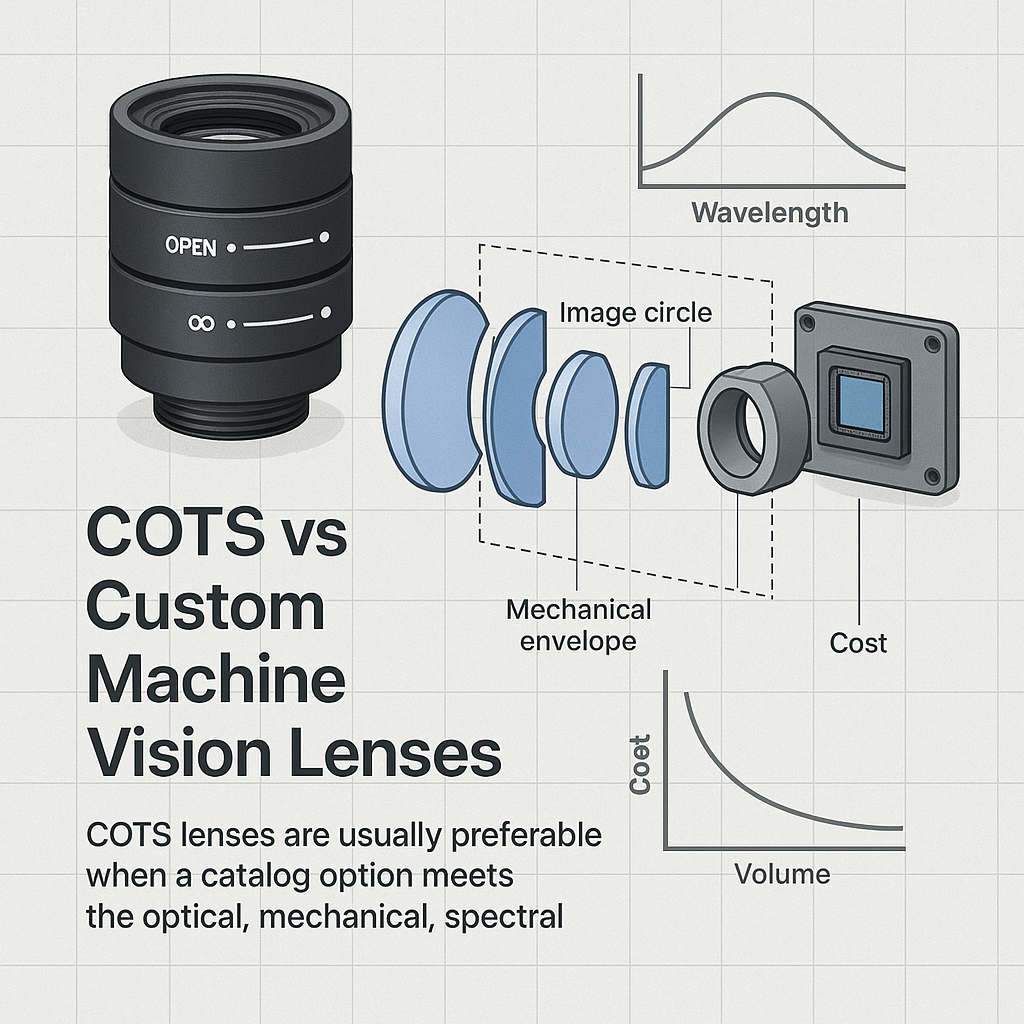
COTS lenses are usually preferable when a catalog option meets the optical, mechanical, spectral and environmental requirements without costly adaptations. Custom optics are justified when standard products limit sensor coverage, packaging, wavelength response, measurement accuracy, inspection yield or supply control. The defensible choice comes from testing the actual sensor, illumination, working distance and temperature range, then comparing lifecycle cost—not simply the first unit price. A modified catalog assembly can provide a useful middle path when the optical design is adequate but the mount, housing or focus retention needs to change.
COTS vs Custom Machine Vision Lenses: Make-or-Buy Comparison
| Decision factor | Off-the-shelf machine vision lenses | Custom machine vision optics | Buyer implication |
|---|---|---|---|
| Upfront engineering | Usually lower | Engineering charges may apply | Protect the prototype budget or fund requirement-specific work |
| Tooling and NRE | Usually avoided | May be required | Amortize separately from unit price |
| Initial unit cost | Known from catalog or quote | Program-specific | Compare equivalent tested configurations |
| Sustained-volume cost | May remain attractive | May improve with volume, not automatically | Model multiple forecast cases |
| Design-start timing | Faster when stock is available | Includes design and sampling stages | Align with qualification gates |
| Specification flexibility | Limited to published options | Built around agreed requirements | Pay for flexibility only where it changes outcomes |
| Sensor and image-circle fit | Must be verified | Can be designed around the sensor | Check corners, not only image center |
| Mechanical packaging | Standard interfaces | Housing and interface can be tailored | Include adapter volume and tolerance effects |
| Wavelength and coatings | Catalog-dependent | Application-specific options possible | Test with the intended source and sensor |
| Validation effort | Still required | Required for samples and production | Neither path is qualification-free |
| Performance or yield risk | Higher if specifications are marginal | Lower only if requirements and acceptance tests are sound | Convert optical limits into production consequences |
| Availability and change control | Catalog lifecycle is supplier-controlled | Dedicated supply introduces MOQ and forecast exposure | Negotiate continuity terms for either path |
COTS Lens vs Custom Lens Comparison: Cost, Time, and Risk
A catalog product has predefined optical, mechanical and commercial specifications. A custom assembly is configured around system requirements. That distinction affects who absorbs design work, but it does not remove validation from either path. Superior’s broader COTS lenses vs custom lenses cost comparison identifies qualification, integration, inventory and expected change cost as parts of lifecycle cost.
Upfront cost versus total ownership
COTS normally avoids new optical-design and tooling charges. It may still require an adapter, camera redesign, focus-locking hardware or additional calibration. Custom development can add engineering, non-recurring charges, samples and qualification, while minimum order quantities may increase cash-flow, forecast-error and obsolescence exposure.
A useful commercial model is:
Lifecycle cost = NRE + qualification + integration + units × unit price + inventory carrying cost + expected change cost
This is an editorial calculation framework, not a supplier quotation. Run low, expected and high volume cases. If custom unit cost is lower, a simple screening breakpoint is NRE ÷ per-unit saving; then add qualification, inventory and redesign exposure before approving the business case.
Lead time, ownership and change control
Stock availability can shorten prototyping, whereas custom optics add design, sampling and approval stages. Faster design start does not guarantee production continuity. Ask which specifications are controlled, how changes are communicated, whether substitutes require approval, and what happens to tooling or drawings if supply ends.
Greater custom control also has boundaries. Contract terms should identify ownership of design data, tooling, test methods and application-specific interfaces. Without those terms, “custom” may describe fit rather than buyer ownership.
When Off-the-Shelf Machine Vision Lenses Are the Better Choice
Begin with available machine vision lenses when the required sensor format, focal length, working distance and mount are represented by catalog options. The choice remains provisional until testing confirms field of view, focus range, corner response, distortion, relative illumination and behavior under intended lighting and temperature.
COTS is particularly defensible for prototypes, uncertain demand or low initial volume because it limits non-recurring exposure. Multiple technically qualified catalog options can also reduce dependence on one part, although alternatives are not interchangeable until their optical and mechanical behavior has been validated.
Mount terminology deserves scrutiny. According to Sunex’s lens-mount guidance, M12/S-mount, C-mount and CS-mount are not interchangeable. C-mount and CS-mount use the same thread approach but different standardized back-focal distances. A nominally familiar mount therefore does not establish sensor position, focus travel or package compatibility by itself.
When Should I Choose a Custom Machine Vision Lens?
Custom development becomes more compelling when no stocked lens meets the combined field-of-view, resolution, distortion, relative-illumination, spectral-range and chief-ray-angle requirements. The trigger should be a measurable system limitation, not a preference for bespoke hardware.
Sensor coverage and usable resolution
The image circle must be assessed against the active sensor area and required corner performance. For line-scan and area-scan systems alike, “covers the sensor” is insufficient if edge resolution or illumination causes missed features. Pixel pitch also does not prove system resolution; lens performance, sampling, contrast, focus and motion all contribute.
A screening calculation can expose risk early. If 2,048 pixels span a 100 mm field, object-space sampling is about 0.0488 mm per pixel. A two-pixel feature spans about 0.0977 mm. Inference: a requirement near that value leaves little allocation for blur, motion, threshold variation or manufacturing tolerance, so representative imaging tests are warranted. Guidance on matching M12 lens resolution and chief-ray angle provides further sensor-matching context.
Packaging, wavelength and measurement behavior
A standard lens may meet image quality but fail the envelope because of barrel diameter, flange position, connector clearance or inaccessible focus controls. Adapters can solve geometry while adding parts, tolerance stack and assembly work. Purpose-designed custom optical assemblies can instead incorporate the interface, housing and focus-retention method into one controlled assembly.
Application-specific wavelength or illumination requirements also warrant testing. Coating options and spectral transmission must be evaluated with the intended source, sensor and filters rather than inferred from visible-light imagery.
For dimensional inspection, connect magnification, distortion, depth variation and calibration stability to allowable measurement error and reject decisions. A telecentric vs conventional lens comparison can help frame that architecture choice before custom specifications are frozen.
Environmental customization may include material, sealing or focus-retention requirements. The verified system-level guidance from EnCata on machine-vision hardware selection supports custom development for specialized tasks and harsh environments, but it does not establish lens-specific performance. Those details require supplier data and application testing.
How to Build a Machine Vision Lens Cost Comparison
Keep non-recurring and recurring costs on separate lines. Otherwise, a low unit quote can conceal tooling and qualification, while a catalog price can conceal adapters, assembly labor or camera changes.
Use four cost groups:
- Development: optical and mechanical engineering, tooling, samples and project management.
- Integration: mounts, adapters, camera changes, lighting changes, calibration and software rework.
- Production: unit price, incoming inspection, assembly, scrap, inventory and minimum-order exposure.
- Lifecycle: requalification, supplier changes, redesign, last-time buys and obsolescence.
Translate performance gaps into business terms. If marginal corner contrast causes uncertain classification, model the cost of additional lighting, slower throughput, manual review or false decisions. This is necessarily an inference until production-like trials provide measured rates. Do not assign a yield saving to custom optics before the acceptance method and baseline are agreed.
For COTS vs Custom Machine Vision Lenses, compare at least three demand cases and document which party carries excess inventory. A custom path may become economical at sustained volume, but volume alone does not guarantee savings; NRE, MOQ, validation and forecast accuracy remain material.
Decision Tree: Should Your Team Buy a COTS Lens or Develop Custom Optics?
- Test catalog fit. Does an available lens meet sensor coverage, field of view, working distance, mount, wavelength, environmental and image-performance requirements under representative conditions? If yes, qualify COTS.
- Examine adaptations. If optical performance is adequate, determine whether a mount, housing, focus lock or coating modification resolves the remaining gap without unacceptable tolerance or reliability risk. If yes, request a modified-standard path.
- Model production economics. Compare NRE, qualification, unit cost, MOQ, inventory and expected change cost across forecast ranges. Include the cost of leaving the performance gap unresolved.
- Choose the controlled path. Use fully custom optics when measurable requirements remain unmet and the commercial plan supports development. Record acceptance tests, ownership, change control and continuity obligations before commitment.
A Practical Evaluation Process for OEM Buyers and Integrators
Build a requirement package around the complete imaging condition: sensor model and active area, pixel pitch, field of view, working-distance range, object depth, wavelength, illumination geometry, mount, maximum envelope, temperature range and forecast volume. Add the defect or measurement that the system must resolve and an objective acceptance method.
Test representative COTS options on the intended sensor. Capture center and corner performance, focus range, distortion, illumination behavior and sensitivity to expected operating variation. Published specifications narrow the field; they do not replace application qualification.
If no option passes, preserve the failed test evidence. It gives the optical supplier a concrete design target and helps distinguish a lens limitation from lighting, motion, sensor or algorithm effects.
Discuss Your Machine Vision Lens Requirements: submit the sensor, field of view, working distance, wavelength, package constraints, environment and forecast volume for a catalog-fit review or custom-optics feasibility discussion before committing to tooling or qualification.
Frequently Asked Questions
Can a COTS machine vision lens be modified for an OEM application?
Yes. A supplier may retain the optical design while changing the housing, mount, focus lock, aperture setting or selected coating. Feasibility depends on the original construction and required volume. Treat the result as a controlled configuration: define drawings, tolerances, qualification tests, minimum orders and change-notification obligations before production approval.
What information should I provide when requesting a custom machine vision lens quote?
Provide the sensor model, active area, pixel pitch, field of view, working-distance range, object depth, wavelength, illumination, mount, package envelope and operating environment. Include the feature or measurement to resolve, allowable distortion or error, expected annual volume, program timing and a proposed acceptance test. Separate mandatory requirements from preferences.
How do sensor pixel size and image circle affect the decision between stock and custom optics?
The lens must illuminate the active sensor area with acceptable corner performance, while its delivered contrast must support the required sampling. Small pixels alone do not guarantee more resolved detail. Test candidate lenses on the actual sensor; consider custom optics when catalog choices cannot provide the required coverage, contrast, illumination or chief-ray-angle compatibility.
Is a custom lens always more expensive over the life of a machine vision program?
No. Custom development usually adds engineering, sampling, tooling or qualification costs, but recurring economics may improve at sustained volume. The result is program-specific. Compare total cost across forecast ranges, including integration, minimum orders, carrying cost, yield effects, redesign and obsolescence rather than using initial unit price as the decision criterion.
What should buyers ask about long-term availability before selecting a catalog lens?
Ask about lifecycle status, change-notification practice, last-time-buy provisions, production location, controlled specifications and approved substitutes. Determine whether the supplier can reserve inventory or support a program-specific configuration. Because replacements still require technical validation, document the requalification plan, expected notice period and ownership of any adapters or calibration data.
Topics
Related Articles
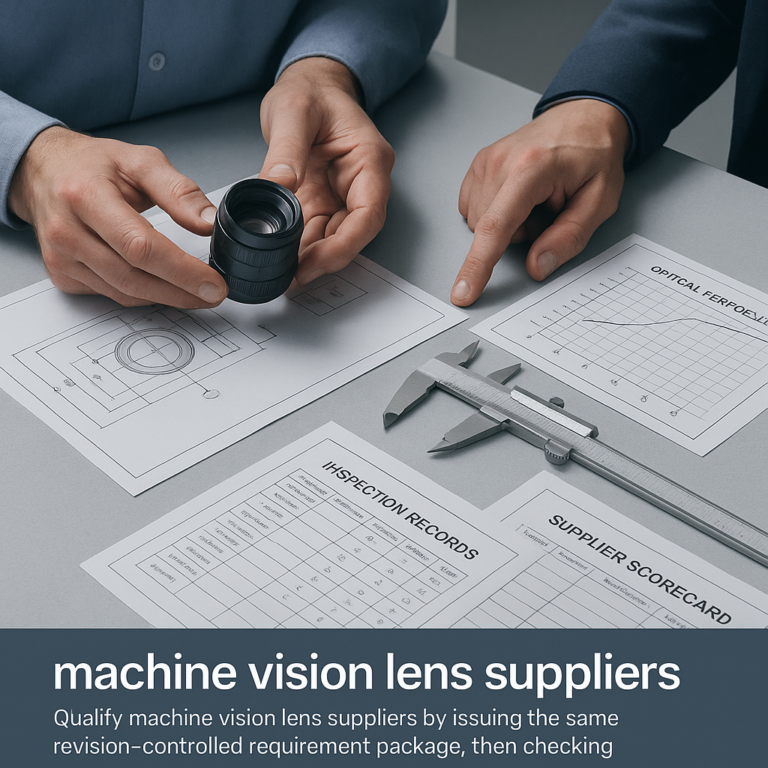
How to Qualify and Compare Machine Vision Lens Suppliers for OEMs
11 min read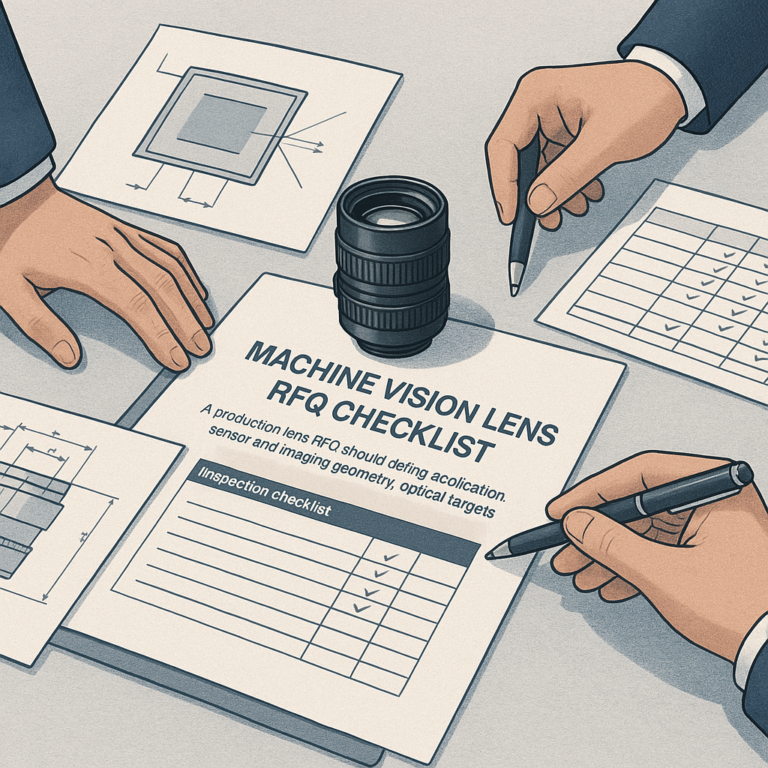
Machine Vision Lens RFQ Checklist for OEM Production Programs
11 min read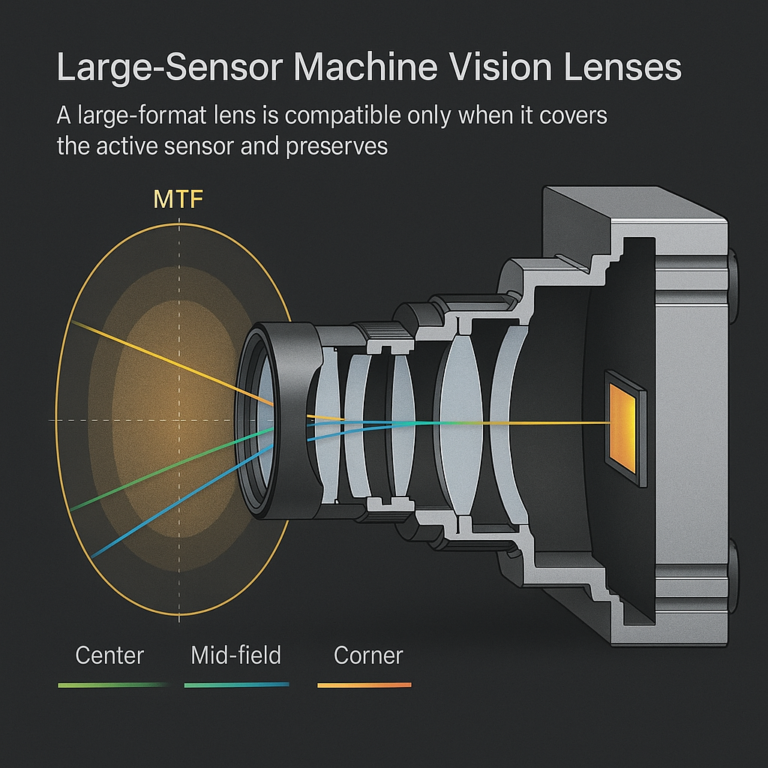
Large-Sensor Machine Vision Lenses: Image Circle and Edge Quality
12 min readAbout SUPERIOR OPTICS
SUPERIOR OPTICS specializes in CCTV lenses, machine vision optics, and custom optical solutions for security, industrial imaging, and specialty applications. We also provide professional lens selection and application support.