

M12 Visible and NIR Lens Selection: Wavelengths and Filter Choices
A buyer-focused guide to selecting M12 lenses and filter arrangements for visible, 850 nm, 940 nm and dual-band camera systems.
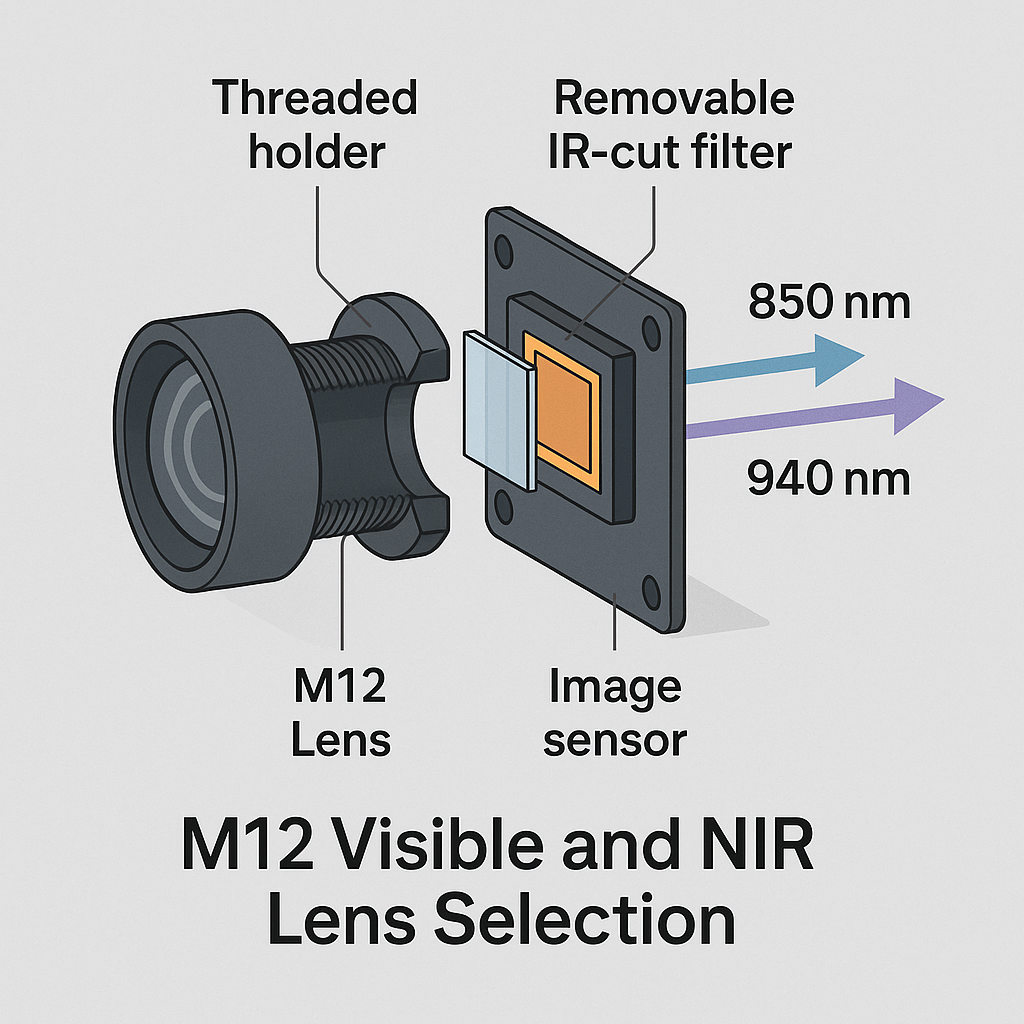
Key Takeaways
A defensible M12 Visible and NIR Lens Selection decision starts with the actual illumination band, sensor, filter position and required focus behavior—not a general IR-compatible label.
- Classify the camera as visible-only, NIR-only or day/night before comparing lens specifications.
- Evaluate 850 nm and 940 nm separately when both wavelengths may enter the product configuration.
- Approve the lens, sensor, filter, holder and focus-lock method as one optical assembly.
- Record focus position and image quality at the intended working distance, aperture and illumination wavelength.
- Tie production purchasing to identified samples, measurable acceptance limits and controlled filter configurations.
The Short Answer
M12 Visible and NIR Lens Selection should begin by fixing the operating mode: visible-only, 850 nm NIR, 940 nm NIR or switched day/night. Then evaluate the exact lens with the production sensor, filter, holder and working distance. An IR-compatible description does not establish acceptable focus or edge performance at a specified wavelength. Visible-only systems normally require a defined IR-cut arrangement; NIR-only systems need an appropriate pass or band-pass strategy; dual-mode systems require separate evidence for each state. Approval should record focus position, image quality and whether switching wavelengths requires refocus.
Define the Required Visible and NIR Operating Bands First
A lens request stating only “IR compatible” leaves the supplier unable to determine whether the camera will operate in visible light, at 850 nm, at 940 nm or across multiple modes. Those are different approval conditions even when the mechanical lens interface is unchanged.
Separate the requirement into one of three operating models:
- Visible-only: Color or monochrome imaging under the specified visible illumination, with a controlled IR-cut filter configuration.
- NIR-only: Imaging under a named NIR source, such as 850 nm or 940 nm, without an unintended IR-blocking element in the optical path.
- Day/night: Visible imaging in one state and NIR imaging in another, usually requiring two filter and focus conditions to be assessed.
The distinction also prevents NIR requirements from being confused with SWIR. The bands require different sensor and optical decisions; see this overview of visible light lenses, NIR, and SWIR compatibility when an application extends beyond conventional visible/NIR imaging.
Record the LED or laser center wavelength provided by the illumination supplier, the sensor model, and the expected scene. Sensor response must come from the sensor manufacturer’s data or measured assembly results. Lens terminology alone cannot establish system sensitivity.
A verified M12 selection guide identifies the format as a compact lens with a 12 mm-diameter thread, also known as S-mount. It also lists sensor size, resolution, NIR sensitivity, aperture and operating temperature among the selection factors. The same M12 lens engineering guide notes that visible-block, IR-pass, band-pass and narrow-band filter options are available for NIR camera configurations.
Compare M12 Lens Configurations by Wavelength and Filter Choice
Visible imaging with an IR-cut configuration
For a visible-only camera, define the IR-cut component by part number or approved transmission specification rather than merely requiring “IR cut.” Its position—integrated with the lens, attached to the sensor package, installed in the holder or supplied as a separate window—belongs in the controlled assembly definition.
Image samples should use the production-intent filter. Testing the lens without it does not reproduce the purchased optical stack.
NIR imaging without an IR-cut filter
An M12 NIR lens request should name 850 nm, 940 nm or both. It should also state whether the system uses an IR-pass, visible-block, band-pass or narrow-band filter. These are recognized filter categories for NIR camera configurations, but their suitability must be established against the source spectrum and sensor response.
Buyers comparing infrared camera lenses for NIR imaging should request wavelength-specific samples rather than infer performance from the product-family name.
Dual visible and NIR imaging
A removable or switchable filter is a candidate architecture for day/night operation, not proof that one focus setting will work in both states. Approve the visible state and each NIR state independently. If the design cannot refocus, the acceptance plan must test whether one locked position satisfies every required mode.
Integrated versus separate filters
Engineering inference: An integrated filter can reduce separate purchased parts, but it couples the lens and filter into one qualification and replacement unit. A separate filter permits independent sourcing or switching, while adding another controlled part, position and assembly tolerance. The better choice depends on service strategy, space, contamination control and whether multiple spectral states are required.
Selection Table: Operating Band, Filter Arrangement, Focus Requirement, and Evidence
The M12 Visible and NIR Lens Selection matrix below is an approval framework, not a claim that every listed configuration will meet performance. An IR-compatible label alone does not confirm acceptable focus, contrast or field uniformity at the intended wavelength.
M12 Visible and NIR Lens Selection Matrix
| Operating mode | Primary illumination condition | Lens spectral requirement | Filter arrangement | Focus requirement | Typical approval evidence needed |
|---|---|---|---|---|---|
| Visible-only | Defined visible source or scene | Evaluate across the specified visible condition | Controlled IR-cut part and position | Lock focus under production filter stack | Center/edge images, FOV and focus position |
| 850 nm NIR-only | Named 850 nm source | Evidence at 850 nm | No unintended IR cut; define pass filter if used | Focus and lock at 850 nm | 850 nm images at intended distance and aperture |
| 940 nm NIR-only | Named 940 nm source | Evidence at 940 nm | No unintended IR cut; define pass filter if used | Focus and lock at 940 nm | 940 nm images and recorded focus position |
| Visible plus 850 nm | Day visible; night 850 nm | Evidence in both modes | Fixed, removable or switchable arrangement as designed | Verify common focus or document refocus | Matched visible/850 nm samples from one assembly |
| Visible plus 940 nm | Day visible; night 940 nm | Evidence in both modes | Defined day/night filter states | Verify common focus or document refocus | Matched visible/940 nm samples and switch-state record |
| 850 nm plus 940 nm evaluation | Both NIR sources may be used | Separate evidence at each wavelength | Filter must support approved source states | Compare focus positions at both wavelengths | Identified 850/940 nm samples and acceptance results |
Evaluate Focus Shift Between Visible, 850 nm, and 940 nm
A visible-focus result must not be assumed to hold at 850 nm or 940 nm. The verified source supplied for this article confirms that an M12 lens can be focused by tightening it into its mount because lens-to-sensor distance is adjustable. It does not quantify wavelength-dependent focus shift for a particular lens. That question therefore requires assembly-level evidence.
Set the priority before samples are built:
- A fixed-band camera can be focused and locked in its production wavelength condition.
- A day/night camera with no focus actuator needs one position that passes the limits for all required states.
- A system permitted to refocus should define the mechanism, travel, repeatability criterion and command state in its own design specification.
A useful sample sequence holds the sensor, holder, target distance and aperture constant, then captures visible, 850 nm and 940 nm results as applicable. Record the lens rotation or axial focus reference for each state. Do not rely only on a visually attractive center image; include the image locations that matter to the task.
Illustrative acceptance plan, not a reported test: An access-control camera operating in daytime visible and nighttime 940 nm could be evaluated at its installed subject distance. The OEM would compare both modes at one locked position. If either misses the predefined image-quality limit, the choices are a different lens, controlled refocus or revised system requirements—not an unsupported “IR corrected” designation.
Specify the Complete M12 Optical Assembly, Not Just an IR-Compatible Lens
The controlled configuration should identify the lens revision, sensor, holder, filter, spacer or window, focus depth and locking material or method. M12 threads permit focus adjustment, so thread compatibility alone does not fix the lens-to-sensor spacing.
Sensor format and resolution are recognized compatibility inputs. The active area must also sit within the usable image field established during approval. Applications sensitive to corners can use the same review logic applied to machine vision lens image circle and edge quality.
Aperture is another controlled condition. The verified source states that a larger aperture admits more light with shallower depth of field, while a smaller aperture admits less light with deeper depth of field. Samples captured at an unrepresentative aperture may therefore produce a misleading focus decision.
For broader sourcing, optical lens assemblies for camera integration should be evaluated as assemblies rather than isolated catalog lenses. Incoming inspection can then check identifiable items: lens marking or lot, filter part, holder revision, locked focus reference and a defined image test.
Temperature limits should be included when relevant, but no thermal focus performance should be assumed without data for the candidate assembly. The supplied verified source lists operating temperature as a selection factor; it does not provide temperature performance for any specific product.
Request Approval Evidence for a Visible and NIR Lens
Evidence should correspond to the operating state rather than a broad product description. Ask for:
- Images or measured resolution/contrast results at each required wavelength.
- Center and task-relevant field positions, including edges where they affect detection or inspection.
- Sensor, filter, holder, aperture, working distance and illumination identification.
- Focus position for each state and a statement of whether refocus was used.
- Sample serial or lot identification linked to the proposed production configuration.
Where no numerical image-quality limit exists, establish one before supplier approval. A reference image can support review, but a measurable threshold is easier to apply across inspectors and production lots. The exact metric should follow the camera task; this article does not prescribe a universal value.
Configuration control matters as much as the initial result. A passing sample with one filter cannot qualify a production assembly using another filter unless equivalence is demonstrated under the OEM’s change process.
How to Select an M12 Lens for Visible and NIR Wavelengths
Use this decision path for M12 Visible and NIR Lens Selection:
- Visible-only system: Identify sensor and image requirements, approve the IR-cut component and focus with the complete optical stack.
- 850 nm or 940 nm NIR system: Name the actual wavelength, remove conflicting filter assumptions and test with the production-intent source.
- Day/night system: Define each filter state, test every required band and decide whether common focus or controlled refocus is acceptable.
- Both 850 nm and 940 nm: Treat them as separate evidence conditions. Approval at one does not qualify the other.
- Production release: Freeze the lens, filter, sensor, holder and focus-lock configuration against the approved sample record.
This path does not replace field-of-view, focal-length, distortion or mechanical checks. Those remain part of M12 lens selection even when spectral compatibility is the immediate sourcing issue.
Prepare an RFQ and Approval Package for Wavelength-Specific M12 Lens Supply
A usable RFQ includes the sensor model and active format, required field of view, working distance, aperture condition, visible/NIR mode, 850 nm and/or 940 nm source, filter arrangement, holder interface, environmental limits and permitted focus behavior.
The purchase specification should then identify:
- Lens and filter part numbers or controlled performance requirements
- Filter location and each switch state
- Focus-setting and locking process
- Required wavelength-specific evidence
- Sample quantity and identification method
- Acceptance limits and change-notification expectations
For the wider sourcing document, use this guide to custom lens requirements for an OEM RFQ and attach the wavelength matrix to the quotation package.
Request a wavelength-specific M12 lens evaluation. Supply the camera sensor, operating modes, 850 nm and/or 940 nm illumination details, working distance, field of view, aperture, filter configuration and required focus behavior. The objective is an approved optical assembly with traceable evidence, not an unqualified IR-compatible part number.
Frequently Asked Questions
Can the same M12 lens be used with both 850 nm and 940 nm illumination?
Possibly, but approval at one wavelength does not establish performance at the other. Test the exact lens, sensor, filter and holder at 850 nm and 940 nm using the intended distance and aperture. Record focus position, center and edge image quality, and whether either mode requires refocus before approving one part for both.
What information should be included in an M12 NIR lens sample request?
Include the sensor model, active format, illumination wavelength, source details, working distance, field of view, aperture, filter type and location, holder interface, environmental range and permitted focus behavior. Also state the image locations and acceptance method to be evaluated, plus how each sample and configuration must be identified.
Does an IR-cut filter need to be matched to the camera sensor and illumination source?
Yes, the filter must be evaluated as part of the specific optical assembly. Its controlled transmission requirement should align with the intended visible mode, sensor response and any NIR source that must be blocked or passed. Approval should use the production-intent filter rather than images captured with an unspecified substitute.
When is a separate IR filter preferable to an integrated filter arrangement?
A separate filter may be preferable when the camera needs switchable day/night states, independent filter sourcing or service replacement without changing the lens. This is an engineering trade-off, not a universal rule. The design must also control filter position, cleanliness, mechanical tolerance and the resulting focus condition during assembly approval.
What should an OEM approve before releasing a visible and NIR camera assembly to production?
Approve the identified lens, sensor, filter, holder, spacer and focus-lock configuration together. Evidence should cover every required wavelength, working distance and aperture condition, including relevant field positions. The release record should define acceptance limits, approved sample identities, focus or refocus behavior, incoming checks and the process for evaluating component changes.
Topics
Related Articles
M12 Lens Resolution and CRA: Matching Optics to the Camera Sensor
11 min read
M12 Working Distance and Aperture: Specifying Usable Depth of Field
11 min read
M12 Fisheye vs Rectilinear Lenses: Matching Coverage to Camera Tasks
10 min readAbout SUPERIOR OPTICS
SUPERIOR OPTICS specializes in CCTV lenses, machine vision optics, and custom optical solutions for security, industrial imaging, and specialty applications. We also provide professional lens selection and application support.