
M12 Working Distance and Aperture: Specifying Usable Depth of Field
A buyer-focused method for selecting an M12 lens across a defined object-distance range, balancing aperture, illumination, diffraction and task-level image quality.
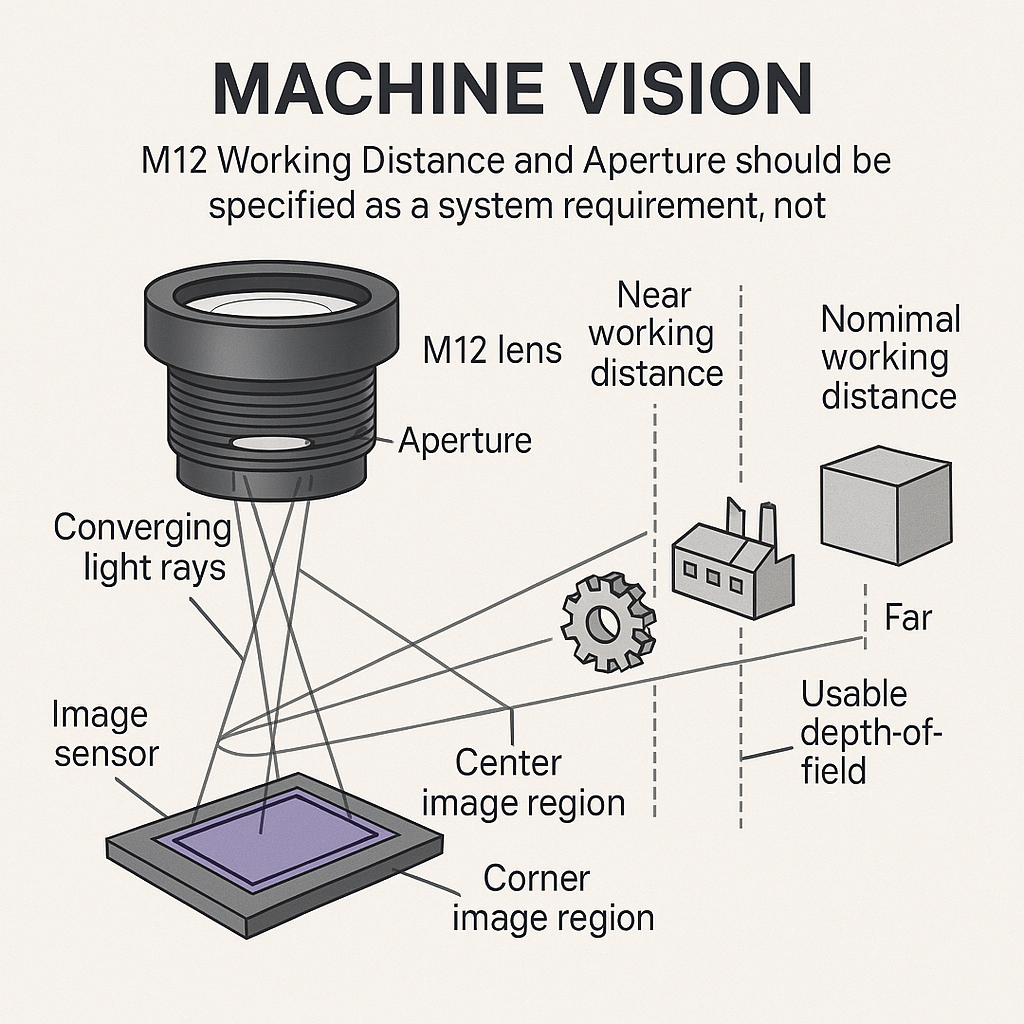
Key Takeaways
A defensible M12 Working Distance and Aperture specification connects the complete object-distance range to a measurable image-quality threshold and the lighting available in the installed system.
- Approve a lens against minimum, nominal and maximum object distances—not one favorable focus position.
- Define acceptable sharpness through target-detail visibility, MTF or inspection performance rather than an undocumented visual judgment.
- Treat a smaller aperture as a trade-off: it can increase focus tolerance but reduces light and eventually increases diffraction blur.
- Choose finite-conjugate or infinity-oriented optics according to the required object range, not the holder’s ability to reach center focus.
- Request customization only after testing whether lighting, exposure, mounting tolerance or a stock aperture can meet the documented requirement.
The Short Answer
M12 Working Distance and Aperture should be specified as a system requirement, not as isolated catalog values. Record the nearest, nominal and farthest object positions; active sensor dimensions; pixel pitch; smallest relevant feature; illumination band; exposure ceiling; and an objective pass/fail criterion. Select the aperture by testing whether added depth tolerance outweighs lost light and diffraction. Compare finite-conjugate and infinity-oriented lenses at every required distance, including image corners. Approve the configuration only when it passes under installed lighting and mechanical tolerances.
A sharp frame at the nominal station position proves only that the lens, sensor and focus setting worked for that frame. It does not establish usable depth of field across component-height variation, camera mounting tolerance or changing illumination.
A practical selection sequence is:
- Record the minimum, nominal and maximum M12 lens working distance.
- Add object-position and installation tolerances to that range.
- Set a measurable image or inspection acceptance criterion.
- Document illumination, exposure and fixed-aperture constraints.
- Compare finite-conjugate and infinity-oriented options over the complete range.
Define the Operating Range Before Selecting an M12 Lens
Specify the minimum, nominal and maximum object distances
Working distance may be measured from the front of the lens housing to the object, but suppliers do not necessarily use the same reference. The RFQ and drawing should identify the datum explicitly. Separate the closest permitted object position from the nominal setup distance and the farthest position.
Field of view, focal length, sensor coverage and distance are interdependent. Establish those inputs using a consistent method for machine vision lens working distance, field of view, and sensor selection before comparing depth-of-field claims.
Document object-position variation and installation tolerances
The operating band should include more than product variation. Camera-bracket tolerance, lens-holder position, sensor-stack spacing and assembly movement can shift the actual conjugates. A fixed M12 assembly focuses by moving in its threaded holder, but usable movement is limited by thread engagement and clearance from the sensor stack.
Engineering inference: if the optical requirement barely passes with the holder at the edge of safe travel, production units are likely to have little allowance for stack-up variation. That condition warrants a mechanical review even when the sample image appears acceptable.
Set an acceptance criterion for allowable image degradation
“Looks sharp” is not a purchase specification. Use the smallest feature that must be resolved, a contrast threshold at a relevant spatial frequency, edge-localization error or the pass rate of the intended inspection algorithm. Apply the criterion at the center and required field positions.
The relevant lens specifications, including F-number and MTF help translate a visual preference into a testable requirement. A published depth-of-field value is incomplete unless its sharpness criterion and test conditions are known.
Record illumination conditions, exposure limits and aperture constraints
State the illumination spectrum or band, geometry, expected intensity range and whether the source is continuous or strobed. Also record the maximum exposure permitted before motion or throughput becomes unacceptable. Many M12 lenses have a fixed aperture, so F-number may be a configuration choice rather than an adjustment available during commissioning.
How Working Distance and Aperture Determine Usable Depth of Field
Why one sharp image does not prove production-range performance
Depth of field is the range of object distances that remain acceptably sharp at one focus setting. According to the Edge AI and Vision Alliance’s depth-of-field guidance, it depends on F-number, focal length, working distance and the permissible circle of confusion.
Center focus does not guarantee sharp corners. At short distances, field curvature, astigmatism and spherical aberration can change with object position. Test both the nearest and farthest required positions across the field instead of refocusing for every image.
How aperture affects depth of field, light and image quality
Closing the aperture generally increases geometric depth of field and reduces sensitivity to small focus errors. The cost is lower light throughput. Each full stop halves the light, potentially requiring a longer exposure or greater strobe output. Continued stopping down eventually increases diffraction blur, including at points that are otherwise in focus.
Treat M12 Working Distance and Aperture as a coupled decision: an aperture that expands the geometric sharp zone may still fail if exposure produces motion blur or diffraction removes contrast from the target detail.
Evaluate the complete distance range
Lock the selected focus position, then capture the same target at the required near, nominal and far distances. Preserve illumination, exposure, gain, image processing and target orientation. Refocusing between positions measures what the holder can reach; it does not measure depth of field at one production setting.
Account for sensor resolution and inspection tolerance
Permissible blur must relate to the sensor and task. Record active sensor dimensions, pixel pitch and the smallest relevant feature. Relaxing the circle-of-confusion criterion makes a calculated depth-of-field range appear larger without changing the physical image. Task-level MTF or measured inspection performance is therefore more useful than a depth number with no acceptance basis.
M12 Lens Aperture Selection: Balance Depth of Field Against Available Light
When a smaller aperture helps
Stopping down is a rational first experiment when failures are caused by modest object-height or focus-position differences and the system has sufficient light. It can also reduce the need for repeated mechanical focus adjustment. The result still has to pass at the field positions used by the application.
Where stopping down creates another failure
A smaller aperture can force longer exposure, higher gain or more illumination. Longer exposure may increase motion blur; gain can make weak detail harder to classify; greater source power may be limited by thermal, packaging or strobe constraints. Diffraction sets another boundary, so the smallest available aperture is not automatically the safest choice.
Fixed, adjustable or illumination-led correction
A fixed aperture removes an operator adjustment and suits a controlled production configuration once validated. An adjustable iris is useful during development or where lighting genuinely changes, but its approved setting and locking method need documentation. Alternatively, improved illumination may permit a smaller fixed aperture without extending exposure.
Validate under installed lighting
Bench lighting can hide a throughput problem. Repeat the range test with the production source, diffuser, filters, enclosure and exposure controls. Where illumination ages or varies, test the documented low-light boundary rather than only the nominal level.
Choose Between Finite-Conjugate and Infinity-Optimized M12 Lenses
When finite-conjugate correction fits
A finite-conjugate M12 lens is corrected for an object at a finite distance. It is a logical candidate for close inspection, identification or viewing where the working band is known. The designation does not guarantee equal performance at every nearby distance, so the actual near and far limits still require testing.
When infinity-oriented correction fits
An infinity-optimized M12 lens is more appropriate when distant scenes dominate and infinity performance must be retained. Adding extension can move its focus range closer, but extension does not recorrect aberrations and usually sacrifices infinity focus. Reaching center focus at close range is therefore not evidence that the optical design is suitable there.
Focus travel is not optical optimization
Focus adjustment changes lens-to-sensor spacing. Optical optimization concerns how aberrations are corrected for the intended object and image conjugates. The working-distance guidance for machine-vision assemblies notes that image quality can remain aberration-limited even when an M12 holder reaches center focus.
Stock fixed focal length lenses can be suitable when their sensor coverage, correction distance, aperture and mechanical interface match the documented operating band.
Configuration Comparison: M12 Working Distance and Aperture Options
| Configuration or use case | Object-distance condition | Aperture priority | Primary evaluation focus | Validation requirement | Customization consideration |
|---|---|---|---|---|---|
| Fixed, controlled distance | Narrow band around one station position | Light and required contrast | Center and corner quality at the fixed setup | Test tolerance limits without refocusing | Stock configuration is often the first candidate |
| Variable finite distance | Defined near-range band | Focus tolerance balanced against exposure | Feature contrast through the range | Test near, nominal and far positions | Review finite-conjugate correction if stock performance changes materially |
| Long-distance viewing | Distant scene or infinity requirement | Light collection and distant detail | Infinity correction and field performance | Test representative distant targets | Avoid extension if infinity must be retained |
| Variable distance, limited light | Broad range with constrained illumination | Throughput may override maximum geometric depth | Motion, noise and target contrast | Test worst-case light and exposure | Consider lighting changes before custom aperture work |
| Strict acceptance threshold | Any range with quantified image criteria | System MTF or task result | Smallest feature and required field positions | Run the defined pass/fail test on the installed system | Optical review is justified if standard options miss a documented threshold |
A stock part is sufficient only when it passes the same criterion over the complete mechanical and optical range expected in production. Customization becomes defensible when the failure is repeatable, attributable to the optical configuration and not more economically corrected by lighting or mounting changes.
Validate the Lens Across the Intended Operating Range
Test the boundary positions
Use the production sensor, holder, cover glass or filter stack and target. Set focus once, then evaluate the nearest, nominal and farthest object positions. Include intermediate positions if the failure mode is non-monotonic or the application moves continuously.
Apply the defined acceptance criterion
Measure the relevant detail at the center and required corners or field zones. Preserve raw images and processing settings. If the acceptance decision depends on an algorithm, run that algorithm rather than substituting a general-purpose sharpness score.
Verify installed stability
Check production illumination, exposure, gain and aperture. Record how the lens is locked, the permitted focus position or torque-controlled assembly method, and any holder travel limits. For systems that require field-of-view adjustment as well as focus, assess whether varifocal length lenses are mechanically and optically appropriate; adjustment range does not remove the need for boundary testing.
Freeze the approved configuration
The purchase specification should identify the lens revision, aperture, sensor and stack, focus or assembly condition, distance datums, illumination band, exposure limits and acceptance method. Without those controls, a nominally equivalent replacement can alter depth of field or corner performance while retaining the same focal-length label.
When to Request a Customized M12 Aperture or Optical Assembly
Start with the observed limitation
Describe where the stock configuration fails: near distance, far distance, corner, spectral band, exposure limit or target-detail threshold. Include passing and failing images captured under controlled settings. A request for “more depth of field” is less actionable than a documented contrast failure at a specified object boundary.
Check non-optical remedies first
Reduced object-height variation, tighter camera mounting, more illumination or a revised exposure limit may solve the problem with lower qualification risk. Engineering inference: this comparison should include the cost of maintaining the remedy in production, not just prototype feasibility.
Escalate when the standard configuration cannot pass
A customized aperture may be justified when a required F-number is unavailable as a stable stock configuration. A broader optical redesign may be needed when aberration correction, sensor coverage, chief-ray behavior, spectrum or package constraints—not aperture alone—cause the failure. The framework for when to choose COTS versus custom optical lenses can support that sourcing decision.
Prepare an engineering-ready request
For an M12 Working Distance and Aperture review, provide active sensor dimensions, pixel pitch, minimum/nominal/maximum object positions with measurement datums, field of view, smallest target feature, required field positions, illumination band, exposure ceiling, mounting envelope and pass/fail criterion. Compare a stock fixed-aperture option with a custom assembly only after the validation record identifies the unresolved limitation.
Frequently Asked Questions
What information should I provide when requesting an M12 lens recommendation?
Provide active sensor dimensions, pixel pitch, minimum, nominal and maximum object distances with their measurement datum, required field of view, smallest relevant feature, illumination spectrum, exposure limit and available mounting space. Add a measurable center-and-corner acceptance criterion plus production tolerances for the holder, sensor stack and object position.
Can an M12 lens maintain acceptable focus at more than one working distance?
Yes, if every required distance falls within the lens-and-system’s usable depth of field under the chosen acceptance criterion. Lock focus at the intended production setting and test the nearest, nominal and farthest positions without refocusing. Sensor resolution, aperture, focal length, aberrations and target-detail requirements all affect the result.
Should I choose a fixed-aperture or adjustable-aperture M12 lens for a controlled-lighting system?
A fixed aperture is usually the first configuration to evaluate when illumination, exposure and object range are controlled because it removes an adjustment from production. An adjustable iris is useful during development or where conditions truly vary, but the approved setting, locking method and worst-case light performance must be documented.
What is the difference between lens focus adjustment and an optical design optimized for a specific distance?
Focus adjustment moves the optical assembly relative to the sensor so one object plane forms its sharpest image. Optimization addresses aberration correction for intended object and image distances. A holder may reach center focus outside the design range while corners or fine detail remain degraded, so travel alone cannot establish suitability.
When is a custom M12 lens configuration more appropriate than a stock lens?
Customization is appropriate when a stock lens repeatedly misses a documented optical, aperture, spectral, packaging or image-quality requirement across the intended operating range. First test whether illumination, exposure, mounting tolerance or another stock design resolves the failure. Escalate with controlled images, mechanical constraints and a quantitative acceptance criterion.
Topics
Related Articles
M12 Fisheye vs Rectilinear Lenses: Matching Coverage to Camera Tasks
10 min read
M12 Sensor Coverage and Field of View: Comparing Lens Specifications
10 min read
M12 Lens Selection: Building RFQ and Approved Purchase Specification
10 min readAbout SUPERIOR OPTICS
SUPERIOR OPTICS specializes in CCTV lenses, machine vision optics, and custom optical solutions for security, industrial imaging, and specialty applications. We also provide professional lens selection and application support.