


Lens Specifications Explained: Focal Length, F-Number, and MTF
A buyer-focused comparison framework for focal length, aperture, MTF, distortion, field illumination and transmission, with condition-controlled sample checks.
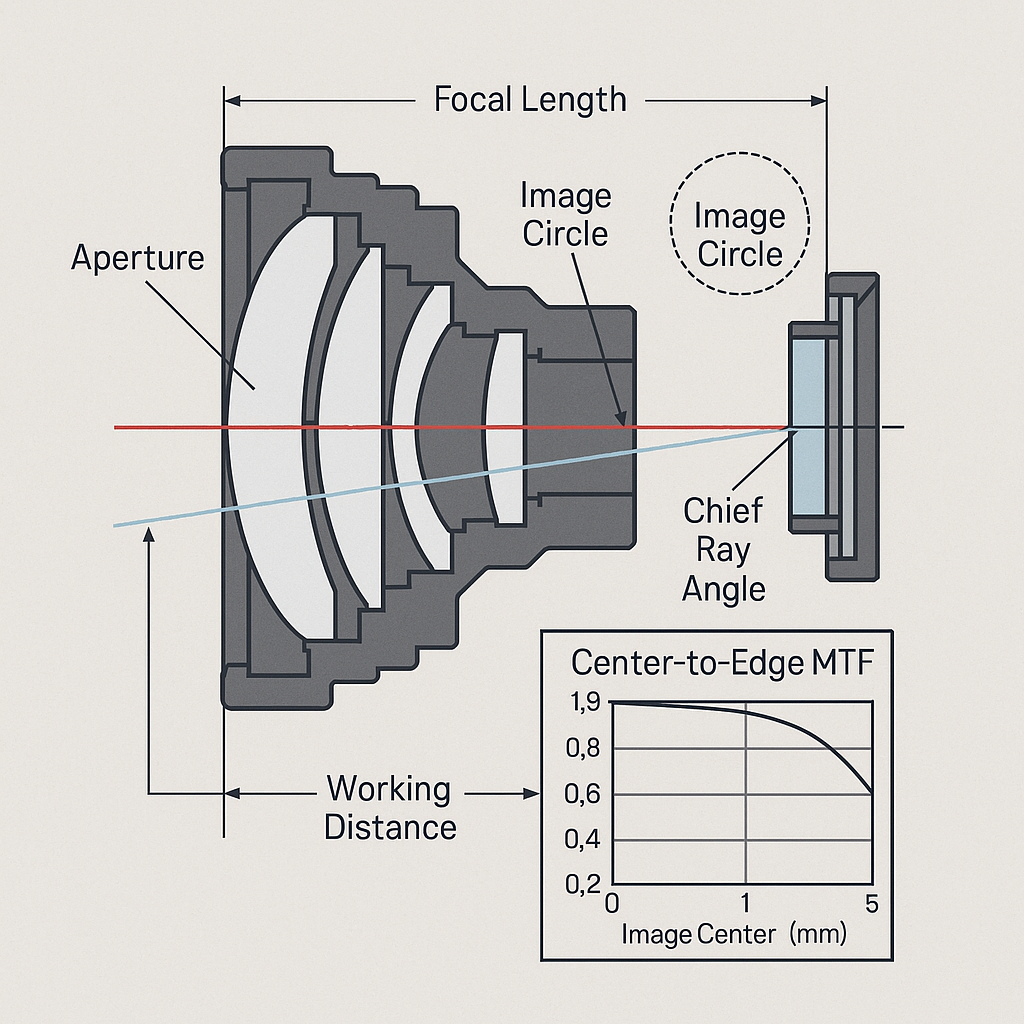
Key Takeaways
Lens specifications become useful purchasing evidence when each value is tied to a defined test condition and a real imaging requirement. Compare coverage, detail, geometry and spectral behavior separately.
- Interpret focal length with sensor dimensions and working distance, and aperture with the intended exposure and depth range.
- Compare MTF at the same frequency, field position, aperture, spectrum and focus condition.
- Treat distortion as a geometric mapping issue and distinguish it from blur and perspective error.
- Request wavelength-dependent transmission and system-level illumination evidence rather than relying on a coating label.
- Separate nominal design data, sample measurements and production acceptance requirements before approving a supplier.
The Short Answer
Lens specifications describe how an optical assembly frames the scene, covers a sensor, transfers contrast and behaves under defined operating conditions. To evaluate optical performance, compare focal length and f-number together with MTF, distortion, relative illumination and spectral transmission. Ask for the test distance, aperture, wavelength band, field positions and measurement method behind each result. A single megapixel rating or center-only curve cannot establish application suitability. Use supplier evidence to shortlist a lens, then validate the intended sensor, illumination, filters, mounting and image processing on representative objects before production approval.
Turn Datasheet Labels Into Comparable Evidence
A purchasing table often reduces each lens to a handful of numbers. That is convenient for screening, but the missing conditions can decide whether the comparison is meaningful. Schneider-Kreuznach’s discussion of lens datasheets explains why buyers need to look beyond labels and apparently equivalent specifications.
Use this structure to separate the question from the evidence:
| Lens specification | What it helps answer | Evidence to request |
|---|---|---|
| Focal length | Will the required scene fit with the chosen camera and distance? | Lens-specific field data at the intended focus condition |
| F-number | Is the aperture suitable for the light and depth requirements? | Operating stop, relevant image-quality curves and exposure trial |
| Image circle | Can the lens support the required sensor area? | Usable diameter plus edge illumination and detail evidence |
| MTF | How much contrast remains at relevant detail frequencies? | Field-dependent curves with matched operating conditions |
| Distortion | How does geometric mapping depart from the intended model? | Definition, field plot, test distance and spectrum |
| Relative illumination | How does response vary across the field? | Normalization, aperture, sensor area and measurement conditions |
| Spectral transmission | What fraction of light passes through the lens across wavelength? | Full-assembly spectral data and the relevant optical path |
The table is a comparison framework, not a list of guaranteed SUPERIOR capabilities or numeric acceptance limits. Set those limits from the application’s needs and verify which evidence a proposed model actually has.
Read Focal Length and F-Number in Context
Focal length is useful for framing only when the sensor area and object distance are known. Two cameras using the same lens can record different fields if their active sensor dimensions differ. For the calculation sequence, use the FOV, sensor and distance selection guide.
The f-number is the focal length divided by entrance-pupil diameter. It describes an aperture relationship, not measured full-system transmission. When other conditions remain comparable, aperture choices affect exposure, depth of field, aberrations and diffraction. The most useful operating stop therefore depends on the required result, not simply the smallest or largest number on the iris. See Edmund Optics on aperture and system throughput for the underlying distinction.
Request performance at the intended stop and distance. If a supplier supplies only wide-open or infinity-focused curves, document the gap before treating them as proof for a stopped-down, close-range inspection.
Evaluate MTF at the Frequencies and Field Positions That Matter
MTF describes contrast transfer as a function of spatial frequency. Edmund Optics’ MTF explanation shows why curves must be interpreted with their operating conditions and image-field positions.
Read the axes first. Check whether frequency is expressed in image-space line pairs per millimeter, object-space units or another convention. Then identify center and off-axis curves, and the supplier’s sagittal and tangential definitions where used. Do not rank lenses from unmatched frequency scales or compare a center result with a corner requirement.
For a square-pixel sensor, a sampling reference is:
Sensor Nyquist frequency (lp/mm) = 1000 / (2 × pixel pitch in micrometers)
An illustrative 3.125 micrometer pixel pitch gives 160 lp/mm. This is a sampling limit, not a guarantee of useful contrast at that frequency or an instruction to accept a particular MTF percentage. Edmund Optics’ resolution guide explains the sensor-sampling relationship.
Translate the actual feature requirement into an optical review with the engineering team. For a code near the field edge, the relevant edge performance may control approval even when the center is excellent. Also check the frequency range below Nyquist that matters to the algorithm. Processing and sampling can change the final camera result. For a deeper camera-level treatment, read Machine Vision Lens MTF: Match Resolution to Camera Pixel Size.
| MTF comparison item | Comparable evidence requires |
|---|---|
| Frequency | Same units and the nominated evaluation frequencies |
| Field | Same image positions or a clearly matched coverage map |
| Aperture and focus | Same operating stop and object-distance condition |
| Spectrum | Same band or an agreed spectral weighting |
| Data status | Clear identification of design, sample measurement or guaranteed limit |
| Test method | Documented target or measurement method and relevant processing |
Distinguish Distortion, Blur and Perspective
Distortion changes the geometric mapping of object positions. Blur reduces the separation or contrast of detail. Perspective causes apparent shape or size to change with viewpoint and object depth. They need different tests and should not share one vague image-quality score.
Ask whether a distortion figure is maximum geometric distortion, a TV-style metric or a value at a particular field location. Edmund Optics’ distortion note explains why different definitions and field behavior matter. A small value under one definition cannot be assumed equivalent to another supplier’s specification.
Test a suitable calibration target at the intended distance, aperture, spectrum and focus. Record residual error after any calibration or remapping required by the application. Calibration should be evaluated as part of the complete measurement process; it should not be presented as a way to recover detail already lost to optical blur.
Evaluate Transmission Separately From Field Brightness
Spectral transmission describes throughput versus wavelength. Relative illumination describes how response varies across the field, usually normalized to a reference region. These are different questions: a uniform image can be dim overall, while a lens with useful central throughput can have unacceptable peripheral falloff.
For wavelength-sensitive applications, ask for transmission of the complete lens assembly and identify whether the data include the camera filter or protective window. A coating’s stated range does not, by itself, establish the transmission of every glass element or the assembled optical path. Edmund Optics’ SWIR-coated lens note provides a component-level example of coating bandwidth and substrate transmission being separate limitations.
Do not use that component example to assign a band or throughput to another lens. For a SWIR project, review the SUPERIOR SWIR lens family with the specific sensor, source spectrum and filter requirements attached to the inquiry.
Build a Repeatable Sample Test
The following is a suggested qualification record, not a report of tests performed by SUPERIOR.
| Check | Practical test record | Acceptance rule |
|---|---|---|
| Coverage and corner detail | Full-field target on the intended camera | Required regions pass the agreed image criterion |
| Depth and focus | Near, nominal and far object positions without unrecorded refocusing | Task remains usable across the specified range |
| Geometry | Calibration target before and after the intended correction | Residual error fits the application’s error budget |
| Brightness and spectrum | Controlled illumination and exposure, with the final filter stack | Signal and field variation stay within agreed limits |
| Assembly robustness | Final mount, focus lock and relevant operating conditions | The approved configuration remains repeatable |
Record lens and camera revisions, target identification, distances, illumination settings, exposure, gain and processing. Agree what happens when one of those inputs changes. Keep representative images and the evaluation method so another team member can reproduce the decision.
The M12 resolution and CRA guide explains a compact-camera compatibility check that should remain distinct from geometric coverage. The inspection-procedure page is a starting point for discussing which production and sample evidence is relevant to a SUPERIOR inquiry.
Convert Lens Specifications Into a Purchase Requirement
Use one controlled specification identifying the required application result, the nominated optical metrics, operating conditions, method and acceptance limits. State whether each supplier response is a nominal design target, measured prototype result or production commitment. Request clarification where a report’s configuration differs from the proposed camera assembly.
Bring the sensor model, feature requirement, field of view, working distance, wavelength and test expectations to SUPERIOR. Request an optical performance review before choosing a lens from headline numbers alone.
Frequently Asked Questions
What lens specifications matter most for optical performance?
The priority depends on the task, but review coverage, MTF, distortion, relative illumination, spectral transmission and the intended aperture and focus conditions. Connect each metric to an application requirement. A specification becomes useful evidence only when its definition, test method and operating conditions are clear enough to compare or reproduce.
Is a higher megapixel lens rating enough to guarantee sharper images?
No. A megapixel label does not necessarily disclose spatial frequency, aperture, wavelength, working distance or corner performance. Request the underlying optical data and test the intended camera configuration. Sampling, motion, illumination, mounting and processing also affect the recorded image, so a label cannot replace application-level validation or a controlled acceptance method.
What MTF percentage should every industrial lens meet?
There is no single percentage that establishes suitability for every task. Define the spatial frequency, field positions, aperture, spectrum and focus condition first. Then set the acceptable contrast or task outcome with the engineering team. A threshold from another application should not be copied without checking its measurement method and assumptions.
Can software remove all distortion and image-quality problems?
Calibration can correct a measured geometric mapping within the validated configuration, but it does not recover detail lost to blur or solve every perspective and signal problem. Evaluate the residual error and any resampling effects. Confirm that calibration remains valid when focus, distance, illumination band, mounting or camera configuration changes.
Does a broad coating range guarantee useful lens transmission across that range?
No. Coating performance is only one part of the optical path; substrate absorption, other elements, filters and windows also matter. Request full-assembly transmission for the required wavelength band and identify what is included in the data. Confirm image quality and usable camera signal under the intended illumination and exposure conditions.
Topics
Related Articles
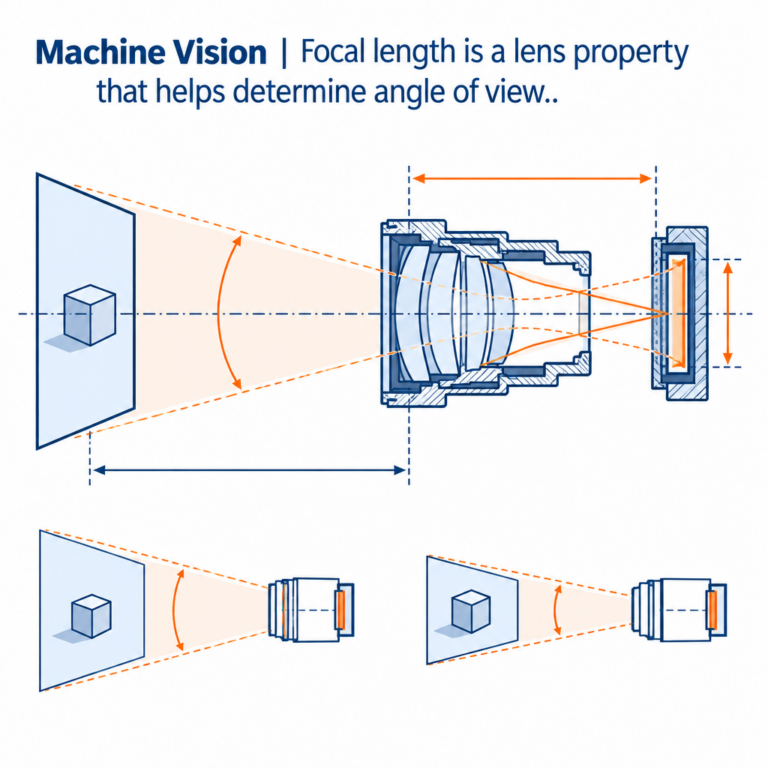
Understanding Focal Length and Field of View
12 min read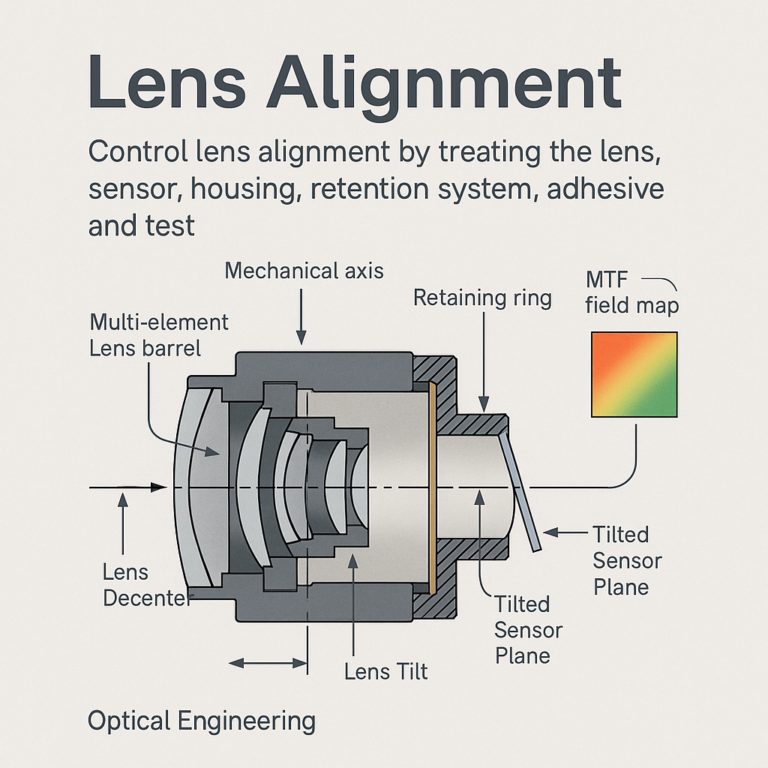
How to Control Lens Alignment, Tilt, Decenter, and MTF Degradation
11 min read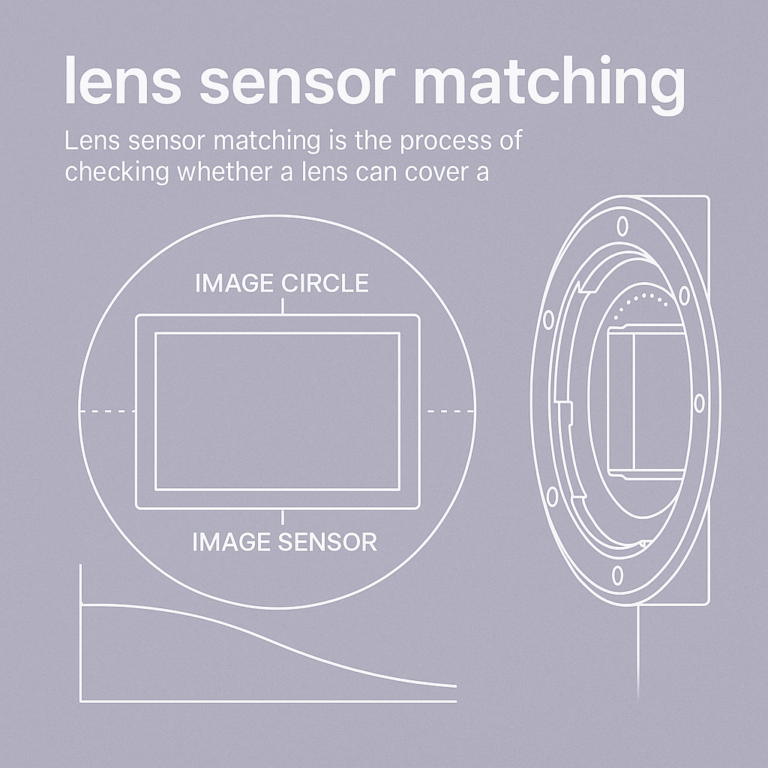
Lens Sensor Matching: Image Circle, Pixel Size and Mounts
8 min readAbout SUPERIOR OPTICS
SUPERIOR OPTICS specializes in CCTV lenses, machine vision optics, and custom optical solutions for security, industrial imaging, and specialty applications. We also provide professional lens selection and application support.