M12 Lens Selection: Building RFQ and Approved Purchase Specification
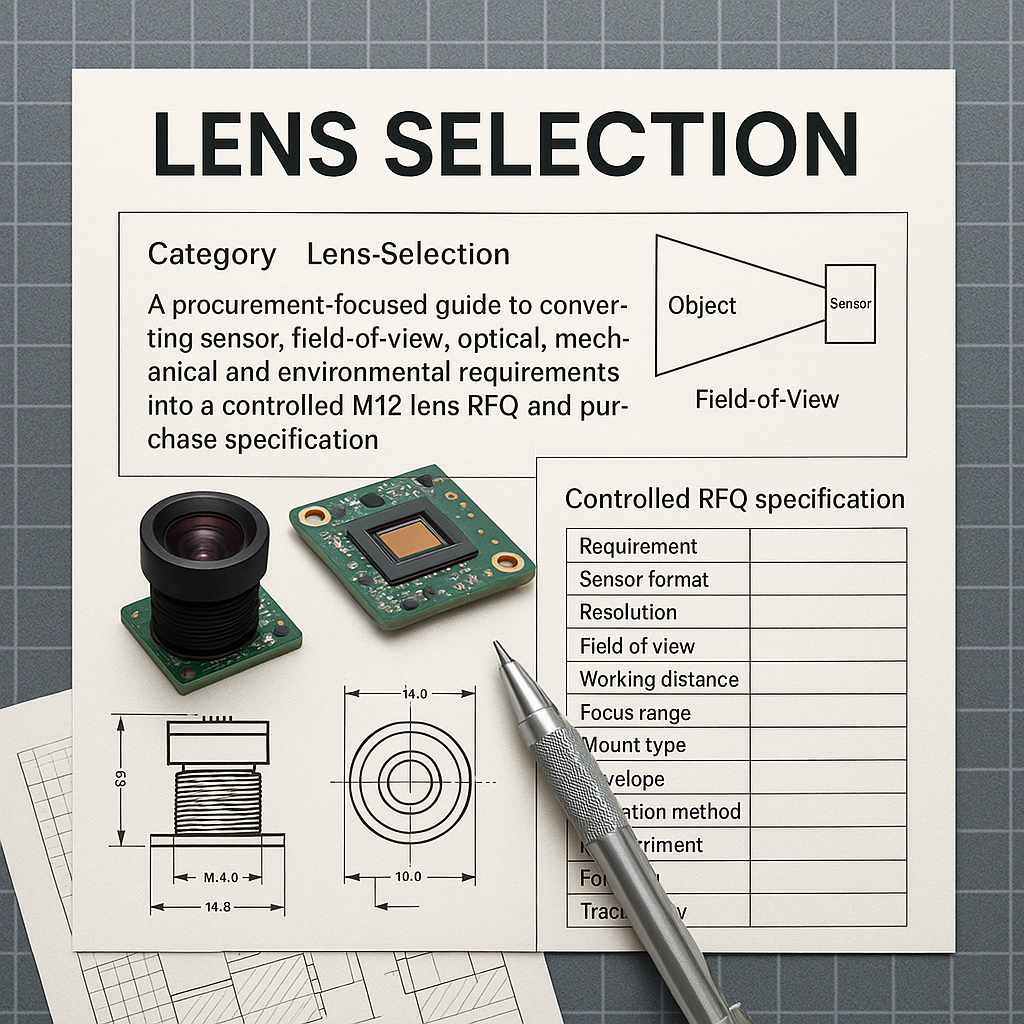
A procurement-focused guide to converting sensor, field-of-view, optical, mechanical and environmental requirements into a controlled M12 lens RFQ and purchase specification.
Key Takeaways
Successful M12 Lens Selection depends on translating the required image into measurable optical, mechanical, environmental and acceptance requirements before requesting a quotation.
- Specify sensor active area, field of view and working distance together; focal length alone does not define the captured scene.
- Classify each requirement as mandatory, target, preferred or open so suppliers can identify trade-offs without silently relaxing purchase requirements.
- Attach a test condition or method to every optical limit, including sensor, wavelength, focus distance, aperture and image-field position.
- Keep typical catalog data outside lot acceptance unless the supplier explicitly agrees to a guaranteed limit.
- Use the same controlled specification revision for the RFQ, engineering approval, first article and purchase order.
The Short Answer
Build the RFQ from the required image backward. Record the sensor and active area, object coverage, field of view, working distance, focus range, illumination and spectral band. Then add the mount interface, available envelope, retention method, operating environment, production forecast and traceability needs. Convert performance needs into measurable limits with stated test conditions. Separate contractual limits from typical catalog data, assign approval ownership and require written disclosure of exceptions before selecting a lens or releasing a purchase order.
M12 Lens Selection becomes a procurement problem when a catalog description must support repeatable production. A lens can fit the thread yet fail to cover the active sensor, clear nearby components, hold focus or deliver acceptable corner performance. The RFQ therefore needs to describe the complete camera configuration rather than a nominal focal length and price target.
Start With the Imaging Requirement, Not the Lens Part Number
Sensor format, active area, pixels and optical format
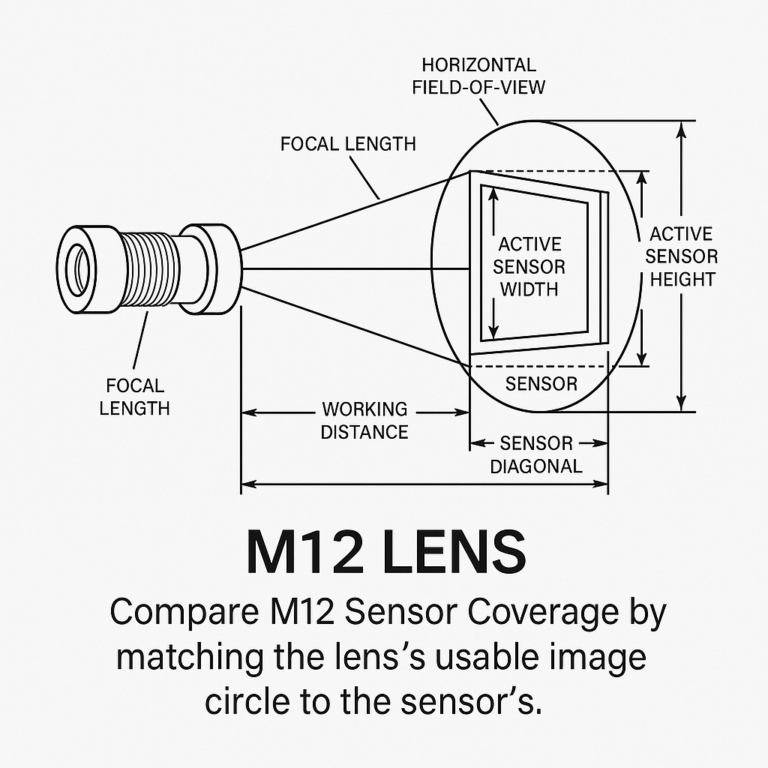
Record the sensor manufacturer and part number, active width and height, pixel pitch, color or monochrome configuration, cover-glass arrangement and orientation. Image-circle compatibility should be judged against the active-area diagonal and allowable corner shading, not only a broad format label. The lens selection guide from Optics Online confirms that field of view depends on both effective focal length and imager-area size.
Pixel size is not a stand-alone lens-resolution specification. Sampling, the color-filter array and processing chain affect the delivered image, while lens MTF varies with spatial frequency and field angle. State the task the camera must resolve and where in the field it must do so.
Field of view, working distance and object coverage
Give horizontal and vertical field of view at a defined working distance, including tolerances. If a 200 mm target needs 10% framing margin, the required horizontal field is 220 mm. That arithmetic defines coverage; it does not by itself select a focal length because distortion, principal-plane location and sensor dimensions still affect the final design.
For inspection systems, identify the smallest relevant feature, target depth variation and permissible perspective. The related guide to selecting a machine vision lens by field of view, sensor and distance provides a broader geometry workflow.
Resolution at the required field and focus distance
Replace terms such as “high resolution” with an agreed measurement: MTF at stated spatial frequencies and field positions, resolved feature size under a defined chart method, or application-level detection performance. Include focus distance, aperture, spectrum, sensor and processing state. Center-only data cannot establish corner performance.
Visible, near-infrared and day/night operation
Name the illumination source and wavelength band. For a day/night camera, define acceptable visible-to-infrared focus shift and whether refocusing is allowed. The embedded-camera M12 guide identifies near-infrared sensitivity, operating temperature, sensor size, resolution, aperture and distortion as relevant selection variables.
Where both spectral bands matter, use the test approach described in IR-corrected lens selection rather than assuming an IR-capable coating guarantees common focus. Buyers evaluating dedicated bands can also review available infrared camera lenses.
M12 Lens RFQ Checklist: Information to Provide Before Quotation
The following M12 lens RFQ checklist shows how to specify an M12 lens for an RFQ without turning unresolved assumptions into purchase requirements.
- Camera and application: sensor part number, active area, pixel data, cover glass, processing mode and target task.
- Scene geometry: horizontal and vertical field of view, working distance, object depth and orientation.
- Optical configuration: focal-length target or range, aperture, fixed or adjustable focus, iris type and focus-lock condition.
- Mechanical interface: exact thread designation, engagement, holder drawing, barrel envelope, board clearance and retention method.
- Environment: operating and storage conditions, vibration, shock, humidity, sealing and contamination exposure relevant to the application.
- Production basis: prototype quantity, forecast, packaging, labeling, lot traceability, target schedule and commercial assumptions.
- Approval package: controlled drawings, CAD where relevant, reference images or samples, test methods, golden-sample rules and document owners.
Attach unresolved questions and request a written assumptions list. For a broader sourcing package, use the custom lens RFQ checklist to cover design ownership, validation gates and quotation inputs.
Build an M12 Lens Specification With Measurable Requirements
Optical and image-quality requirements
Focal length, F-number, field of view, distortion and relative illumination describe different behaviors; none substitutes for the others. Specify whether distortion is measured geometrically or through a named calibration method. For relative illumination, identify the field locations, aperture and spectral condition.
MTF requirements need spatial frequency, image height or field angle, orientation, focus method and pass/fail threshold. Chromatic performance should identify the wavelengths or illumination spectrum. Shading limits must distinguish lens falloff from sensor or image-signal-processing correction.
Spectral behavior and focus shift
List coating or transmission needs as wavelength-dependent requirements, not simply “visible” or “IR.” Identify filters in the optical path, illumination bandwidth and whether performance is measured before or after camera correction. If visible and infrared share one fixed-focus position, define the permitted image-quality loss in each condition.
Mechanical interface and retention
The drawing should control thread designation, usable engagement, datum scheme, maximum barrel diameter, installed length, rear-element clearance and focus-lock approach. Also define torque or adhesive requirements only when engineering has an applicable validated method. Back focal or interface dimensions must use unambiguous datums.
Environmental and reliability boundaries
State operating and storage ranges separately, plus the camera state during testing. Vibration, shock, humidity and contamination requirements need referenced profiles or agreed methods; a bare severity label is not reproducible. Clarify whether acceptance occurs during exposure, immediately afterward or following recovery.
Separate Guaranteed Limits From Typical Lens Data
A typical value helps compare candidates but usually lacks the tolerance, sampling plan and test commitment needed for acceptance. A mandatory value belongs in the approved purchase specification only when it is measurable, commercially agreed and tied to a method. Targets guide optimization. Preferred values may be traded. Open items require supplier proposals.
The table below is a control template, not a set of universal tolerances.
| Specification category | Parameter | Mandatory limit or requirement | Typical/reference value | Required condition or method | Approval responsibility |
|---|---|---|---|---|---|
| Compatibility | Sensor coverage | Active area covered within agreed shading limit | Nominal optical format | Named sensor and orientation | Optical engineering |
| Geometry | Field of view | Min/max at stated distance | Nominal focal length | Sensor, focus and object plane defined | Systems engineering |
| Focus | Range and lock | Required distances; approved lock state | Nominal focus position | Installed holder and thermal state | Engineering/quality |
| Aperture | F-number/configuration | Agreed value or range; fixed/iris type | Nominal F-number | Iris state and illumination stated | Optical engineering |
| Image quality | MTF or task metric | Threshold by frequency and field | Typical curve | Wavelength, aperture, focus and method | Optical engineering |
| Geometry/illumination | Distortion and shading | Maximum agreed limits | Typical plots | Defined field mapping and correction state | Engineering |
| Spectrum | Transmission/focus shift | Band and dual-band limits | Coating description | Sources, filters and focus rule stated | Optical engineering |
| Mechanics | Thread and envelope | Drawing-controlled dimensions | Catalog outline | Calibrated dimensional inspection | Mechanical engineering |
| Environment | Temperature/reliability | Approved profiles and pass criteria | Supplier-rated range | Referenced procedure and recovery rule | Quality/reliability |
| Production control | Marking and traceability | Lot, revision and labeling rules | Standard packaging | Incoming documentation review | Quality/sourcing |
| Approval | First article/change | Written approval before release | Golden sample for reference | Controlled report and revision | Engineering/quality |
Approval ownership prevents procurement from accepting an optical exception that engineering has not assessed, or engineering from approving a sample without defining production inspection. Supplier responses should mark compliance, exception or proposed alternative against every row.
Define M12 Camera Lens Acceptance Criteria Before Production Release
Incoming dimensional checks can cover thread condition, controlled envelope dimensions, markings, cleanliness and visible assembly defects. Cosmetic language needs illustrated defect classes, viewing conditions or another agreed method; “no defects” is difficult to enforce consistently.
Optical acceptance should use the production camera or a correlated fixture. Control focus procedure, field of view, aperture, illumination, distance, chart or target, software settings and defect masks. Guidance on optical lens quality control explains how MTF, distortion and centering methods address different failure modes.
Set the sample size or inspection frequency before release, together with lot definition, escalation and disposition authority. A golden sample is useful for comparison but should not replace numerical limits where a measurement is practical. First-article approval verifies the agreed configuration; it does not authorize later material, coating, optical-design or process changes.
Align the RFQ, Engineering Approval and Purchase Order
M12 Lens Selection can fail commercially after sound engineering if the quotation, approved sample and purchase order reference different revisions. Assign one specification identifier and revision across all three. The supplier’s quote should return a line-by-line compliance matrix, list assumptions and identify every exception.
The purchase order should prohibit unapproved substitutions affecting optical prescription, glass or polymer materials, coatings, filters, barrel, adhesives and assembly process. Change notification needs a defined approval path and enough technical information to determine whether dimensional inspection, optical retesting or full requalification is required.
COTS Lens or Custom Optical Assembly?
A catalog lens is the lower-risk choice when its published configuration meets every mandatory requirement and the supplier will support the required availability, traceability and change controls. Do not customize merely to tighten a preferred value.
Modification becomes defensible when the gap involves the mount, barrel, filter, coating, focus retention or another bounded feature. A new optical design may be necessary when field coverage, image quality, distortion, spectral behavior and mechanical constraints cannot be reconciled with available products. The decision guide to COTS versus custom optical lenses frames the cost, schedule and qualification trade-off.
This is an engineering inference rather than a universal rule: higher forecast volume can improve the business case for customization, but it does not remove tooling, validation or change-control risk.
M12 Lens Specification Handoff Package for Suppliers
Required attachments
Send the controlled specification, sensor datasheet, camera and holder drawings, mechanical envelope, optical-path details, environmental profiles, validation plan and any approved reference files. Identify which files govern if dimensions conflict.
Supplier response fields
Request manufacturer and part number, revision, compliance by requirement, proposed exceptions, test capability, sample basis, production assumptions, lead-time basis, traceability method and change-notification process. Typical data should be labeled as such.
Final pre-PO review
Before release, verify that engineering has closed optical exceptions, quality owns the inspection plan, sourcing has documented commercial assumptions and the supplier has acknowledged the same revision. Send sensor details, required field of view, mechanical envelope, operating conditions, forecast volume and proposed acceptance criteria for a quotation review aligned with the approved purchase specification.
Frequently Asked Questions
What information is needed to specify an M12 lens for an RFQ?
Provide the sensor part number and active area, pixel data, field of view, working distance, focus range, aperture, illumination spectrum, mechanical envelope, mount interface, environment and production forecast. Include drawings, test methods, acceptance limits, traceability needs and the people authorized to approve technical or commercial exceptions.
Which M12 lens values should be guaranteed rather than listed as typical?
Guarantee values that determine fit, image performance, reliability or regulatory design compliance and can be measured using an agreed method. These commonly include controlled dimensions, field of view, focus range and application-specific image-quality limits. Keep comparative catalog values typical unless the supplier accepts a production limit and test obligation.
How should an OEM define M12 lens acceptance criteria for incoming inspection?
Define the inspected characteristics, equipment, setup, sample plan, lot definition and pass/fail limits before production release. Dimensional checks should use drawing datums; optical checks should control the sensor, distance, focus, aperture, spectrum and processing. Also assign authority for retest, deviation approval, sorting and lot rejection.
Can an M12 lens be specified for visible and infrared operation?
Yes, but the RFQ must identify both spectral bands, illumination sources, filters and allowable visible-to-infrared focus shift. State whether refocusing is permitted and set image-quality limits for each condition. An IR-transmitting coating alone does not establish common focus or acceptable performance across the sensor field.
When should a buyer move from a standard M12 lens to a custom optical assembly?
A defensible M12 Lens Selection moves toward customization when no catalog product satisfies the mandatory combination of sensor coverage, field of view, image quality, spectrum, envelope and environmental conditions. Compare modification before commissioning a new optical design, then account for engineering work, tooling, qualification, forecast volume, lead time and change-control exposure.
Topics
Related Articles
M12 Sensor Coverage and Field of View: Comparing Lens Specifications
10 min read
Understand the Increasing Demand for M12 (S-Mount) Lenses in Automobiles
6 min read