IR-Corrected Lens Selection for Day/Night Security Camera Systems
A buyer-focused guide to specifying and validating IR-corrected optics for security cameras that must remain usable when infrared illumination replaces visible light.
Key Takeaways
Specify and test the lens, sensor, filter, illuminator, aperture and working distance as one imaging system.
- Confirm that the lens image circle covers the camera’s active sensor area before assessing focus.
- Specify the illuminator wavelength and IR-cut filter states instead of requesting a generic day/night lens.
- Choose focal length from the required scene coverage and target distance, not sensor resolution alone.
- Test visible and infrared focus at the widest expected aperture, where residual defocus is easier to detect.
- Approve the lens only after documenting results across required distances, focal settings and camera modes.
An IR-corrected lens reduces the change in best-focus position between visible and near-infrared light. For day/night security cameras, that correction helps preserve subject detail when the IR-cut filter moves and an infrared illuminator becomes the main light source. Effective IR-Corrected Lens Selection still requires more than an “IR” marking on the barrel: the lens must match the sensor, wavelength, aperture, field of view and operating distance.
Before requesting samples, define six inputs: sensor format and mount; visible and IR bands; required field of view; working aperture; critical subject distances; and the sharpness criterion for both camera modes.
What Is an IR-Corrected Lens?
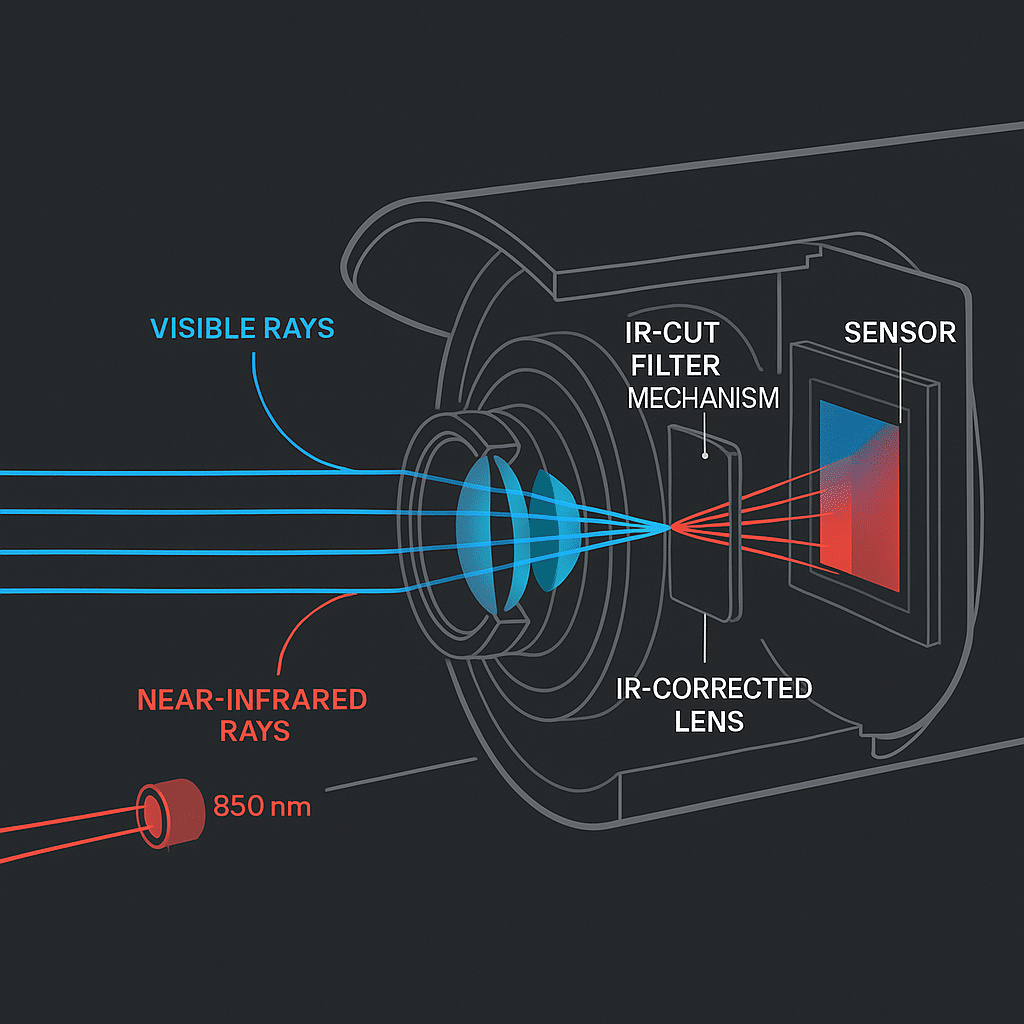
Visible and near-infrared wavelengths do not always converge at the same image plane. A visible-only system may tolerate this chromatic focus error, but a day/night camera can reveal it after removing its IR-cut filter.
IR-corrected designs use optical materials, element powers and spacing to reduce the separation between visible and near-IR best focus. The practical target is not identical focus at every wavelength. It is acceptable image quality throughout the system’s specified band. This distinction is described in a vendor technical guide from Towin Lens; the source is explanatory material, not an independent standard.
Correction must be assessed at the wavelength the camera will use. A lens designed around one near-IR band should not be assumed to perform equally with every illuminator or sensor. Buyers comparing IR-corrected lenses for infrared camera systems should provide the illuminator’s nominal wavelength and tolerance, the sensor response data and the filter state in each mode.
Why Night Images Lose Focus
A true day/night camera generally inserts an IR-cut filter for visible operation and removes or replaces it for infrared imaging. Exposure, gain, shutter speed, aperture and image processing may also change during that transition. Soft night footage is therefore not proof of lens focus shift.
When IR illumination dominates, the lens receives a different spectral distribution. If the near-IR image plane falls ahead of or behind the sensor, daytime focus no longer produces the sharpest night image. Motion blur, aggressive noise reduction and inadequate irradiance can produce similar symptoms. Diagnose focus with a stationary, high-contrast target and controlled camera settings.
Back-focus adjustment aligns the sensor with the lens image plane, but it cannot eliminate a material difference between visible and infrared best focus. A midpoint setting may bring both modes within tolerance, although neither will be at its individual optimum. Whether that compromise is acceptable depends on the specified sharpness threshold.
How IR-Corrected Lenses Improve Night Surveillance
By bringing visible and near-infrared focus positions closer together, an IR-corrected lens increases the chance that both modes will meet the same focus tolerance without mechanical refocusing. The benefit matters most at wide apertures, where depth of field is limited.
Judge performance where usable evidence is required—not only on a nearby setup chart. A gate, loading bay or perimeter camera may need tests at several distances and image-field positions. Define the required detail with a line-pair target, slanted-edge measurement or approved reference image.
IR correction does not make focus invariant. Sensor placement, mount tolerances, zoom position, aperture and temperature can still alter the assembled system. Qualification therefore belongs at camera level, using production-representative components.
IR-Corrected Lens Selection Checklist
Use one specification for quotations, samples and production approval so suppliers work from the same assumptions.
| Selection Factor | What to Confirm | Why It Matters for Day/Night Imaging | Specification or Test Input |
|---|---|---|---|
| Spectral bandwidth | Visible and near-IR wavelengths used | Correction and transmission must support the operating band | Sensor response, filter state and illuminator wavelength |
| Sensor format | Sensor diagonal and active area | An inadequate image circle can vignette the image | Sensor drawing and required image circle |
| Focal length and field of view | Scene coverage and target distance | Determines how much of the scene reaches the sensor | Camera position, scene dimensions and working distance |
| Aperture | Working F-number by operating mode | Changes light collection, depth of field and focus sensitivity | Lighting, exposure limits and sharpness criterion |
| Focus tolerance | Acceptable visible and IR sharpness | Defines whether both modes can share one focus setting | Targets, distances and pass/fail method |
| Mechanical integration | Mount, flange geometry and envelope | Incorrect geometry can prevent focus or assembly | Camera drawing, mount specification and enclosure clearance |
Specify the Spectral Band
Do not specify only “IR compatible.” Record the illuminator’s nominal wavelength and tolerance, then state whether the camera must handle daylight, mixed light, IR-only operation or more than one illuminator type. Every permitted configuration belongs in the acceptance plan.
Focus correction and spectral transmission are different properties. A lens can focus adequately at a wavelength while transmitting too little energy to meet the exposure requirement. Request transmission data where available, but verify exposure with the assembled camera under representative irradiance. F-number alone does not describe wavelength-dependent transmission.
The sensor’s spectral response determines how much signal is available at the selected wavelength. The filter mechanism determines what reaches the sensor in each mode. During testing, check filter insertion repeatability and mode-switching behavior before attributing variation to the lens.
Set Aperture and Focus Tolerances
A lower F-number admits more light and reduces depth of field; a higher F-number admits less light and increases depth of field. A vendor selection guide from Towin Lens summarizes this relationship.
Night operation often moves the iris toward its widest setting. Testing only at a stopped-down daytime aperture can hide residual visible-to-IR defocus. Test wide open first, then repeat at the expected operating aperture. Closing the iris may increase focus tolerance, but the resulting light loss can force higher gain or longer exposure.
Set pass/fail criteria before reviewing images. Record the chart, distance, image-field location, aperture, camera settings and measurement method. If evaluation must be visual, retain approved reference images and use consistent display scaling; “looks sharp” is not a repeatable acceptance test.
Choose Lens Format and Configuration
Fixed focal length IR-corrected lenses limit adjustment variables and suit installations with fixed geometry. Varifocal lenses for day/night security cameras provide more installation flexibility, but focus and image quality should be checked at the wide end, telephoto end and commissioned setting.
For a rectilinear lens, a first-order horizontal field-width estimate is W ≈ D × S / f, where D is distance, S is active sensor width and f is focal length. With a 6.4 mm-wide sensor, a 16 mm lens at 20 m gives about 8 m of horizontal coverage. Distortion, principal-plane position and focus distance can change the actual result, so use the estimate for initial selection rather than final approval.
The lens image circle must cover the sensor’s active area. Mount compatibility also requires the correct interface, flange geometry, back-focus range and enclosure clearance. Compare CCTV camera lens selection options with the camera’s sensor and mechanical drawings, not just its nominal format or mount label.
Consider custom optical assemblies for specialized surveillance cameras when catalogue products cannot meet the combined requirements for sensor coverage, wavelength, distortion, focal length, aperture or package size. The commercial review should include volume, tooling, qualification and revision control.
Validate the Assembled Camera
Use the intended sensor, filter mechanism and illuminator. Lock focus, capture visible-light images, switch to IR without refocusing and repeat at the required near, nominal and far distances. For a varifocal lens, include both ends of the focal range and the installation setting.
Test at the widest expected aperture because it is usually least tolerant of defocus, then repeat at the normal operating aperture. Control exposure and processing well enough to distinguish optical sharpness from motion blur, denoising, sharpening and compression.
The approval record should identify the lens revision, sensor, filter state, focal setting, iris position, target distances, illuminator wavelength, exposure settings, environmental conditions and evaluation method. Add temperature testing when the installation range or mechanical stack makes thermal focus drift a procurement risk.
For a useful quotation or design review, provide the sensor format, mount, required field of view or focal length, wavelength range, aperture target, working distances and mechanical envelope. These inputs allow catalogue and custom options to be compared against the same requirements.
Frequently Asked Questions
Can a standard CCTV lens be used with an infrared illuminator?
Yes, but performance must be verified. A visible-light lens may transmit near-infrared energy while focusing it at a different image plane. Test the assembled camera at the intended wavelength, aperture and subject distance. If nighttime detail falls outside the acceptance limit, use an IR-corrected lens rather than relying on daytime focus.
Does an IR-corrected lens eliminate all focus adjustment in a day/night camera?
No. IR correction reduces visible-to-infrared focus shift, but it does not remove sensor-position tolerances, mount error, aperture effects, zoom-dependent behavior or thermal movement. Initial focus and back-focus adjustment may still be necessary. Confirm that both modes meet the specified sharpness tolerance without manual refocusing during each transition.
How does sensor size affect IR-corrected lens selection?
The active sensor area sets the required image circle and affects field of view. A lens designed for a smaller format may vignette a larger sensor or deliver unacceptable corner performance. Use the sensor’s active dimensions—not only its marketing format—and confirm coverage, resolution and chief-ray compatibility where required.
Should a varifocal security lens be checked at both ends of its focal-length range?
Yes. Focus behavior, aperture and image quality can change with focal setting. Test visible and infrared performance at the wide and telephoto ends, then repeat at the installation setting and required distances. Verify the locking mechanisms after adjustment.
When should an OEM specify a custom IR-corrected optical assembly?
Specify a custom assembly when available lenses cannot meet the combined requirements for sensor coverage, visible and infrared bands, focal length, aperture, distortion, environment or packaging. Also consider forecast volume, tooling, qualification and revision control. Quantified limits are needed to compare custom feasibility with a catalogue alternative.
Topics
Related Articles

Key Aspects of a Security Camera Lens – Choose the Lens Wisely
6 min read
Modern Security Camera Lens – A Smart and Affordable Safety Solution
6 min read