What lens is used in CCTV?
A buyer-focused guide to CCTV lens types, field-of-view estimation, sensor and mount compatibility, day/night imaging, and OEM sourcing requirements.
Key Takeaways
The lens used in CCTV should be selected as part of the complete imaging system: operational task, measured scene, sensor, mount, illumination and required target detail all affect the decision.
- Choose the operational objective and required scene width before comparing nominal focal lengths.
- Treat focal length and sensor dimensions as a pair because either value can change the resulting field of view.
- Verify mount, flange-back requirements, image-circle coverage, iris interface and mechanical clearance before purchasing.
- Evaluate visible and infrared performance with the intended camera, illuminator, housing window and scene rather than relying on an IR label alone.
- For OEM sourcing, document optical tolerances, environmental limits, traceability and lifecycle requirements as well as headline lens specifications.
The Short Answer
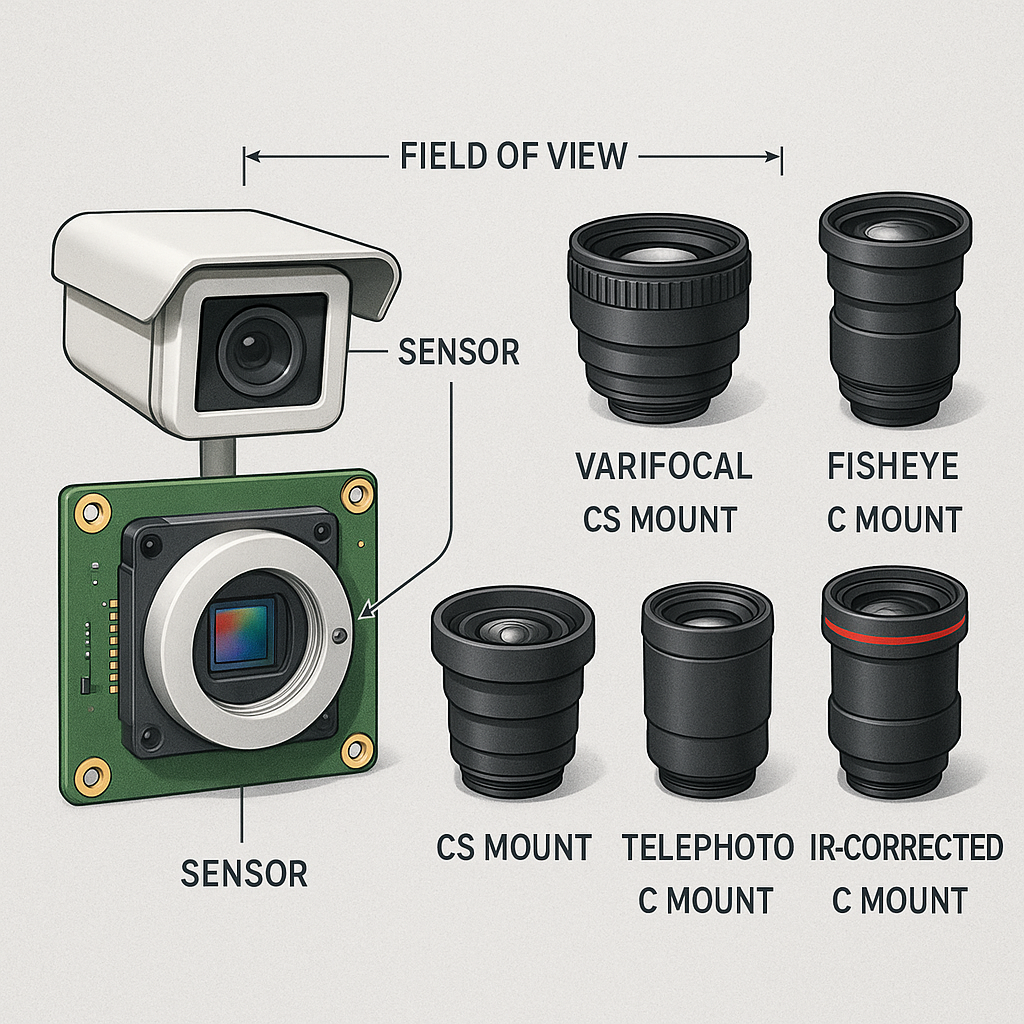
The lens used in CCTV depends on the surveillance task, camera sensor, mount, lighting and target-detail requirement. Common choices include fixed focal length, manual varifocal, motorized varifocal or zoom, wide-angle, fisheye, telephoto, pinhole and IR-corrected lenses. A short focal length generally shows a wider scene, while a longer focal length narrows the view. Neither focal length nor lens category is enough by itself: buyers must also verify sensor coverage, mechanical fit, iris control, optical resolution and day/night behavior.
Available CCTV security camera lenses span multiple optical and mechanical configurations. PTZ movement, onboard analytics, sensor resolution and integrated IR LEDs, however, are camera-system features rather than lens categories.
Start With the Surveillance Task, Not the Lens Type
A wide image is not automatically useful evidence. Begin by defining what an operator or analytics system must do: detect activity, observe behavior, recognize a known person, identify an unknown person, or read a plate under specified conditions. These objectives demand different target sizes in the recorded image.
Measure the target distance and required scene width at that distance. Record mounting height, viewing angle, likely obstructions and the dimensions of the target. For plate capture, also document vehicle direction, speed range and available illumination. A lens cannot compensate for uncontrolled motion blur, severe viewing angle or insufficient light.
Pixel density is a useful planning check, although the acceptable threshold must come from the project owner or applicable specification. For example, a 2,560-pixel-wide image spread across a 10 m scene provides a theoretical 256 pixels per metre. Cropping, distortion, compression and unusable edge pixels can reduce practical detail. This arithmetic is a planning inference, not a performance guarantee.
CCTV Lens Focal Length, Sensor Size and Field of View
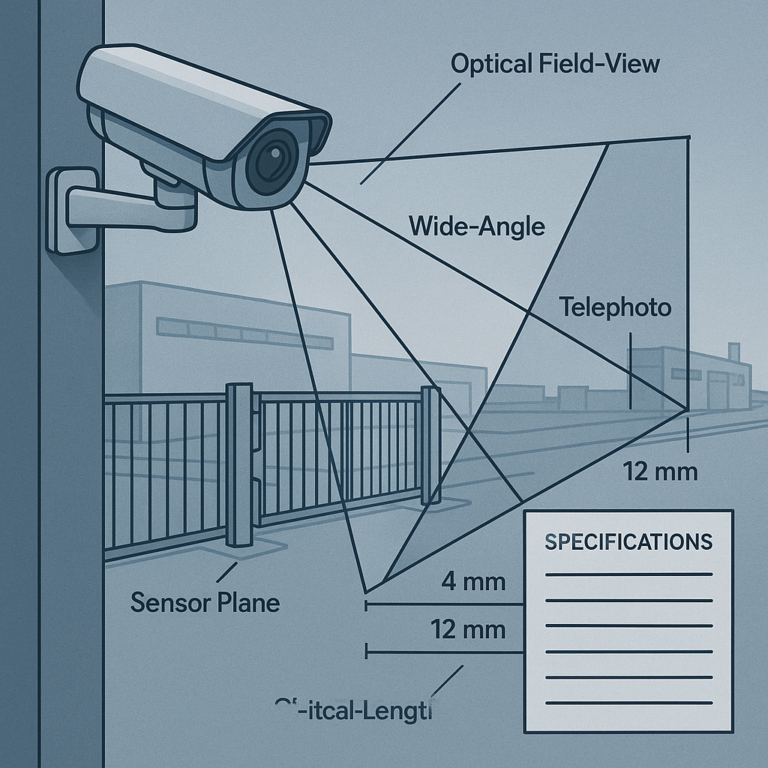
Verified industry guidance states that shorter focal lengths generally produce wider views, while longer focal lengths produce narrower views with more distant detail. It also warns that focal length alone does not establish coverage because sensor size and lens design matter; consult the CCTV focal-length and mount guidance and then check the actual camera and lens datasheets.
For an initial rectilinear estimate, engineers commonly use:
HFOV ≈ 2 × arctan(sensor width ÷ (2 × focal length))
This is a geometric planning inference. It assumes a rectilinear lens and consistent units. It does not account for distortion, electronic stabilization, sensor cropping or manufacturer-specific active areas.
Worked estimate: assume a 5.6 mm active sensor width and an 8 mm lens. The calculation gives an approximate horizontal angle of 38.6°. At a 10 m working distance, the corresponding scene width is about 7.0 m using 2 × distance × tan(HFOV ÷ 2). Choosing the lens used in CCTV from this estimate still requires validation against the specified distortion and actual captured image.
For a deeper explanation of the measurement approach, see how to select a machine vision lens by field of view, sensor and distance. The geometry transfers, but surveillance-specific lighting, compression and target movement remain separate constraints.
CCTV Camera Lens Types and Their Trade-Offs
The market includes fixed, varifocal, pinhole, manual-iris, auto-iris, motorized, C-mount and CS-mount products, as shown in this security-camera lens category reference. Category names can overlap: an IR-corrected lens may also be fixed, varifocal or motorized.
| Lens type | Adjustment | Appropriate starting point | Main trade-off | Checks before purchase |
|---|---|---|---|---|
| Fixed focal length | None | Stable scene geometry and repeatable production builds | Framing changes require repositioning or another lens | Focal length, sensor coverage, focus lock |
| Manual varifocal | Adjusted during setup | Sites where final framing is established during commissioning | More setup variables than a fixed lens | Range, focus interaction, locking method |
| Motorized varifocal or zoom | Remote | Installations needing remote reframing | Requires compatible drive and camera control | Interface, power, position repeatability |
| Wide-angle | Usually short focal length | Broad interior or near-field coverage | Edge distortion and reduced target size | Distortion map and usable edge detail |
| Fisheye | Very broad angular coverage | Situational awareness from one mounting point | Dewarping redistributes existing pixels | Dewarping mode and target detail |
| Telephoto | Usually long focal length | Narrow corridors, gates or distant targets | Tight framing increases alignment sensitivity | Working distance and vibration |
| Pinhole | Fixed, compact front aperture | Space-constrained or discreet enclosures | Enclosure geometry may limit light and field | Aperture alignment and mechanical fit |
| IR-corrected | Fixed or adjustable | Visible/NIR day-night operation | Must be matched to wavelength and camera | Focus retention and illumination band |
A fixed focal length lens is often defensible when the camera position and scene boundaries are controlled. A varifocal CCTV lens provides commissioning flexibility, but “adjustable” does not mean that coverage can change without affecting focus or target pixel density.
Camera Compatibility: Where Otherwise Suitable Lenses Fail
Mount names are only the first filter. Verified guidance lists flange focal distances of 17.526 mm for C-mount and 12.526 mm for CS-mount, and states that a C-mount lens can be fitted to a CS-mount camera with a 5 mm adapter. The reverse arrangement is not equivalent because the required optical spacing differs.
For M12/S-mount, board-camera and proprietary interfaces, use the mechanical drawings rather than assuming thread compatibility guarantees focus. Check rear-element clearance, thread engagement, focus travel, lock-ring space, connector location and housing-window distance.
The lens image circle must cover the camera’s active sensor area. An undersized format can produce dark corners or unusable edge shading. Conversely, nominal sensor-format labels do not establish optical quality; validate the complete active area at the intended focus distance and aperture.
Pre-purchase compatibility checklist
- Mount standard, thread and required flange-back distance
- Sensor format, active width and diagonal
- Lens image circle across the specified wavelength range
- Focal-length tolerance and working-distance range
- Maximum aperture and iris-control interface
- Rear clearance, outer diameter and housing-window position
- Distortion, corner illumination and focus-lock method
- Lens resolution relative to sensor pixel size
Matching a megapixel label is not enough. The relevant question is whether contrast is retained at the spatial frequencies the sensor and application use. The related guide to machine vision lens MTF and camera pixel size explains the engineering relationship; CCTV buyers should request comparable lens data where identification detail matters.
Aperture and Iris Control Under Changing Light
A lower F-number corresponds to a larger aperture and more light reaching the sensor. It does not, by itself, guarantee a better night image. Exposure time, sensor gain, illumination, focus, depth of field and subject motion all influence the result.
Fixed and manual iris lenses can suit controlled lighting. Auto-iris designs are intended for changing light, but the electrical interface must match the camera. Where P-Iris is specified, verify camera support and the control protocol rather than treating it as a universal connector.
Opening the iris may support shorter exposures in low light but can reduce depth of field. Stopping down can increase depth of field, yet excessive stopping may reduce fine detail through diffraction. The defensible setting is therefore application-specific and should be tested with moving targets, not just a static daytime chart.
Day/Night Imaging and Infrared Focus Risk
“IR-sensitive,” “NIR-compatible” and “IR-corrected” are not interchangeable procurement terms. Camera sensitivity describes the sensor system; IR correction is an optical behavior intended to control sharpness across specified visible and near-infrared bands. Neither term means a camera can image an unilluminated scene without an appropriate source of radiation.
| Lens behavior | Intended use | Main risk | Validation needed |
|---|---|---|---|
| Visible-light lens | Illuminated daytime or visible-light scenes | Night focus may differ when NIR is introduced | Day image at working distance |
| NIR-capable lens | Operation at a stated NIR band | Compatibility may not imply visible/NIR focus retention | Test at each intended wavelength |
| IR-corrected day/night lens | Visible-to-NIR switching | Results still depend on camera, filter and illuminator | Repeated day/night focus comparison |
The system test should use the intended illuminator wavelength, camera IR-cut-filter behavior, housing window and target distance. Review IR-corrected lens selection for day/night cameras when visible-to-infrared focus retention is a purchase requirement.
A Six-Step CCTV Lens Selection Workflow
- Set the operational objective. Define the target, distance, required scene width and acceptance criteria.
- Freeze the camera inputs. Record sensor active area, resolution, mount, housing limits and available controls.
- Estimate the focal-length range. Use scene geometry, then compare the result with candidate datasheets.
- Set light-management requirements. Select the aperture range, iris interface and intended visible or NIR wavelengths.
- Audit compatibility. Review image circle, flange-back spacing, rear clearance, window position and environmental limits.
- Run representative tests. Capture day, night, moving-target and worst-angle images using production-equivalent hardware.
For each lens used in CCTV, retain the calculation assumptions and sample configuration with the approval record. This helps purchasing teams distinguish a validated substitute from a part that merely shares the same focal length and mount label.
Application Decisions by Site Type
Entrance: prioritize target detail at the face plane, backlight behavior and depth of field across the expected approach path. Measure the doorway width rather than defaulting to a familiar focal length.
Warehouse aisle or loading dock: decide whether the objective is broad activity monitoring or detail at a transfer point. A single wide view may not satisfy both tasks; this is a system-design decision, not evidence that one lens category is inherently better.
Parking gate: document plate position, approach angle, distance range, motion and lighting. Plate capture depends on the camera and exposure strategy as well as the lens, so no focal length alone guarantees a readable result.
Wide interior: fisheye or short-focal-length optics can reduce camera count in some layouts, but obstructions, edge detail and dewarping output must be checked against the operational objective.
Compact enclosure: pinhole and M12-style candidates require mechanical validation. Front-aperture alignment, window reflections, focus access and assembly tolerance can be more restrictive than the nominal optical specification.
What OEM Buyers Should Put in the RFQ
An RFQ should state sensor manufacturer and active area, mount, target distance, object field, focal-length range, F-number, wavelength band, distortion limit and resolution target. Add the allowable mechanical envelope, focus-retention method, housing window and expected production quantity.
Environmental requirements need testable limits: operating and storage temperature, vibration profile, condensation exposure, UV or salt-fog conditions where relevant, and cleaning-agent compatibility. Do not assign an ingress rating to a bare lens when protection is actually provided by the finished camera or housing.
For supply continuity, request revision control, lot traceability, inspection documentation, change-notification terms, sample qualification and lifecycle expectations. Lot-to-lot consistency can matter as much as the performance of an engineering sample.
A custom optical assembly becomes worth evaluating when standard products cannot meet the combined field, distortion, wavelength, package, focus stability or lifecycle requirements. Need help selecting the lens used in CCTV? Share the sensor format, mount, target distance, required field of view, day/night conditions and environmental constraints for a standard-or-custom review.
Frequently Asked Questions
What is the most common lens used in CCTV?
There is no verified universal winner. Fixed and varifocal lenses are both widely available, but prevalence varies by camera design and application. Fixed lenses suit stable geometry and production consistency; varifocal models help installers adjust framing on site. Choose from measured coverage, target detail, sensor format and lighting rather than popularity.
What focal length CCTV lens should I use for a wide view?
Start with a shorter focal length, but do not select a millimetre value without the sensor’s active width and required scene dimensions. Shorter focal lengths generally widen the view, while sensor size and lens distortion change the result. Estimate coverage geometrically, consult both datasheets and validate the real camera image.
Is a varifocal CCTV lens better than a fixed lens CCTV camera?
Not inherently. A varifocal lens is useful when framing must be adjusted during installation or requirements may change. A fixed lens reduces adjustment variables and can suit stable, repeatable builds. Compare optical performance, focus retention, size, cost and commissioning effort at the required setting before deciding.
Can I use a C-mount lens on a CS-mount CCTV camera?
Often, provided the camera accepts the arrangement and a correct 5 mm adapter is installed. Verified guidance gives flange focal distances of 17.526 mm for C-mount and 12.526 mm for CS-mount. Mechanical clearance, sensor coverage and focus range still require confirmation from the camera and lens drawings.
Do CCTV cameras need IR-corrected lenses for night surveillance?
Not every night installation does, but systems switching between visible and near-infrared light should evaluate them. The decision depends on the camera, IR-cut filter, illuminator wavelength, target distance and acceptable focus change. Test sharpness in both operating modes with the intended housing window and illumination before approving the lens.
Topics
Related Articles
CCTV camera lens guide
11 min read
Optical Lens DFM: How Tolerances and Coatings Drive Unit Cost
10 min read