Stock vs Custom SWIR Lenses: Cost, Bandwidth, and Performance
A buyer-focused comparison of catalog and custom SWIR lenses across wavelength coverage, sensor format, imaging performance, integration, cost and supply.
Key Takeaways
Treat Stock vs Custom SWIR Lenses as a system-level decision: the lowest lens price may not produce the lowest qualified-system cost.
- Choose a catalog lens when its documented wavelength range, image circle, mount and imaging performance fit the application with adequate margin.
- Compare the specified image-circle diameter with the sensor’s active diagonal; a nominal format label does not by itself rule out vignetting.
- Define resolution at the required wavelength, aperture, field position and working distance instead of relying on a general high-resolution claim.
- Ask what custom engineering charges cover, including design, prototypes, tooling, validation, documentation and ownership rights.
- Compare prototype timing, qualification work, forecast volume, supply continuity and surrounding system changes—not lens price alone.
The choice between Stock vs Custom SWIR Lenses starts with the sensor, operating wavelengths and imaging geometry. Catalog optics can shorten evaluation when their published limits fit. Custom development is easier to justify when compromises in coverage, focus, distortion or packaging would force changes elsewhere in the camera or machine.
Stock vs Custom SWIR Lenses: Decision Matrix
| Decision Factor | Off-the-Shelf SWIR Lenses | Custom SWIR Lens Design | Best Fit / Buyer Consideration |
|---|---|---|---|
| SWIR lens spectral range | Fixed, published band | Band and coatings optimized to requirements | Confirm source, sensor and filter overlap |
| Image circle and sensor coverage | Limited to stated format or diameter | Sized around the selected sensor and field | Compare image circle with sensor diagonal |
| Resolution and distortion targets | Predetermined design balance | Allocated by field, wavelength and aperture | Define measurable acceptance limits |
| Focal length, FOV and working distance | Catalog combinations | Co-optimized around geometry | Model the actual object plane |
| Mechanical envelope and mount | Standard interfaces and housings | Non-standard mount and package possible | Check flange depth and nearby hardware |
| Coating and transmission | Standard coating curve | Band-specific material and coating choices | Request wavelength-dependent data |
| Prototype and production lead time | Potentially available for early evaluation | Development and validation required | Obtain supplier-specific schedules |
| Non-recurring engineering cost | Usually none beyond integration | Design, tooling and validation charges may apply | Ask what deliverables NRE covers |
| Unit cost at low volume | Often commercially attractive | NRE dominates small builds | Compare total program cost |
| Unit cost at planned volume | Catalog price and availability apply | Production design may improve unit economics | Use realistic lifetime volume |
| Integration and qualification risk | Low only when specifications align | Requirements can be controlled at lens level | Price system changes, not just optics |
| Lifecycle and change control | Catalog continuity depends on supplier | Contractual controls can be negotiated | Review PCN, tooling and supply terms |
Three sourcing paths are available. Buy stock when every hard requirement fits. Test a catalog lens with documented compromises when calibration or packaging can absorb the gaps. Start custom development when those gaps threaten image quality, yield or lifecycle control. That is the practical commercial test for Stock vs Custom SWIR Lenses.
Catalog choices vary substantially. Axiom Optics’ SWIR lens catalog lists examples covering 800–1700 nm, 950–1800 nm and 450–2200 nm, along with format and image-circle limits. Such listings are useful for screening, but they do not establish current inventory or delivery dates.
How Stock vs Custom SWIR Lenses Differ in Practice
A catalog lens is a predefined balance of focal length, aperture, spectral correction, image circle, distortion and packaging. Custom work allows those variables to be reallocated around a specified detector and housing. This is not inherently a quality ranking; either path can fail if the acceptance conditions are incomplete.
A stock part may have the required focal length yet lose performance at the sensor edge, outside its optimized band or behind a different cover-glass stack. Compare specifications at the intended wavelength, aperture, focus distance and temperature rather than combining best-case values from unrelated data-sheet conditions.
Custom development becomes relevant when the required combination is unavailable—for example, a large sensor in a tight enclosure, low distortion at short working distance or broadband focus through a non-standard interface. Shanghai Optics describes optimization for wavelength coverage, focal length, field of view, sensor compatibility, distortion and mechanical integration, followed by prototype validation and OEM support, in its custom SWIR lens capabilities.
Match Spectral Range to the Useful Signal
A detector sensitive from 900 to 1700 nm does not necessarily need equal lens performance across that interval. A narrow-band inspection may care most about transmission and focus near one illumination line, while a multispectral system may need stable focus across several bands. Compare Stock vs Custom SWIR Lenses over the wavelengths actually used, not the broadest advertised range.
Request wavelength-dependent transmission for the assembled lens when available. A coating sample does not account for all lens elements, filters, windows, adhesives or detector cover glass. Buyers can review available infrared lens options for SWIR system evaluation before deciding whether a standard platform is close enough.
Broad VIS-SWIR or extended-SWIR operation also raises chromatic-correction demands. State whether the system must retain one focus setting across wavelengths or may refocus between channels.
Verify Image Circle and Sensor Coverage
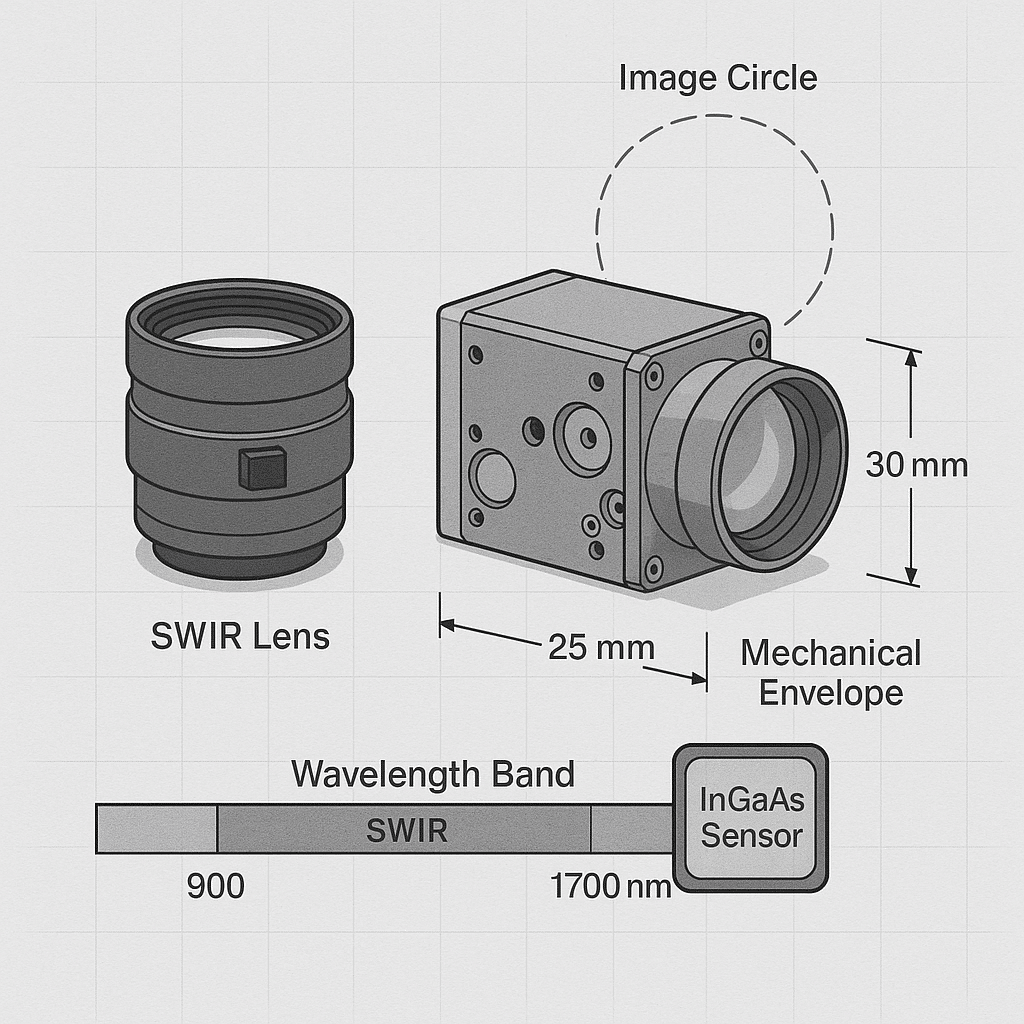
Calculate the active sensor diagonal from its width and height, then compare that value with the specified image-circle diameter. Allow margin for alignment tolerance, stabilization and any required cropping. A nominal sensor-format label is not a substitute for active dimensions.
Coverage alone is insufficient. Ask for relative illumination and image quality at the required field points. The Axiom catalog provides a concrete warning: a lens intended for formats up to 2/3 inch is described as producing severe vignetting with the larger IMX992 because its image circle is too small.
If a larger image circle would compromise aperture, package size or edge resolution in a catalog design, custom optics may be warranted. Record active dimensions in the machine vision lens integration requirements, not only the marketed format.
Define Resolution and Distortion as Testable Requirements
Specify spatial frequency or minimum resolvable feature, contrast threshold, wavelength, f-number and field position. Pixel pitch provides a sampling reference, but delivered resolution also depends on the detector, illumination, motion and processing.
Distortion tolerance depends on the task. A viewing system may accept geometry that would bias dimensional inspection. Software can remap distortion, but it cannot recover missing edge detail and may require stable calibration. For measurement systems, assess telecentric lens options when perspective and magnification stability determine the architecture.
Hold focal length, aperture, working distance and field constant when comparing designs. Shorter focal lengths can increase edge demands; faster apertures gather more light but make aberration control and focus sensitivity harder.
Account for Mechanical and Environmental Constraints
Define the mount, flange reference, available back focal space, cover-glass stack and focus adjustment. Adapters can solve an interface mismatch, but they consume space and add tolerance stack-up.
Large image circles, long focal lengths and fast apertures generally require more optical or mechanical volume. When the enclosure is fixed, the Stock vs Custom SWIR Lenses decision becomes a trade among throughput, field coverage, correction and package size.
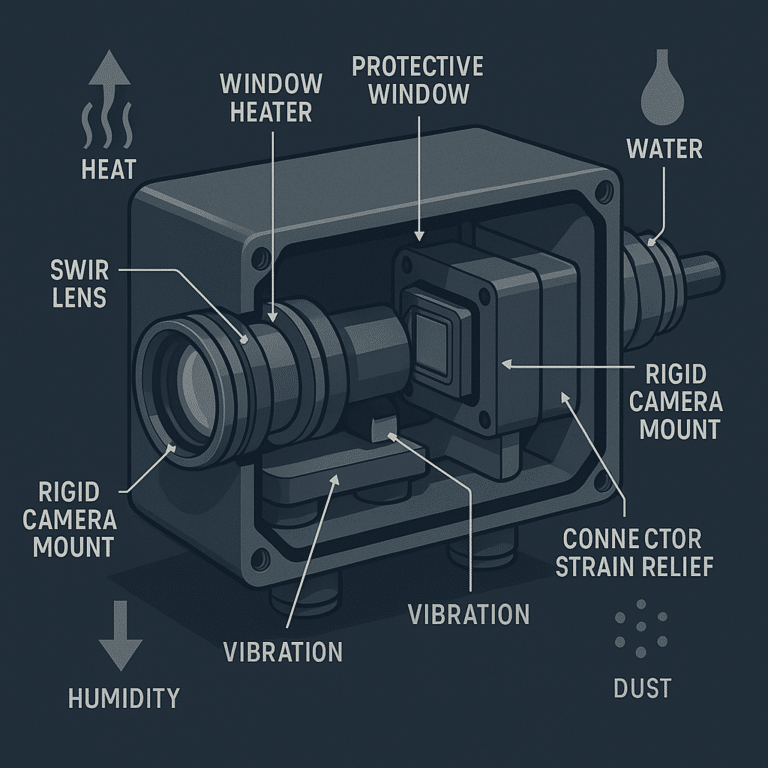
Also state operating and storage temperature, shock and vibration conditions, sealing, focus-lock method and contamination limits. These require project-specific validation. Neither a catalog description nor a custom drawing proves environmental compliance on its own.
Compare Lens Price With Qualified-System Cost
Catalog pricing is usually easier to assess at low volume because the buyer is not funding a new optical design. The comparison should still include adapters, calibration, integration labor, qualification and inventory.
Custom NRE may cover requirements review, optical and mechanical design, tolerancing, prototypes, tooling, coating development or validation. Scope varies by supplier. When requesting custom SWIR lens design and optical engineering, separate the NRE scope from the production quotation and define milestones, acceptance criteria, documentation and ownership terms.
A higher lens price can reduce lifecycle cost if it removes adapters, avoids a camera redesign, stabilizes calibration or reduces rejected assemblies. That is a commercial inference, not a universal outcome. Custom development remains difficult to justify when volume is low and a catalog lens meets every hard limit.
Review Lead Time, Volume and Supply Terms
Catalog parts can support faster evaluation if inventory exists, but a published listing does not confirm stock, allocation status, end-of-life policy or delivery date. Obtain a dated quotation.
A custom program commonly moves through specification, feasibility, design, tolerance analysis, prototype build, testing, qualification and production release. Lead time depends on the design and supplier; generic estimates are not a substitute for dated milestones.
Share annual demand, batch size, ramp timing and expected service life. Review product-change notifications, tooling capacity, second-source options and last-time-buy provisions before qualification.
When Should I Choose a Custom SWIR Lens?
Choose a catalog lens when documented performance fits with margin, the mount needs no risky adaptation and qualification is straightforward. This is often the stronger choice for low-volume programs.
Consider custom development when several coupled requirements remain unmet, such as sensor coverage, wavelength correction, distortion, aperture, working distance, envelope or environmental limits. The business case improves when one controlled design can prevent recurring system cost across meaningful production volume or a long service life.
Before requesting a quotation, identify mandatory and negotiable requirements, measurement methods, drawing and tooling ownership, and the changes that would trigger requalification.
Prepare a Requirements Package for Stock vs Custom SWIR Lenses
Provide active sensor dimensions, pixel pitch, cover-glass stack, used wavelengths, object field or focal length, working distance, f-number, transmission target, distortion limit and field-dependent resolution criteria.
Add interface drawings with datums and tolerances, plus the mount, envelope, mass limit, focus mechanism, clearances, temperature range, sealing and shock or vibration conditions. Commercial inputs should cover prototype quantity, annual and lifetime volume, target production price, tests, documentation, schedule and supply expectations.
A complete package makes the sourcing decision traceable and helps a supplier review broader lens applications and system-selection considerations without guessing which constraints can move.
Request a SWIR lens feasibility review: submit the wavelength range, sensor format, image circle, focal length, field of view, resolution, distortion, mechanical envelope, forecast volume and target timeline.
Frequently Asked Questions
Can a visible-spectrum lens be used with a SWIR camera?
Sometimes, but only after verification. Glass, coatings and adhesives optimized for visible light may transmit poorly or shift focus in SWIR. Check wavelength-dependent transmission, focus position, image circle and resolution on the intended sensor. A lens producing a visible image is not proof that it meets SWIR performance requirements.
What information should I provide when requesting a custom SWIR lens quote?
Provide the wavelength band, sensor model and active dimensions, pixel pitch, cover glass, field of view, working distance, aperture, transmission, resolution and distortion targets. Add the mount drawing, package limits, environment, prototype quantity, annual volume, qualification requirements, target price and requested production date.
How do I verify whether a lens will cover my SWIR sensor format?
Compare the lens’s specified image-circle diameter with the sensor’s active diagonal, calculated from active width and height. Then verify relative illumination and edge image quality at the required aperture and wavelength. Allow margin for alignment tolerances, stabilization, cropping and any sensor area used outside the nominal image region.
Can a custom SWIR lens be designed for a non-standard camera mount?
Yes, a non-standard mount can be part of a custom mechanical design when flange position, thread or bayonet geometry, envelope and tolerance requirements are defined. Feasibility still depends on available back focal distance, sensor cover glass, focus adjustment, assembly access and whether the interface remains manufacturable at production volume.
What happens if my SWIR lens requirements change after optical development begins?
The supplier should assess the change against optical performance, mechanics, tooling, schedule and qualification. A small interface revision may be contained; a new sensor, wavelength band or field of view can force substantial redesign. Use formal change control, document cost and timing effects, and reapprove affected acceptance criteria before proceeding.
Topics
Related Articles
Environmental Design Guide for Reliable SWIR Imaging Systems
12 min read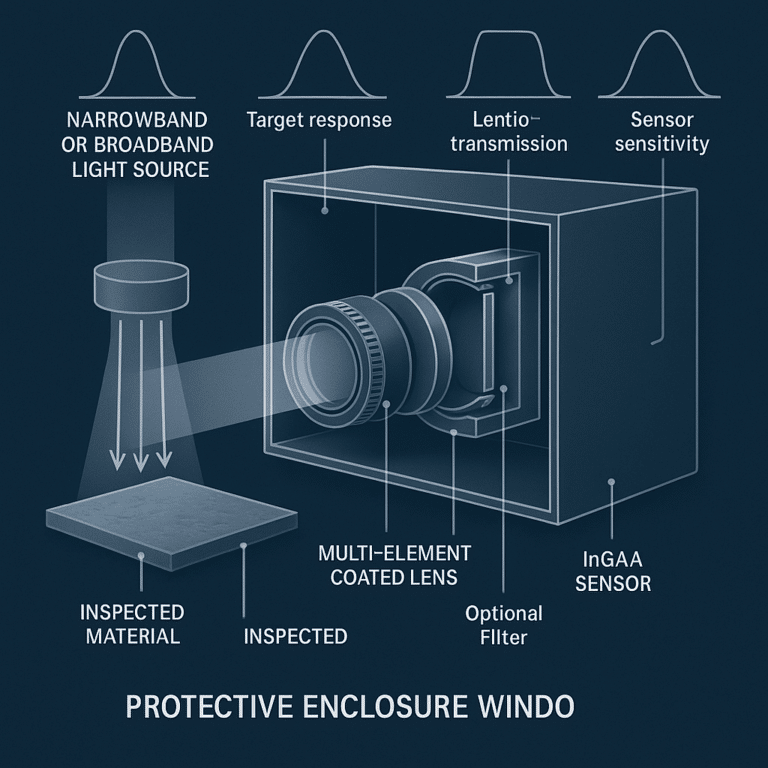
SWIR Lens Spectral Matching: Sensor, Lighting, and Coatings
10 min read