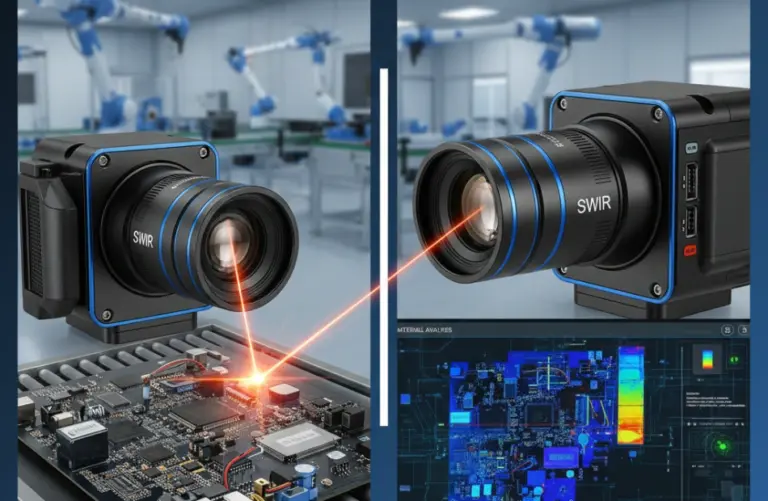
Visible vs SWIR Lenses: Focus, Coatings, and Glass Materials
A visible lens may mount on a SWIR camera and still underperform. This guide explains how to evaluate focal shift, material transmission, coatings, resolution and application-specific compatibility.
Key Takeaways
Physical fit does not establish optical compatibility: buyers must evaluate the lens over the camera, illumination and working conditions that will be used in production.
- Confirm the complete operating wavelength band rather than approving a lens from focal length, mount or an 850 nm test alone.
- Measure focus position and image quality at each required wavelength because refocusing at one band does not prove broadband correction.
- Request transmission or coated-element data for the specified band, since material transmission and surface losses accumulate through a multi-element lens.
- Validate resolution, flare and signal margin on the intended sensor at the production aperture, field position and working distance.
- Use a wavelength-specific or custom optical design when production requires simultaneous visible-to-SWIR focus, tight measurement stability or controlled stray light.
Visible light lenses are not automatically suitable for SWIR imaging. Glass transmission, optical coatings and focal correction can behave differently outside the lens’s intended band. A lens may attach to a SWIR camera and produce an image, yet still cause focus shift, low signal, flare or inadequate edge resolution.
Visible vs SWIR Lenses: Key Compatibility Differences
| Evaluation Factor | Visible Light Lenses | SWIR-Capable Lenses | Buyer Impact |
|---|---|---|---|
| Designed wavelength range | Usually optimized for a stated visible band | Specified for a defined NIR, SWIR or combined band | Obtain actual band limits; labels alone are insufficient |
| Glass material transmission | Some common materials transmit part of SWIR, but performance varies | Materials are selected for the required spectral band | Poor transmission increases illumination or exposure demands |
| Optical coating optimization | May suppress or reflect energy outside the visible band | AR coating is designed around specified SWIR wavelengths | Coating mismatch can reduce signal and increase reflections |
| Focus behavior across wavelengths | Best focus may move outside the design band | Chromatic correction targets the stated operating band | Refocusing may work for one wavelength but not several |
| Chromatic correction | Primarily corrected for visible operation | Corrected for SWIR or a stated visible-to-SWIR range | Simultaneous dual-band imaging needs explicit correction |
| Flare and reflection control | Controlled within the visible design range | Surfaces and internal control are evaluated in the SWIR band | Ghosts can obscure low-contrast inspection features |
| Resolution on NIR and SWIR sensors | Not guaranteed by visible image quality | Should be specified against sensor format and pixel needs | Test centre and edge performance on the intended camera |
| Suitability for visible-to-SWIR imaging | Conditional and often requires refocusing | Possible only where the design specifies a broad corrected band | Do not infer broadband performance from a single-band result |
| Recommended validation approach | Screen, then test on the production setup | Verify supplier data and test the integrated system | Use the actual sensor, illumination, aperture and working distance |
Visible, NIR, and SWIR wavelength ranges in practical imaging systems
Band names are useful shorthand, not a complete procurement specification. Sensor response, illumination bandwidth and filters establish the wavelengths that reach the lens. Commercial products also use overlapping definitions: one cited SWIR series is described as transmitting from 800 to 1900 nm, while a visible-to-SWIR series is specified from 400 to 1700 nm. These are product specifications, not universal band boundaries (Clearview Imaging).
Write the requirement as a range or set of lines—for example, visible inspection plus a narrow SWIR illumination wavelength—rather than asking only for a “SWIR lens.” Include any blocking or band-pass filter, because unwanted transmitted wavelengths can add artifacts or noise.
Why a lens mount and focal length match do not confirm SWIR lens compatibility
Mount, flange geometry and focal length answer mechanical and field-of-view questions. They do not establish spectral transmission, best-focus position, chromatic correction or stray-light control. Even sensor coverage can be misleading: a lens may avoid hard vignetting while delivering weak contrast at the field edge.
Engineering inference: if two lenses provide the same field of view but one loses more light through its elements and coatings, the camera may need longer exposure or stronger illumination. That can reduce line speed, increase motion blur or raise illumination cost. The exact penalty must be measured; it cannot be calculated from the mount designation.
Comparison table: visible light lenses vs SWIR-capable lenses
The table is a screening tool, not a pass/fail certificate. A visible lens that transmits the required wavelength may be useful for feasibility work. Production approval should be based on measured image quality and signal margin under the application conditions.
Why Focus Shift Occurs in SWIR Imaging
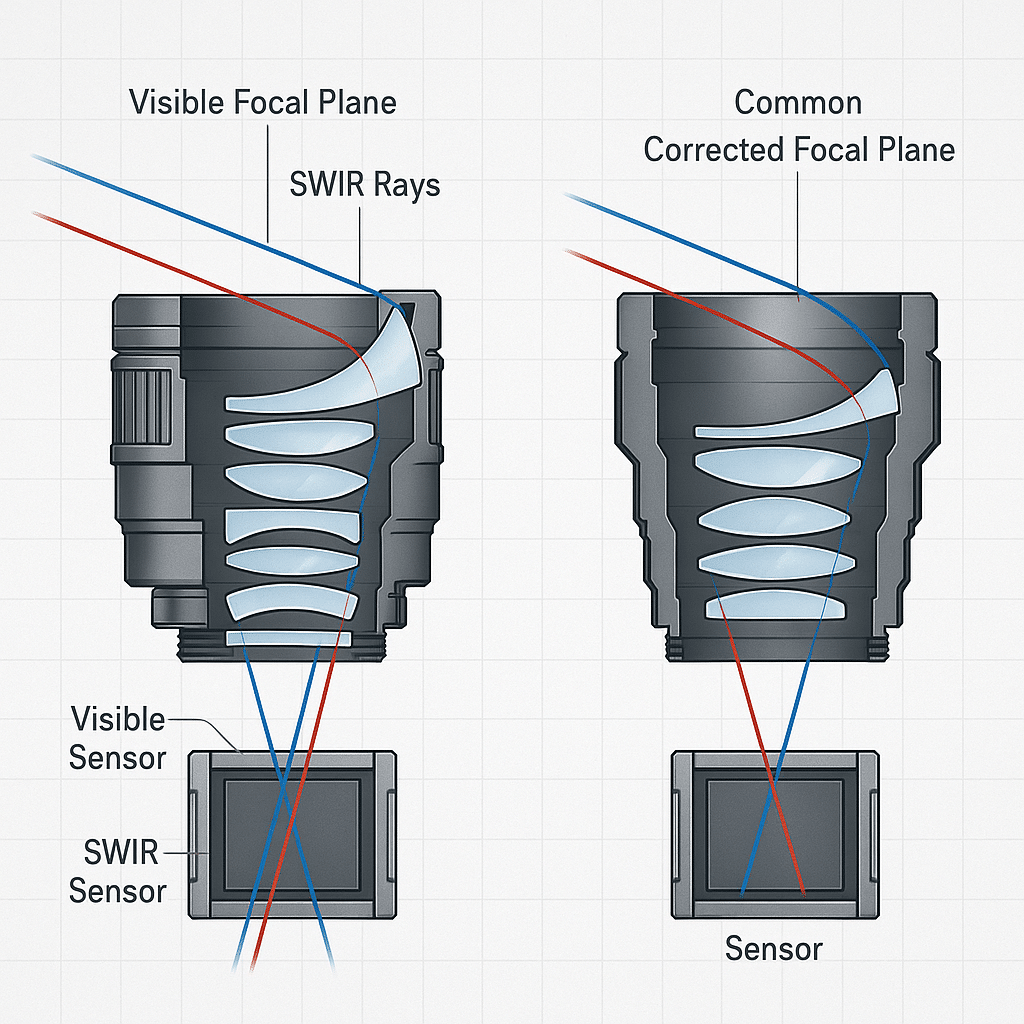
How dispersion changes focal position across visible and SWIR wavelengths
A material’s refractive behavior changes with wavelength. In a multi-element lens, the element powers, material combinations and spacing determine whether different wavelengths converge at sufficiently similar image planes. When correction does not cover the operating band, the best-focus plane moves axially. The result may appear as blur, reduced contrast or wavelength-dependent feature size.
This effect is not resolved merely by finding one sharp image. Focus at a visible alignment wavelength, then switch to SWIR illumination and compare the optimum sensor or lens position. Repeat at the shortest and longest required wavelengths. If the system uses both bands without mechanical refocusing, their acceptable focus regions must overlap.
Focus shift in SWIR imaging with broadband and dual-band cameras
Broadband detection is demanding because the image can contain several wavelengths at once. Refocusing cannot place every poorly corrected wavelength at its own best plane simultaneously. A narrowband source is easier: the integrator can focus for that line and, where stable, lock the lens.
Dual-band systems need a decision early in the architecture. They can use a lens corrected across both bands, separate optical channels, or controlled refocusing. For continuous web inspection, wavelength-dependent blur can become a repeatable classification or measurement error; this makes focus shift in SWIR imaging for line-scan inspection a system-level issue rather than a setup inconvenience.
When refocusing can be acceptable and when it creates inspection risk
Refocusing can be acceptable when the source is narrowband, the wavelength does not change during a run, the object distance is fixed and the mechanism can be locked. It is less defensible when visible and SWIR frames are compared geometrically, autofocus operates only in the visible band, or operators can alter focus between batches.
- Set production working distance, aperture and filters.
- Record the focus position at every required wavelength.
- Measure the target feature at centre and edge, not just visually.
- Repeat after any zoom, temperature or object-distance change relevant to use.
- Define an acceptance limit tied to detection or measurement performance.
How Glass Materials Affect SWIR Transmission and Resolution
Why common visible glass materials may lose transmission at longer wavelengths
Some common optical materials pass portions of the SWIR band, which is why a standard lens can sometimes form a usable image. That does not establish efficient transmission across the whole project range. Material grade, thickness, cement, filters and coatings all contribute, and losses compound across a multi-element assembly.
SWIR Vision Systems identifies borosilicate glass and fused silica among materials used in both visible and SWIR contexts, while also listing magnesium fluoride and sapphire for SWIR components. The same source warns that a visible lens made with a potentially transmitting material can still be hindered by its coatings (SWIR Vision Systems).
SWIR glass materials and their role in chromatic correction
Transmission is only one selection criterion. Designers combine materials with different dispersion behavior to manage aberrations and bring required wavelengths toward a common focus. A material that transmits the band may still be a poor choice if its optical properties prevent the needed correction within the available element count, package length or cost.
Ask whether a transmission curve refers to raw material, a coated element or the complete lens. These are not interchangeable. Complete-lens data are more useful for exposure planning, while image-quality data are needed to judge whether transmitted photons form a suitably resolved image.
Glass selection trade-offs for resolution, manufacturability, and environmental durability
Material selection affects more than spectral response. The optical design must also account for surface fabrication, coating compatibility, thermal behavior, element size, supply continuity and environmental exposure. A theoretically attractive material can be unsuitable if it creates an unstable supply chain or cannot meet the product’s durability requirement.
Engineering inference: an OEM with a long production life may rationally accept a larger or more complex lens if it uses available materials and preserves focus tolerance. Conversely, a cost-sensitive fixed-wavelength system may not benefit from broad correction it will never use. The correct trade-off follows the operating band and acceptance test, not the broadest catalogue specification.
Why SWIR Lens Coatings Matter
How wavelength-specific optical coatings support transmission
Every air-to-glass surface reflects some incident energy unless reflection is controlled. Anti-reflection coatings are designed over stated spectral and angular conditions to reduce those losses. SWIR Vision Systems reports that a typical SWIR broadband AR coating can reduce reflection at a single surface from about 4% to below 1% across its specified band. This figure is source- and condition-specific, not a guarantee for every lens.
Multi-element assemblies make small surface losses consequential. Buyers should request complete-lens transmission where available, along with the wavelength range, angle assumptions and measurement conditions. Wavelength-specific optical coatings in custom optical design become especially relevant when the required band, chief-ray angles or package differs from an off-the-shelf design.
How unsuitable coatings contribute to reflections, flare, and ghosting
A coating optimized for visible light may transmit SWIR adequately, attenuate it, or create higher residual reflection than expected. Reflected light can travel between element surfaces or between the lens and sensor window, producing ghosts and veiling flare. The consequence is often loss of local contrast rather than a completely dark image.
Test with bright sources and reflective objects positioned both inside and just outside the field. Flat, evenly illuminated targets will not expose every stray-light path. If a pass/fail decision depends on a faint absorption feature near a bright edge, flare control deserves its own acceptance criterion.
Coating considerations for broadband visible-to-SWIR imaging
A broadband coating balances performance over a wider interval; it does not imply identical transmission at every wavelength or angle. Request a spectral curve, not only a peak value. Confirm whether the curve covers the assembled lens and whether protective windows or filters were included.
Filters can also narrow the problem. A band-pass filter may reject unwanted wavelengths and improve the useful signal-to-noise relationship for a selected measurement. The camera supplier cited above gives 1450 nm moisture identification as one machine-vision example. Filter choice, illumination and coating specification should therefore be developed together.
Can Visible Lenses Be Used for SWIR Imaging?
Conditions where an existing visible lens may be suitable for preliminary testing
Yes—conditionally. An existing lens is a reasonable feasibility candidate when it transmits the illumination wavelength, covers the sensor, can be refocused, and supplies enough contrast across the required field. Narrowband, fixed-distance experiments are more forgiving than simultaneous visible-to-SWIR imaging.
Treat the result as configuration-specific. Passing at one wavelength, f-number and working distance does not approve the lens for a broader band or a different sensor. Record the exact setup so that a promising prototype result can be reproduced.
Warning signs that a visible lens should be replaced with a SWIR design
Replace or redesign when the lens cannot reach focus mechanically, the visible and SWIR focus positions cannot coexist, edge detail fails, exposure margin is poor, or flare masks the target feature. Unexplained wavelength-dependent magnification or inconsistent autofocus are further warning signs.
For production systems, review SWIR lens compatibility for infrared imaging when the existing optic requires workarounds that affect throughput, calibration or serviceability. A dedicated design is also easier to justify when the optical requirement must be maintained across multiple camera builds.
How to validate usable performance on the intended camera and illumination setup
Use the production sensor or an electrically and optically equivalent unit. Test the shortest, longest and most important wavelengths; the intended aperture; minimum and maximum working distance; centre and corner field points; and representative bright and low-contrast scenes.
Capture objective outputs: exposure needed for a target signal, contrast or MTF at relevant spatial frequencies, focus position, distortion if measurement matters, and flare response. Include the sensor window and filters. A bare-lens bench result may not reveal reflections introduced by the final camera stack.
How to Select a Lens for NIR and SWIR Sensors
Define the sensor spectral response and illumination wavelengths
Start with the sensor response curve, source spectrum and filter passband. State whether wavelengths are simultaneous, sequential or optional product modes. This prevents a supplier from optimizing around a nominal camera category while missing the wavelengths that carry the inspection information.
Specify field of view, working distance, aperture, and required resolution
Provide sensor format, active area, pixel pitch, mount, field of view, working-distance range, object-space feature size and allowed distortion. State the production f-number and exposure constraints. Buyers assessing visible light lenses for machine vision systems should use the same discipline when migrating an inspection from visible to NIR or SWIR.
A short worked requirement might read: “Resolve a 0.20 mm defect across the full field at the production working distance, using 1450 nm narrowband illumination, without refocusing after setup.” That is testable. “High-resolution SWIR lens” is not.
Evaluate focus stability, transmission, flare control, and mechanical integration
Build a compliance matrix with separate rows for spectral transmission, image quality, focus shift, stray light and mechanics. Check flange distance, rear-element clearance, filter space, focus-locking method and environmental limits. If zoom or focus mechanisms are present, test repeatability after movement rather than assuming the engraved scale is adequate.
Approval should follow the weakest production-relevant result. Strong centre resolution does not compensate for failed corner detection, and high transmission does not compensate for chromatic blur.
When a custom optical assembly is the better path
A custom path becomes reasonable when no catalogue lens combines the required band, sensor coverage, package, working distance and image quality. It may also reduce system complexity where an off-the-shelf lens would require active refocusing, unusual adapters or added stray-light mitigation.
For SWIR glass materials and custom optical assemblies, supply a prioritized requirement rather than an unrestricted wish list. Separate mandatory values from targets and identify where cost, package size or spectral breadth may be traded. Early tolerancing can reveal whether the risk lies in nominal design performance, manufacturing variation or camera integration.
Request a compatibility review for your sensor wavelength range, illumination source, working distance and resolution target. The decision should identify whether the current lens can be validated, needs a controlled refocus strategy, or should be replaced by a wavelength-specific assembly.
Frequently Asked Questions
Does a lens that works at 850 nm also work at SWIR wavelengths?
Not necessarily. Performance at 850 nm proves compatibility only near that test condition. Transmission, coating response and best focus can change at longer wavelengths. Test the actual SWIR illumination lines, sensor, aperture and working distance before approval, especially if the system must operate across a broad band without refocusing.
How can I test an existing lens for SWIR compatibility?
Mount it on the intended camera, install production filters and illuminate at each required wavelength. Compare exposure, best-focus position, centre and corner detail, flare and distortion at the production aperture and distance. Record quantitative acceptance results rather than relying on whether the live image merely appears usable.
What information should I provide when requesting a SWIR lens evaluation?
Provide the sensor model and active area, pixel pitch, spectral response, illumination wavelengths, filters, mount, field of view, working distance, aperture, feature size and environmental limits. Also state whether visible and SWIR images are simultaneous and whether focus, zoom or object distance changes during operation.
Do SWIR cameras require different lens mounts than visible cameras?
Not inherently. SWIR cameras may use familiar mount families, but a matching thread or bayonet does not establish the correct flange distance, sensor coverage, rear clearance or spectral performance. Verify the camera drawing and optical stack, then confirm that the selected lens can focus over the required distance range.
Can a zoom or varifocal lens maintain focus across visible and SWIR bands?
Only if its optical design and mechanical tolerances support that requirement across the specified zoom and focus range. Do not infer dual-band parfocal behavior from a visible-only claim. Test multiple focal settings, field points and wavelengths, including movement repeatability, before specifying a zoom or varifocal lens for production.
Related Articles
How to Select a SWIR Lens for InGaAs Camera Inspection Systems
1 min read
Cutting Through the Haze: Superior Surveillance in Fog, Smoke, and Dust
1 min read