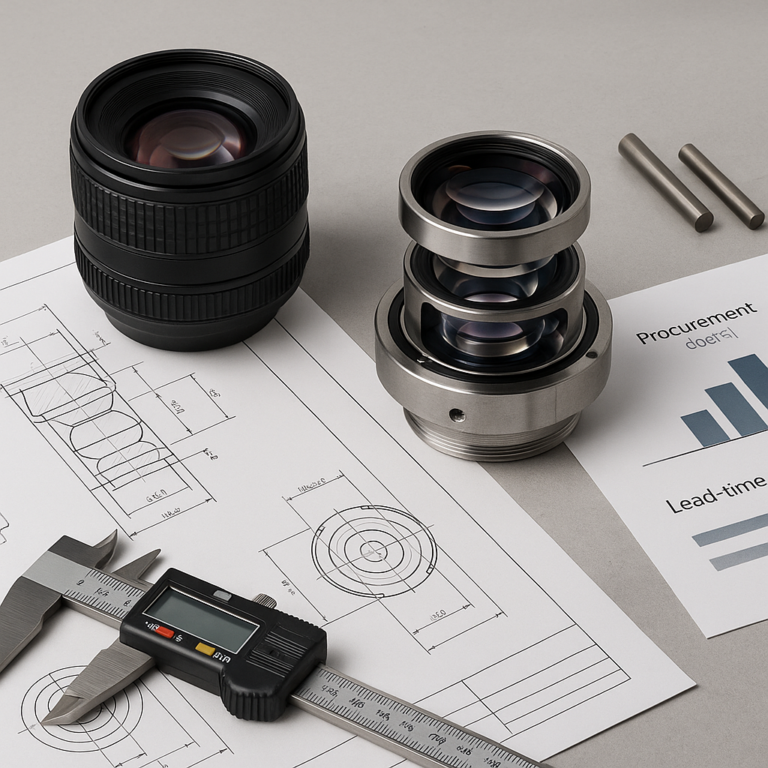
CCTV camera lens guide
A calculation-led guide to selecting surveillance optics by target detail, sensor dimensions, field of view, lighting, mount compatibility and procurement risk.
Key Takeaways
A CCTV camera lens should be selected from the required surveillance result, not from a familiar focal-length label.
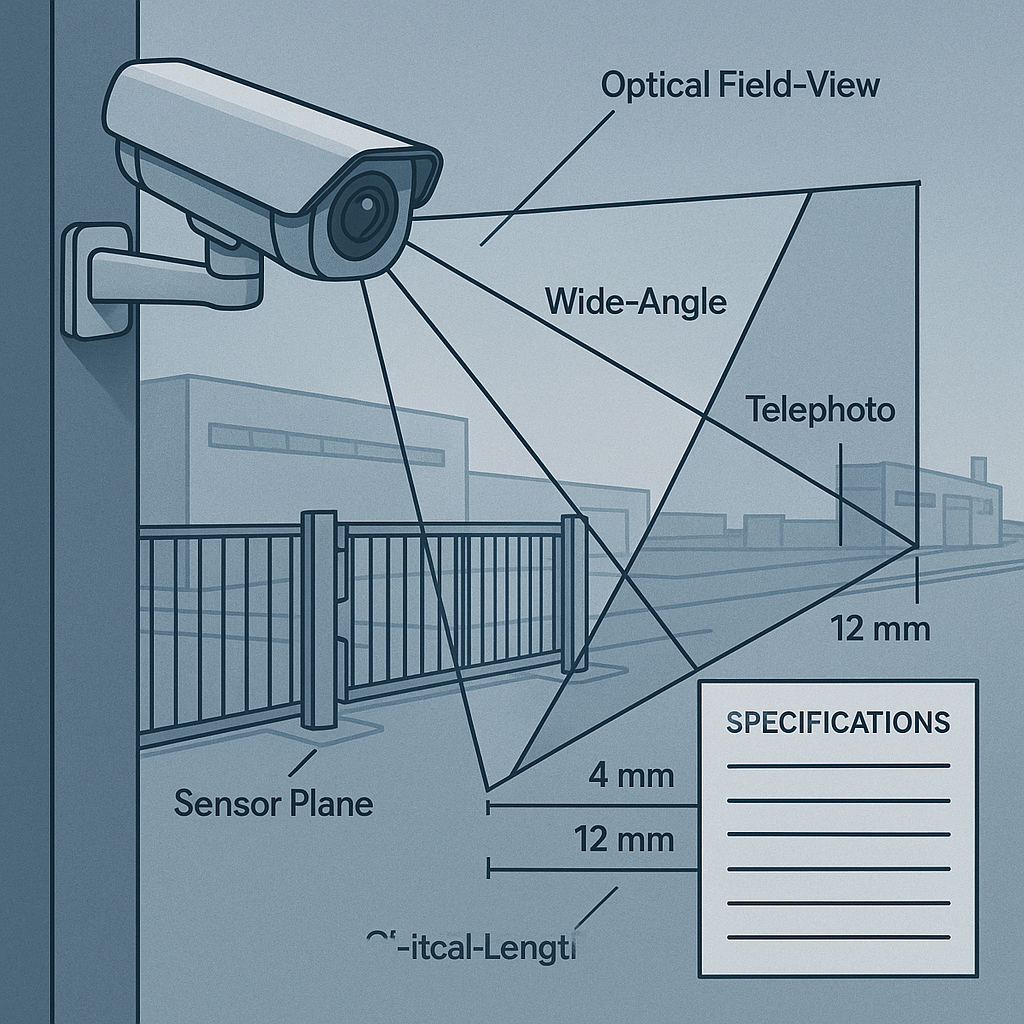
- Calculate a starting focal length from active sensor width, target distance and required scene width.
- Check pixels on target before accepting wide coverage; seeing an area is not the same as capturing usable detail.
- Treat 2.8 mm, 4 mm, 6 mm and 12 mm as starting points because sensor size and lens design change the resulting view.
- Verify image circle, mount, focus range, aperture and infrared behavior against the actual camera.
- Approve production lenses against documented optical, mechanical, environmental and supply requirements.
Related reading: lens used in CCTV.
The Short Answer
Choose a CCTV camera lens by first defining the target, working distance, required scene width and usable image detail. Estimate focal length as sensor width × working distance ÷ scene width, using the sensor’s active dimensions rather than its nominal format alone. Next, check pixels on target, image-circle coverage, mount and focus compatibility, aperture, distortion and day/night requirements. A fixed lens suits stable geometry; a varifocal model reduces risk where framing must be adjusted. Treat every calculation as a shortlist tool and validate the final camera-lens combination under representative lighting, motion and installation conditions.
A wide view can reduce camera count, yet it also spreads the available image pixels across more of the scene. A narrow view does the opposite. The defensible choice is therefore tied to a defined target and operating condition—not focal length in isolation.
What a CCTV camera lens controls
The lens determines how much of the scene reaches the sensor and how large a subject appears in the image. Shorter focal lengths generally produce wider coverage; longer focal lengths narrow the view and place more of the sensor’s pixels on a distant target. The Network Webcams field-of-view explainer also cautions that coverage alone cannot ensure effective monitoring because camera and subject position matter.
Aperture affects the light delivered to the sensor. A lower f-number is associated with a larger aperture and greater light collection, but buyers should evaluate the complete exposure system: lens transmission, sensor response, shutter time, illumination and image processing. Depth of field must be tested across the actual target zone rather than assumed from one specification.
Resolution, contrast, flare, geometric distortion and chromatic aberration can also limit useful detail. Ultra-wide optics may cover the required area while stretching or warping objects near the frame edges.
Start with the surveillance task, not focal length
Record four inputs before opening a lens catalogue:
- The target: person, package, doorway, lane or registration plate area.
- Nearest and farthest working distances.
- Required horizontal and vertical scene dimensions.
- The decision the image must support, such as general monitoring or distinguishing a specific subject feature.
Then account for mounting height, downward angle, likely target paths and obstructions. A doorway seen obliquely can provide less usable facial detail than its nominal scene width suggests. A vehicle may cross the critical zone too quickly for the selected shutter and illumination, even when the optical framing is correct.
Understand CCTV camera focal length and sensor size
Focal length is not a universal coverage rating. The same lens produces different fields of view when paired with different active sensor dimensions. Lens design and distortion introduce further variation, which is why a camera datasheet is more reliable than a generic focal-length chart.
The table below applies the planning equation in the next section. Values are calculated approximations, not product specifications. The 3.2 mm and 4.8 mm chip-width examples come from the DTS Digital CCTV calculation guide.
| Focal length | Active sensor width | Distance | Approximate scene width | Buyer implication |
|---|---|---|---|---|
| 2.8 mm | 3.2 mm | 10 m | 11.4 m | Smaller sensor gives narrower coverage |
| 2.8 mm | 4.8 mm | 10 m | 17.1 m | Same lens, substantially wider scene |
| 4 mm | 4.8 mm | 10 m | 12.0 m | Wider monitoring zone |
| 6 mm | 4.8 mm | 10 m | 8.0 m | More pixels concentrated on the target zone |
| 12 mm | 4.8 mm | 10 m | 4.0 m | Narrow framing demands accurate alignment |
Thus, labels such as 2.8 mm, 4 mm, 6 mm and 12 mm are shortlist inputs. They do not replace the active sensor width and camera-specific field-of-view data.
How to estimate CCTV lens field of view
For a rectilinear lens at ordinary surveillance distances, a useful first approximation is:
Focal length ≈ active sensor width × working distance ÷ required scene width
Keep sensor width and focal length in the same units. Distance and scene width must also share a unit. A related guide explains the same relationship between field of view calculation and sensor compatibility.
Worked planning example
Assume an active sensor width of 4.8 mm, a target distance of 15 m and a required horizontal scene width of 9 m:
f ≈ 4.8 × 15 ÷ 9 = 8 mm
An 8 mm lens is the calculated starting point. Engineering validation may move the choice because the simplified model does not include lens distortion, exact principal-plane location, focus breathing, mounting tolerance or the target’s movement through depth.
Check pixels on target before choosing coverage
Horizontal pixel density can be estimated as:
Horizontal image pixels ÷ scene width
For an assumed 3,840-pixel image covering 8 m, the result is 480 pixels per metre. A 0.5 m-wide target would occupy about 240 horizontal pixels under ideal geometric framing. These figures are arithmetic outputs, not a promise of identification performance.
Compression, defocus, glare, noise, motion blur and viewing angle can remove usable information. The acceptance test should therefore use recorded video from representative day and night conditions—not a still frame viewed beside the camera. Optical resolution must also suit the sensor’s pixel size; more sensor pixels do not recover contrast that the lens fails to deliver.
Compare CCTV lens types for security applications
| Lens type | Adjustment | Best-fit situation | Commissioning issue | Main trade-off |
|---|---|---|---|---|
| Fixed focal length | None | Stable, repeatable geometry | Requires accurate selection before deployment | Compact and simple, but little framing flexibility |
| Manual varifocal | On-site rings | Distance or framing is uncertain | Focal adjustment commonly requires refocusing | Flexible setup with manual access required |
| Motorized varifocal | Remote mechanism | Distributed or difficult-to-access cameras | Needs compatible controls and final focus verification | Easier remote setup with added complexity |
| Wide-angle | Fixed or adjustable | Broad room or loading-area coverage | Edge distortion needs checking | More coverage, less detail per object |
| Telephoto | Fixed or adjustable | Gate, corridor or perimeter target | Alignment becomes more sensitive | More distant detail, narrower coverage |
| Board or M12 | Threaded compact mount | Embedded and space-limited cameras | Mechanical clearance and focus lock matter | Small package with tighter integration constraints |
| Pinhole or specialty | Application-specific | Concealed or constrained aperture | Housing geometry can restrict performance | Specialized packaging, limited interchangeability |
Fixed lenses maintain one focal length. Varifocal designs let an installer alter framing during setup; true zoom systems are designed to retain focus through focal-length changes, whereas ordinary varifocal adjustment may require refocusing. Buyers can compare standard security camera lenses after establishing these system inputs.
Fixed lens vs varifocal lens: the commercial trade-off
A fixed lens is practical when camera position, target distance and scene width are controlled across every unit. It can reduce adjustment steps and the risk of undocumented field settings. Review available fixed focal length lenses against a confirmed geometry, not an approximate room description.
A manual or motorized varifocal lens adds value when mounting tolerances, site layouts or target zones vary. The buyer is paying for adjustment range and commissioning flexibility. That benefit must be weighed against package size, control compatibility, focus procedure, setting retention and production inspection. For uncertain installations, varifocal CCTV lens options can reduce the cost of selecting the wrong fixed focal length.
Sensor and mechanical compatibility can invalidate the calculation
The lens image circle must cover the sensor’s active area. An undersized image circle can darken the corners, while a lens designed for a larger format may still have mechanical or resolution limitations.
Mount labels also carry dimensional consequences. The verified CCTV lens and mount guide states flange focal distances of 17.526 mm for C-mount and 12.526 mm for CS-mount, with a 5 mm adapter used for a C-mount lens on a CS-mount camera. A mismatch can prevent correct focus.
For M12 and board-camera assemblies, request the thread specification, lens envelope, allowable back focal position, sensor cover-glass details and focus-lock method. Confirm that surrounding housings, filters and illuminator windows do not clip the field.
Low light, motion and depth of field
A lower f-number can deliver more light to the sensor, but the lens cannot be selected independently of shutter strategy. Extending exposure may brighten a static scene while blurring a moving person or vehicle. Increasing electronic gain can also change the usable image, so catalogue illumination claims need camera-specific validation.
Test the nearest and farthest targets at the intended aperture. Include the darkest expected condition, representative motion and any protective window in front of the lens. The pass criterion should concern usable recorded detail, not whether an object is merely visible.
Day/night systems and IR-corrected optics
Visible and infrared operation should be treated as two optical conditions. If the camera removes an IR-cut filter at night or uses an infrared illuminator, verify focus in both modes. An IR-corrected design is intended to reduce visible-to-infrared focus change, but performance still depends on the lens, sensor, filter and illuminator wavelength as a system.
Use the engineering checks in this guide to IR-corrected lens selection for day/night security cameras, then test daytime color, night focus, edge detail, reflections and illumination uniformity on the final assembly.
Installation and validation checklist
- Mark critical target zones at their real distances.
- Check horizontal and vertical coverage, including frame edges.
- Focus at the intended aperture and operating mode.
- Record moving targets by day and night.
- Inspect distortion, flare, corner shading and obstructions.
- Verify that adjustment and focus locks retain their settings.
- Save the final focal, focus, iris and camera configuration.
- Document acceptance clips, lighting and environmental conditions.
Specify a CCTV camera lens for B2B procurement
A CCTV camera lens specification should enable two suppliers—or two production lots—to be evaluated against the same requirements.
| Requirement | What to verify | Evidence to request |
|---|---|---|
| Sensor coverage | Active dimensions and image circle | Drawing and compatible sensor list |
| Optical geometry | Focal length, range, working distance and scene width | Datasheet plus calculation assumptions |
| Interface | Mount, flange position and mechanical envelope | Controlled mechanical drawing |
| Exposure | F-number, iris type and transmission requirements | Datasheet and sample test method |
| Image quality | Resolution, distortion, shading and focus range | Defined test chart or inspection criteria |
| Spectral operation | Visible range, IR wavelength and filter state | Spectral data and day/night samples |
| Environment | Temperature, vibration, sealing and coatings | Qualification plan and material declarations |
| Production control | Focus lock, lot repeatability and change notice | Approved sample and inspection agreement |
| Supply | Forecast volume and continuity | Lead-time and lifecycle commitment |
A commercial off-the-shelf lens is appropriate when it meets the optical envelope, interface and supply requirements without modification. A custom assembly becomes a rational option when packaging, spectral correction, coatings, focus retention or repeatable high-volume integration cannot be met by standard products. Buyers can review CCTV camera lens options or submit the sensor, scene, lighting and mechanical requirements for engineering review.
Frequently Asked Questions
What is the best CCTV camera lens for a vehicle gate?
The best choice depends on lane width, camera position, vehicle speed and the detail required. Calculate focal length from active sensor width, gate distance and required scene width, then check pixels across the target area. Validate plate or vehicle detail under representative angle, motion, headlight glare, daylight and nighttime illumination.
Can I use a larger sensor camera with an existing CCTV lens?
Only if the lens image circle covers the larger sensor and its mount, back-focus position and optical resolution remain compatible. An undersized image circle may cause dark corners or unacceptable edge quality. Compare the lens drawing with the sensor’s active dimensions, then test focus and image quality across the entire frame.
What should be included in a CCTV lens sample-approval plan?
Include focal length, field of view, focus range, image-circle coverage, aperture behavior, distortion, center and edge detail, spectral mode and mechanical fit. Test approved samples on the intended camera under defined lighting and temperature conditions. Record settings, test distances, acceptance images, inspection limits and rules for supplier design changes.
How do operating temperature and vibration affect CCTV lens selection?
Temperature and vibration should be treated as qualification conditions because the assembled camera must retain focus, alignment and mechanical security throughout its specified environment. Ask for applicable material and mechanical data, define representative thermal and vibration tests, and inspect focus, image position, fasteners and adjustment locks before and after exposure.
When should an OEM use a custom CCTV optical assembly instead of a standard lens?
Use a custom assembly when no standard product meets the combined field-of-view, package, mount, spectral, coating, focus-retention or production-repeatability requirements. The decision should compare engineering and qualification cost against integration risk, recurring volume and supply continuity. Begin with a documented specification and test standard before authorizing optical design work.
Topics
Related Articles
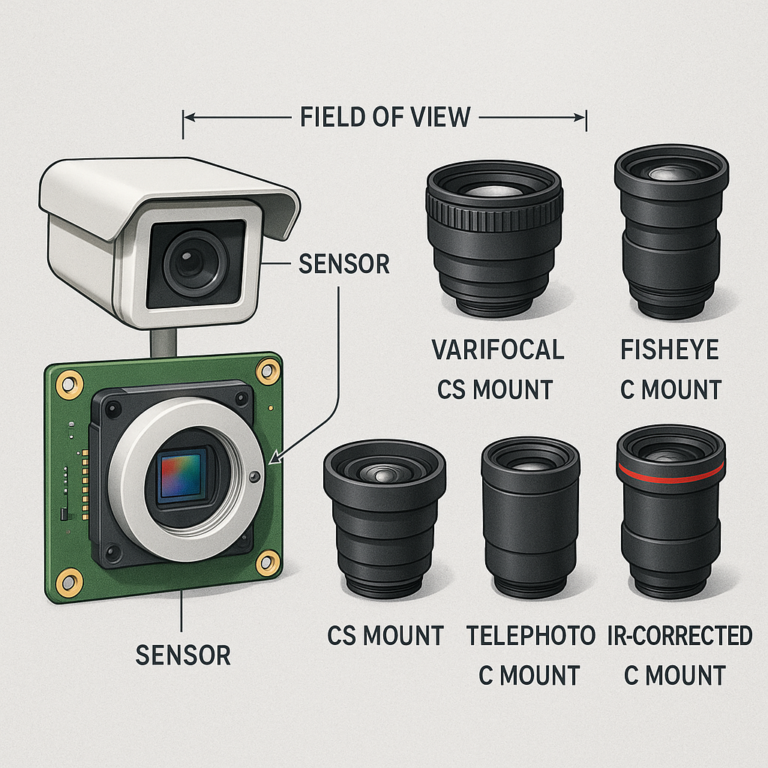
What lens is used in CCTV?
11 min read
Optical Lens DFM: How Tolerances and Coatings Drive Unit Cost
10 min read