


Lens Lifecycle and Dual-Sourcing Guide for OEM Vision Systems
A buyer-focused framework for evaluating production-lens availability, change control, tooling, lot consistency and alternative-source readiness before an OEM design-in.
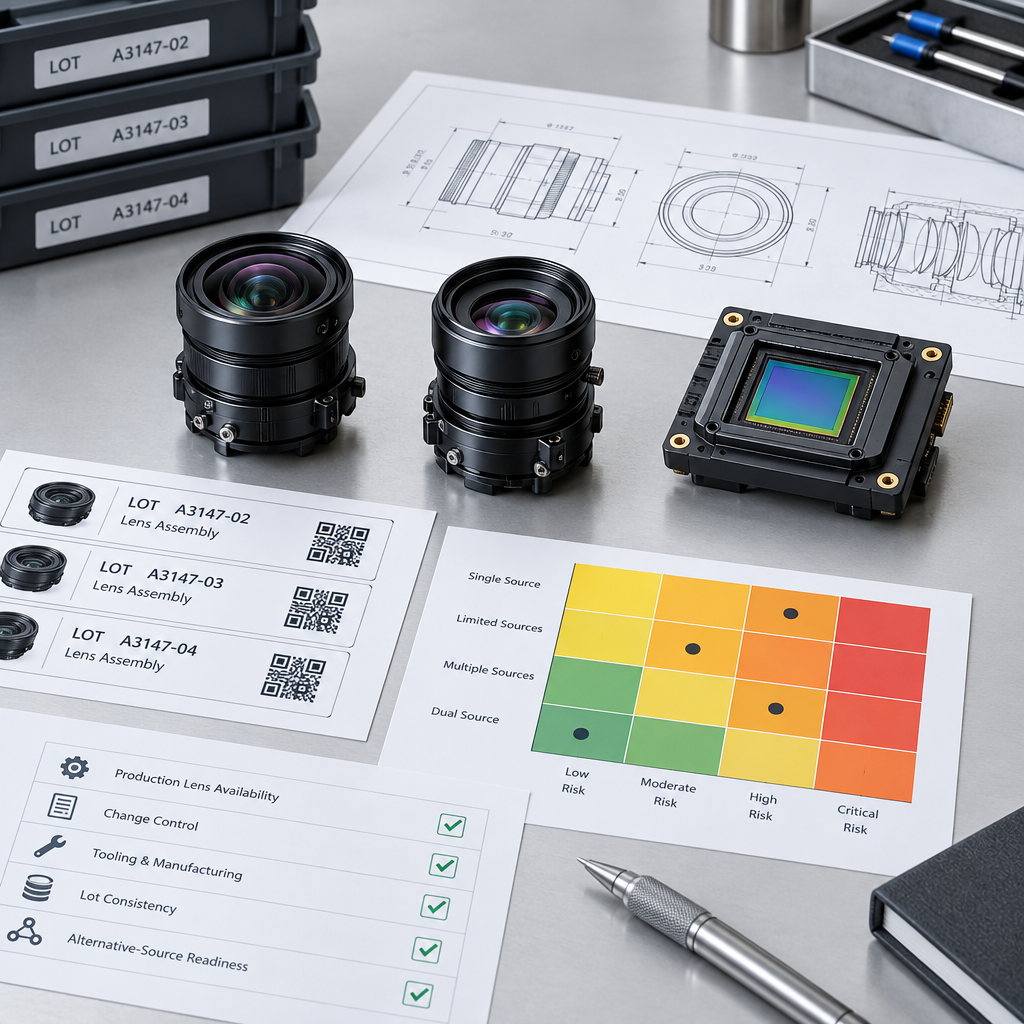
Key Takeaways
Lens Lifecycle decisions should combine supply evidence with system-level qualification; a commercially available substitute is not automatically an engineering-equivalent lens.
- Approve lifecycle status, forecast support, change-control terms and service requirements before freezing the optical design.
- Treat sensor coverage, mechanical fit, critical image performance, drawing control and traceability as pass-or-fail gates.
- Qualify an alternative in the complete camera, illumination and image-processing configuration rather than from catalog labels alone.
- Set written notification and revalidation rules for changes that could affect optical, mechanical or production performance.
- Record tooling rights, lot evidence, approved samples and end-of-life actions in one cross-functional control plan.
The Short Answer
Treat Lens Lifecycle as an engineering and supply-control problem, not merely a catalog-status check. Before design-in, document availability, capacity assumptions, Lens Lifecycle, controlled specifications, lot traceability, change-notification terms, tooling rights, service demand and end-of-life options. If continuity requires another source, compare the candidate with the approved baseline across optical performance, mechanical interfaces, sensor compatibility, image processing, environmental exposure and production consistency. Matching focal length and mount narrows the search, but it does not establish system equivalence.
What Lens Lifecycle Means for OEM Vision-System Design-Ins
Lifecycle stages that affect design-in, production, and service
A production lens moves through selection, qualification, volume manufacture, Lens Lifecycle, service support and eventual replacement or discontinuation. The buyer’s exposure changes at each stage. Early risk concerns specification maturity and capacity; production risk includes lot variation and uncontrolled changes; service risk concerns replacement compatibility and remaining inventory.
Why availability risk begins before a lens reaches end of life
A lens can remain orderable while creating operational risk through extended lead times, constrained components, obsolete tooling or weak forecast alignment. Lens lifecycle management therefore starts before approval. Purchasing needs commercial evidence, while engineering and quality need a stable technical baseline.
Inputs OEM teams should request before approving a lens
The approval package should identify the application, sensor, illumination, field of view, working distance, mechanical interfaces, environment, expected volume, production timing, program life and service demand. Add a controlled drawing, revision status, inspection evidence, Lens Lifecycle, traceability method, change-control expectations and lifecycle contact. A sample demonstrates application potential; it doesn’t alone establish production readiness.
Build an OEM Lens Supply Chain Risk Matrix Before Design-In
An OEM review should cover long-term availability, forecast and capacity exposure, product-change control, lot consistency, tooling, end-of-life planning and second-source feasibility. Qualification is complete only when optical, mechanical, system and production requirements have been checked against the approved baseline.
OEM Lens Lifecycle and Dual-Sourcing Risk Matrix
| Risk area | Questions before approval | Potential impact | Evidence to request | Mitigation or decision | Owner |
|---|---|---|---|---|---|
| Lifecycle status | Is the part active and supportable for the program term? | Redesign or service shortage | Written status and support plan | Approve, buffer or reject | Purchasing |
| Forecast and capacity | What forecast is needed, and what constrains output? | Lead-time or allocation exposure | Forecast process and capacity response | Share rolling demand; set escalation | Operations |
| Change control | Which changes trigger notice and approval? | Fit or image drift | Change procedure and notice terms | Contract notification and revalidation | Quality |
| Lot consistency | Which characteristics are inspected and traceable? | Yield or calibration variation | Lot records and inspection plan | Set limits and retain samples | Quality |
| Tooling | Who owns, maintains and can transfer it? | Single-site dependency | Tool register and contract terms | Clarify rights and maintenance | Legal/engineering |
| Equivalency | Are optical and mechanical limits comparable? | Altered field, focus or assembly | Drawings and comparative data | Test against baseline | Optical engineering |
| Second-source readiness | Is an alternative qualified and orderable? | False redundancy | Approved-source record | Stage-gate qualification | Cross-functional team |
| End of life | What notice, buy and replacement routes apply? | Stranded inventory or redesign | EOL terms and demand model | Last-time buy or requalify | Program owner |
This matrix is a decision framework, not proof that a supplier can meet a particular commitment. Dates, capacity and notification periods require supplier-specific written evidence.
Evaluate Lens Lifecycle Management and Long-Term Support
Questions about forecast horizons and capacity planning
Ask how forecasts translate into material purchasing and production planning, which operations constrain output, and how demand excursions are handled. A long forecast is useful only if responsibilities are explicit: update frequency, firm window, Lens Lifecycle, allowed variance and escalation path.
Documenting long-term supply commitments
Record the approved part number and revision, expected program and service periods, forecast assumptions, lead-time method, discontinuation process and remedies available if support changes. Avoid treating an informal assurance as a supply commitment.
Tooling ownership, maintenance, and transferability
For a custom assembly, contracts should identify tooling, ownership, maintenance responsibility, replacement approval, permitted manufacturing sites and any transfer rights. Ownership doesn’t by itself ensure transferability; process knowledge, inspection methods and qualified materials may also be needed. These questions belong in optical lens supplier qualification, not after a disruption.
Preparing for end-of-life and last-time-buy decisions
Compare forecast demand, service obligations, storage constraints, redesign cost and qualification time. A last-time buy can bridge stable demand, but it concentrates forecast and inventory risk. An alternative source may be preferable when remaining demand is uncertain or the system must remain supportable beyond available inventory.
Set Product Change Notification Requirements for Production Lenses
Changes that can affect system performance
Potential triggers include optical materials or coatings, element geometry, barrels, adhesives, Lens Lifecycle, assembly settings, inspection methods, manufacturing location and critical suppliers. Not every change requires full requalification, but the agreement should prevent either party from deciding impact from a vague category name alone.
Notification timing, approval workflow, and documentation
A lens product change notification agreement should define covered changes, required advance notice, affected part numbers and lots, technical rationale, comparison data, sample availability, implementation date and disposition of old stock. Name who reviews, approves, rejects or requests testing.
Lot traceability and baseline retention
Traceability should connect received units to the relevant part revision and production lot at the level required by the OEM’s risk assessment. Retain an approved baseline sample or controlled image dataset under documented conditions so later comparisons use a stable reference.
When a notified change requires revalidation
Revalidate when a change could affect fit, field of view, focus, distortion, resolution, illumination response, reliability, calibration or image-processing output. The scope can be targeted if the affected characteristics are understood; uncertain impact warrants broader system testing.
Plan Dual-Sourcing for OEM Vision Systems Without Assuming Interchangeability
When dual sourcing is practical
Dual sourcing is most practical when interfaces and acceptance criteria are controlled, test methods are repeatable, and both sources can support production documentation. It may be uneconomic where volumes are low, proprietary tooling dominates or qualification consumes more resources than the residual supply risk justifies.
The broader relationship between dual sourcing optics and OEM change control should be assessed together: a nominal backup that can change without notice is weak redundancy.
Primary-source and second-source roles
Decide whether the second source will remain dormant, receive periodic orders or share normal production. A dormant source reduces current complexity but may leave capacity and process readiness untested. Split production creates more operational evidence, while adding inventory, quality and scheduling work.
Why focal length and mount don’t establish equivalency
Field of view depends on effective focal length and imager area. Sensor coverage, distortion, f-number, depth of field and MTF also shape the resulting image, while the imager and processing chain affect digital-system quality. These relationships are documented in Sunex’s lens-selection guidance. Therefore, two lenses with matching catalog focal length and mount can still produce materially different system outputs.
Designs that make future second sourcing easier
Use controlled interfaces, measurable image criteria and adjustment ranges that accommodate known variation without masking defects. Avoid undocumented calibration offsets. Where possible, separate lens-specific image-pipeline parameters so an approved alternative can use a controlled profile rather than an uncontrolled production workaround.
Run a Second-Source Lens Qualification Process
Define the baseline and acceptance criteria
Freeze the approved lens revision, camera, sensor mode, illumination, working distance, focus method, image pipeline and test target. Mandatory requirements—such as sensor coverage, mechanical fit, critical image performance, Lens Lifecycle, drawing control and required traceability—should be gates, not points offset by a high total score.
Compare optical, mechanical, environmental, and production variables
A practical second-source lens qualification uses this stage-gated checklist:
| Qualification category | Comparison or test item | Acceptance source | Result | Follow-up |
|---|---|---|---|---|
| Baseline | Part, revision and setup | Approved record | Pass/fail | Resolve gaps |
| Optical | Field, resolution, distortion, illumination | System specification | Data | Tune or reject |
| Mechanical | Mount, envelope, focus and retention | Controlled drawing | Data | Assembly review |
| System | Sensor and image pipeline | Validation plan | Data | Calibration review |
| Environment | Relevant exposure and recovery | Product requirements | Data | Reliability action |
| Consistency | Multiple production lots | Quality plan | Data | Capability review |
| Documentation | Traceability and change control | Supplier agreement | Pass/fail | Close findings |
| Approval | Cross-functional release | Approval procedure | Signed | Add to approved list |
Test the complete vision-system configuration
Bench data can isolate a characteristic, but final acceptance should use the intended camera, sensor mode, illumination, mechanical stack and processing settings. A candidate that fits mechanically may change edge performance or calibration enough to affect detection thresholds.
Approve, document, and monitor the alternative
Release the exact part and revision tested. Store comparative data, deviations, approved settings, supplier documentation and revalidation triggers. Initial approval doesn’t remove the need to monitor incoming lots and notified changes.
Use a Lens Equivalency Process for Alternative Lens Decisions
Optical comparisons
Compare usable field of view, center and edge resolution, distortion, relative illumination, flare behavior where relevant, focus range and depth-of-field behavior. Acceptance limits must come from the application; catalog similarity isn’t a substitute for system requirements.
Mechanical comparisons
Check mount geometry, flange or seating references, back-focus behavior, barrel envelope, filter or cover-glass clearance, retention method and tolerance stack. A thread designation alone doesn’t establish the final optical position.
System comparisons
Evaluate sensor coverage, pixel-level output, exposure behavior, processing thresholds, calibration and focus procedure. Hypothetically, an alternative can pass a visual review yet fail an automated inspection because edge contrast shifts across a decision threshold. That is an engineering scenario, not a reported customer result.
Production comparisons
Review more than a hand-selected sample. Require production-representative units, lot identity, inspection records and defined handling of nonconformance. The number of lots and units should follow product risk and the validation plan; no universal sample quantity is established by the supplied evidence.
Create a Lens Lifecycle Control Plan for Procurement and Engineering
Cross-functional roles
Engineering owns system requirements and equivalency judgments. Quality controls validation, traceability and change review. Purchasing manages forecasts and commercial commitments. Operations assesses capacity and assembly effects. Supplier management can use a structured method for how to compare machine vision lens suppliers without allowing aggregate scores to override mandatory gates.
Documents to retain
Keep the approved drawing and revision, optical evidence, validation plan and results, supplier approvals, production inspection requirements, traceability rules, change agreements, Lens Lifecycle, deviation history, retained-sample record and end-of-life plan. Link each record to the released part number.
Review triggers throughout the program
Review risk when forecasts change materially, lead times deteriorate, a process or site changes, nonconformance trends emerge, a new sensor or firmware alters imaging behavior, or service demand is revised. Calendar reviews may supplement these triggers, but frequency should reflect program risk.
Escalation when risk emerges
First establish the affected lots, technical impact and available inventory. Then choose among containment, targeted validation, broader requalification, controlled substitution, inventory buffering or redesign. Assign one decision owner and preserve the rationale.
Teams evaluating production optical lenses and lens assemblies can prepare for a design-in review by sharing the current lens specification, system configuration, production forecast, expected service period and alternative-source requirements.
Frequently Asked Questions
What information should an OEM request before approving a lens for a long-life program?
Request lifecycle status, controlled drawings, revision history, optical evidence, mechanical tolerances, inspection controls, traceability, capacity assumptions, forecast requirements, change-notification terms, Lens Lifecycle, manufacturing locations, tooling responsibilities, program-life support and end-of-life procedures. The package should also identify the intended sensor, illumination, environment, annual demand assumptions and service obligations.
Can two lenses with the same focal length and mount produce different machine vision results?
Yes. Effective focal length, distortion, image-circle coverage, f-number, MTF, relative illumination, back-focus behavior and manufacturing tolerances can differ. The sensor, illumination and image-processing chain may amplify those differences. Compare candidates in the complete system against measurable acceptance criteria rather than relying on catalog focal length and mount labels.
Who should own the tooling used for a custom optical assembly?
Ownership should be decided contractually according to investment, exclusivity, continuity needs and supplier arrangements. Regardless of owner, document maintenance, storage, replacement approval, access, Lens Lifecycle, permitted production sites and transfer rights. Tool ownership alone may not transfer qualified materials, process knowledge, inspection fixtures or manufacturing capability.
What should be included in a lens product change notification agreement?
Include covered change categories, advance-notice expectations, affected parts and lots, technical rationale, comparison data, sample availability, implementation timing, old-stock disposition and named approval authorities. The agreement should also state which changes require targeted testing, full revalidation or written OEM approval before changed Lens Lifecycle production units can ship.
When should an OEM qualify a second source instead of placing a last-time buy?
Qualify another source when support must extend beyond available inventory, demand is uncertain, storage creates risk, or redesign later would be disruptive. A last-time buy may suit predictable residual demand and stable storage conditions. Compare qualification cost and timing against Lens Lifecycle forecast error, inventory exposure, service obligations and technical substitution risk.
Topics
Related Articles
Lens Mount Selection Guide: C-Mount, F-Mount, M42, M58, and More
11 min read
How to Control Lens Alignment, Tilt, Decenter, and MTF Degradation
11 min read
Machine Vision Lens RFQ Checklist for OEM Production Programs
11 min readAbout SUPERIOR OPTICS
SUPERIOR OPTICS specializes in CCTV lenses, machine vision optics, and custom optical solutions for security, industrial imaging, and specialty applications. We also provide professional lens selection and application support.